Constantine I Coins: 4,000 Types Across 17 Mints
A working reference to one of the largest Roman imperial coinages, 4,096 catalogued types across 17 mints, from common bronzes at $5 to gold solidi that cost more than the plane ticket to see them in a museum.
Most Constantine I coins are common bronzes worth $10 to $40 in Fine to Very Fine: the GLORIA EXERCITVS, VRBS ROMA, and CONSTANTINOPOLIS types you will see most often. Gold solidi begin around $2,000, and the series spans 17 mints between 306 and 337 AD. The price table below breaks values down by denomination and grade, from AE4 bronze to solidus; to keep current figures on coins you own, use NumisLens valuation tracking. Standard catalog: RIC VII (Bruun, 1966).
Entity: Constantine I (Q8413)
A 4.5-gram gold solidus from Nicomedia. Pick it up and you are holding the coin that anchored Mediterranean commerce for seven centuries, struck at 72 to the Roman pound, a standard Constantine set and the Byzantine empire kept.[1] Put it down. Pick up a 1.8-gram bronze from the same reign, a GLORIA EXERCITVS with two soldiers flanking a pair of standards. That one costs $5 at a coin show. Same emperor, same political programme, same propaganda machine: separated by metal, denomination, and about $3,000.
Between those two coins sits one of the most historically dense collecting series in numismatics. Constantine ruled for thirty-one years, operated fifteen or more mints at peak output, and struck coinage in quantities that no predecessor matched. More of his coins survive than for any other Roman emperor.[2] The cheap ones carry as much historical information as the expensive ones.
What makes the series worth collecting seriously (rather than just accumulating ) is what the coins track. Sol Invictus reverses from Trier in 313 tell you where Roman state religion stood that year. A labarum bearing the chi-rho christogram, struck at Constantinople around 327, tells you something had changed. Eastern mint marks appear on Constantinian coins only after 324, when Licinius fell at Chrysopolis and the empire reunified. The commemorative VRBS ROMA and CONSTANTINOPOLIS issues of 330 announce a new capital while tipping the hat to the old one. Each coin is a data point. The series is a political diary in metal.
This guide covers what you need to attribute, collect, and price Constantinian coinage. The full catalog of 4,096 Constantine I types is available for individual lookups.
A Collector’s History of Constantine I
You do not need to be a historian to collect these coins. But a handful of dates explain why the coinage looks the way it does, and knowing them saves you from misattributions that cost money.
Constantine’s father, Constantius I, died at Eboracum (York) on July 25, 306. The troops stationed there proclaimed Constantine Augustus on the spot, though that claim was contested. Galerius, the senior emperor in the Tetrarchic system, recognised Constantine only as Caesar, the junior rank.[3] This distinction matters for your coins: early legends reading FL VAL CONSTANTINVS NOB C (nobilissimus Caesar) predate those reading IMP CONSTANTINVS P F AVG (Augustus). The promotion was gradual and political, not instant, and the obverse legends track it.
Three phases shape the coinage.
306–312. Constantine holds Britain, Gaul, and the Rhine frontier. Coins come from Trier, London, and Lyon. The reverses are overwhelmingly pagan, SOLI INVICTO COMITI, Sol standing with globe raised, dominates the output. If your coin has a western mint mark and a Sol reverse, it almost certainly falls here.
312–324. Maxentius is dead at the Milvian Bridge (October 28, 312). Constantine takes Italy, then Africa. He and Licinius divide the empire east and west. Western mints multiply: Rome, Ticinum, Aquileia, Siscia all strike in Constantine’s name. The Sol types gradually disappear, replaced by deliberately neutral military and Victory reverses that avoid alienating either pagan or Christian constituencies. This is the transition period, and the coins show the hedging in real time.
324–337. Licinius falls at Chrysopolis in September 324. Constantine rules alone. Eastern mints come online for his coinage: Thessalonica, Heraclea, Constantinople, Nicomedia, Cyzicus, Antioch, Alexandria. GLORIA EXERCITVS soldiers-and-standards types dominate the bronze output. In 330, the twin commemoratives mark Constantinople’s inauguration as the new imperial capital. The mint marks from this phase are the most commonly encountered in dealers’ stock.
Pin your coin to one of these three blocks before doing anything else. The mint mark usually makes the answer obvious.
The Monetary System
The denominational system under Constantine is, frankly, a mess. Numismatists still argue about what to call some of these coins, and the terminology has shifted across decades of scholarship. Here is what matters for buying and attributing.
The main circulating denomination was the follis, sometimes called nummus, depending on which scholar you are reading and which decade they were writing in. Diocletian introduced it around 294 as part of his monetary reform: roughly 10 grams of bronze with a thin silver wash, intended to restore confidence in the base-metal coinage.[4] That confidence eroded fast. By early 307, the follis had already dropped to about 6–7 grams. Under Constantine the decline accelerated, around 3–4 grams by the mid-310s, and down to 1.5–2.5 grams with negligible silver content by the late 320s. The coin shrank. The name stuck.
Modern catalogues sort these declining bronzes by diameter rather than fighting over ancient terminology:
- AE1, over 25mm. Rare for Constantine. Mostly early folles from 306–310, before the first major weight reduction.
- AE2, 21–25mm. Early to mid reign. Heavier pieces with more detail.
- AE3, 17–21mm. The standard Constantinian bronze. Roughly nine in ten Constantinian coins on the market fall in this range.
- AE4, under 17mm. Late reign reduced issues. Small, often poorly struck on irregular flans. Not much fun to look at unless you are chasing specific types.
When a dealer writes “AE3” or “reduced follis” on a tag, they mean the same coin. “Centenionalis” appears in older references. Same object, older label.
Gold and silver
Constantine’s lasting monetary achievement was the solidus: 4.5 grams of gold struck at 72 to the Roman pound.[1] He introduced it around 309–312 in his own territories and standardised it empire-wide after defeating Licinius in 324. The coin became the anchor of Mediterranean trade for seven hundred years, the dollar of the ancient world, though the comparison undersells it. Common Constantine solidi sell for $2,500–4,000 at auction in VF. Rare types or coins in superb condition push past $15,000.
Silver played a smaller role. The siliqua was struck at a theoretical standard of about 3.4 grams (96 to the Roman pound), though surviving Constantine I specimens typically weigh less, 2.7 to 3.1 grams is more realistic.[5] The light miliarense, at roughly 4.5 grams of silver, turns up even less frequently. Budget $400 or more for a presentable 4th-century siliqua, but be aware that most available examples are Constantius II or later; a siliqua specifically of Constantine I is genuinely scarce and may cost considerably more.
| Denomination | Types in catalog |
|---|---|
| AE2 | 2,939 |
| Solidus | 400 |
| AE3 | 172 |
| AE1 | 171 |
| Uncertain Value | 127 |
| Roman Medallion | 90 |
| Oneandahalf-Solidus | 52 |
| Fraction | 44 |
| 2-Solidus | 38 |
| Multiple-Gold | 11 |
| Fourandahalf-Solidus | 11 |
| Quinarius | 9 |
| 9-Solidus | 8 |
| 3-Solidus | 7 |
Where the Coins Were Made
Learning to read mint marks is the single most useful attribution skill for Constantinian coinage. Every mint placed a mark in the exergue (the small field below the reverse design) that tells you where the coin was struck, and often which workshop within that mint produced it.
At peak output, Constantine’s mints numbered fifteen or more.[2] Each had a character. Trier struck sharp, well-centered coins on broad flans, the quality control was noticeably better than most, and collectors pay a premium for Trier pieces. London produced a distinctly provincial style: heavy portraits, slightly rough execution, a bluntness that has its own appeal. The eastern mints, Nicomedia, Antioch, Alexandria, tend toward compact flans with tight lettering and a less polished overall finish, though Thessalonica and Constantinople could produce fine work when the occasion demanded it.
| Mint | Types in catalog |
|---|---|
| Treveri | 847 |
| Londinium | 516 |
| Arelate | 416 |
| Lugdunum | 364 |
| Rome | 306 |
| Siscia | 244 |
| Ticinum | 241 |
| Thessalonica | 225 |
| Aquileia | 165 |
| Constantinople | 158 |
| Nicomedia | 157 |
| Cyzicus | 127 |
| Heraclea Thracica | 102 |
| Antiocheia Syria | 79 |
| Sirmium | 67 |
| Ostia | 44 |
| Alexandreia Egypt | 38 |
Reading the exergue
Mint marks follow a rough formula: [officina letter or numeral] + [mint abbreviation]. The officina identifies which workshop within the mint struck the coin. Marks you will encounter constantly:
Western mints
- PTR, STR, TTR (Trier (Prima, Secunda, Tertia officina)
- PLN, SLN) London
- PLG, SLG (Lyon (Lugdunum)
- RP, RS, RT or PR, SR, TR) Rome
- AQP, AQS (Aquileia
- SIS, ASIS, BSIS) Siscia
Eastern mints
- TS, TSA, TSB (Thessalonica
- SMHA, SMHB) Heraclea
- CONS, CONSA (Constantinople
- SMN, SMNA) Nicomedia
- SMKA, SMKB (Cyzicus
- SMANT, SMANTB) Antioch
- SMALA, SMALB, Alexandria
London deserves special attention. The mint closed around 325, after Constantine consolidated power following Licinius’s defeat.[7] That short operating window means London Constantines are scarcer than equivalent types from Trier or Rome, and they command a price premium, double or more for the same type and grade. The PLN or PLON exergue mark is easy to identify when it survives on the flan.
The Portrait
Constantine’s portrait evolved across thirty-one years, and the changes were not cosmetic. They were political statements.
Laureate head, the standard throughout most of the reign. The laurel wreath signalled traditional Roman authority. Early pieces from 306–310 show a clean-shaven, youthful face modelled on Tetrarchic prototypes: broad, square, military. The features coarsened and individualised over the 310s as Constantine asserted his own identity against the Tetrarchic template.
Helmeted and cuirassed bust, military context, usually earlier issues. The helmet signals the emperor as soldier and commander. Found on bronze and some gold, particularly from western mints during the civil war years.
Rosette-diademed head, after about 324. The diadem replaced the laurel wreath, marking Constantine’s adoption of a new imperial style that owed more to eastern monarchy than Roman republican tradition. This is the portrait that signalled the break with the old order. If your coin shows a diademed head, it dates to the last thirteen years of the reign.
Eyes-raised-to-heaven, a distinctive late portrait type showing Constantine gazing upward, chin slightly lifted. The imagery is loaded. Whether it represents Christian piety or solar devotion depends on whom you ask and which book you last read.[8] What matters for attribution: the type appears on later issues, primarily from eastern mints.
Veiled head, posthumous. These coins were struck by Constantine’s sons after May 22, 337, showing the deified emperor with his head covered. The legend reads DIVVS CONSTANTINVS. If you see a veil, the emperor is already dead.
Five portrait types, five political contexts. Get comfortable identifying them and you have a rough chronological framework before you even read the legend.
History in Metal
The reverse types changed as the political and religious ground shifted beneath them. What follows are the major series, roughly chronological, covering the coins you will actually encounter at dealers and auctions. Not all of them (the full list runs to thousands) but these account for the vast majority of available material.
SOLI INVICTO COMITI (c. 310–319)
“To Sol Invictus, the Companion”, Sol being the companion of the emperor, not the other way around.[9] The god stands left, right hand raised, globe in left. Sometimes a chlamys drapes over his arm. This is one of the most common Constantinian types and one of the most historically charged. These coins date from after the Battle of the Milvian Bridge, showing Constantine still publicly aligned with the solar cult years into what Eusebius later framed as a Christian conversion story. Trier was the primary mint. VF examples from a dealer run $15–30. A well-centered Trier piece with traces of original silvering pushes to $40–70. London mint commands a premium.
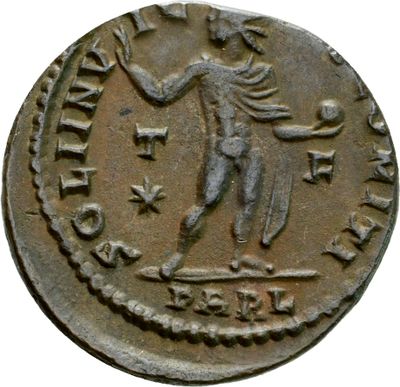
AE2, Arelate
RIC VII Arelate 84 · 316 AD
VICTORIAE LAETAE PRINC PERP (c. 313–320)
Two Victories holding a wreath over an altar, inscribing VOT / PR. A transitional series, Sol is gone from these, nothing explicitly Christian has replaced it. Bruun in RIC VII dates the main production to c. 318–320, though Trier struck an early billon version around 313.[5] VF from a dealer: $25–50. Underrated relative to other Constantinian types, and the paired Victories make for an attractive design.
BEATA TRANQVILLITAS (c. 321–323)
“Blessed Tranquillity.” An altar inscribed VOT / IS / XX, surmounted by a globe and three stars. Struck primarily at northwestern mints (Trier, Lyon, and London) which gives the type a regional character most Constantinian bronzes lack. Not rare, but not as ubiquitous as GLORIA EXERCITVS either. $20–40 in VF. A good example makes a nice counterpoint to the military types that dominate the rest of the series.
Vota types (c. 320–325)
A laurel wreath enclosing a votive inscription: VOT / XX or VOT / XX / MVLT / XXX, celebrating imperial anniversaries. Clean geometric design that strikes well because the die engraver had fewer details to render. Common as anything Constantine produced, but the variety of votive inscriptions and the interplay between obverse legend variants and reverse inscriptions create a collecting puzzle with real depth. $10–30 from dealers. Sometimes less at shows.
A note on the vota reverses. The legend DN CONSTANTINI MAX AVG appears on these coins, but as a reverse legend, surrounding the wreath. The obverse of these coins reads CONSTANTINVS AVG with a standard laureate or diademed bust. This catches people: the DN formula looks like an obverse legend, but it is not.[5]
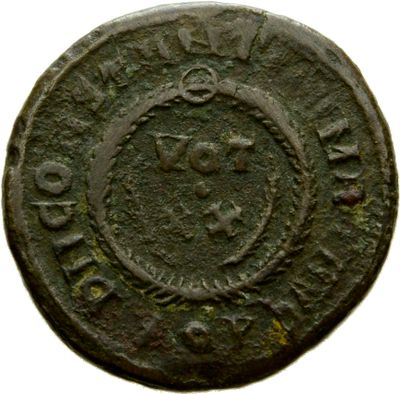
AE2, Aquileia
RIC VII Aquileia 104 · 322 AD
GLORIA EXERCITVS (c. 330–340)
The workhorse of Constantinian bronze. Two soldiers flanking two military standards (c. 330–335), then a later variant dropping to one standard (c. 335–340) as the flans shrank yet again. Struck at every mint in enormous quantities. These are the cheapest Constantinian bronzes on the market, $3–8 at shows, $20–40 for a sharp EF with complete legends. Buy a handful from different mints and use them to practise reading exergue marks. No better way to learn.
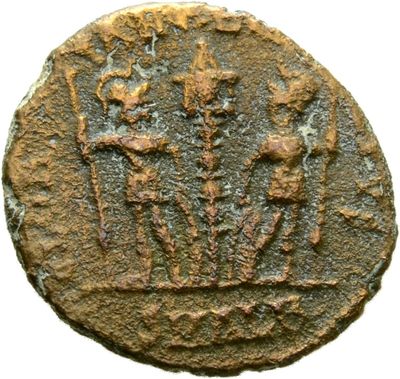
AE2, Alexandreia Egypt
RIC VII Alexandria 69 · 335 AD-337 AD
VRBS ROMA and CONSTANTINOPOLIS (c. 330–340)
The twin commemoratives marking Constantinople’s inauguration. VRBS ROMA shows helmeted Roma on the obverse, the she-wolf suckling Romulus and Remus on the reverse, two stars above. CONSTANTINOPOLIS shows the personified city wearing a helmet and holding a reversed spear; Victory stands on a ship’s prow on the reverse.[5]
The she-wolf design on a decent strike is one of the best-looking ancient bronzes you can buy for under $30. Average VF: $10–20. A sharply struck piece with full wolf detail and clear stars: $30–60. Collectors often buy these as a matched pair from the same mint. The crossover appeal to non-specialists nudges prices slightly above what rarity alone would dictate.
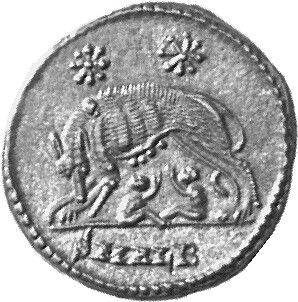
AE2, Alexandreia Egypt
RIC VII Alexandria 63 · 333 AD-335 AD
PROVIDENTIAE AVGG / Camp Gate (c. 317–330)
“To the foresight of the emperors.” A stylised fortification with turrets, sometimes a star above. The earliest issues appeared at Heraclea and other eastern mints around 317, well before Constantine held the east; the type expanded to all mints after 324.[10] The geometric design varies in turret count, stonework layers, and field marks, enough variation to sustain its own collecting niche. $15–40 from dealers.
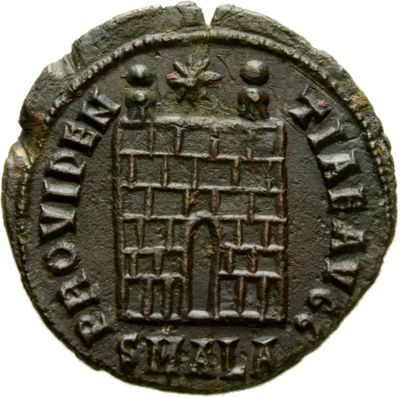
AE2, Alexandreia Egypt
RIC VII Alexandria 34 · 325 AD-326 AD
Posthumous consecration types (after 337)
Constantine died on May 22, 337, near Nicomedia, at a suburban villa called Ankyrona. His sons struck commemorative coins showing the veiled emperor on the obverse, with a reverse depicting Constantine in a quadriga (four-horse chariot) ascending to heaven, the hand of God reaching down from above. These are the most explicitly religious coins in the entire Constantinian series, and they were struck after his death, not during his lifetime. That chronology matters. VF examples run $30–80 depending on mint and condition.
Gold types
Most collectors live in the bronzes, and the series rewards that. But the gold is worth knowing about even if you never buy any. Solidus reverses mirror the bronze designs (Sol, Victories, vota) with the gravity of being actual money rather than small change. Common solidi in VF sell for $2,500–4,000 at CNG or Roma Numismatics. Verify weight before committing: a solidus should land near 4.5 grams, and more than about 0.2 grams off deserves scrutiny. Constantine gold gets faked regularly enough that due diligence is not optional.
The Religious Transition
No other Roman coinage tracks a shift in state religion as visibly as Constantine’s. The coins do not show a sudden conversion. They show a slow, cautious, politically managed transition that played out across two decades.
In 310, Sol Invictus dominated the reverses. By 318–320, the Sol types had quietly disappeared from most mints, not replaced by Christian imagery, but by deliberately neutral military themes. The absence is the message. Constantine was removing pagan content without yet committing to Christian content in a medium that reached every corner of the empire.
Explicit Christian symbols appeared early but sparingly. A chi-rho christogram shows up on some helmet crests as early as c. 315. The SPES PVBLICA type from Constantinople, struck around 327, features a labarum bearing the chi-rho piercing a serpent, the most overtly Christian imagery on any Constantinian lifetime issue.[8] But these are exceptions, not the rule. The bulk of the coinage remained secular and military throughout.
The real shift came after Constantine’s death. The posthumous consecration types, veiled head, quadriga to heaven, hand of God, are explicitly Christian in a way the lifetime coinage never consistently was. If someone shows you a Constantinian coin and calls it “the first Christian coinage,” look at the date. The story is more gradual than the label suggests.
For collectors, the religious transition creates a natural thematic set: a Sol type from Trier c. 313, a neutral Victory or vota type from the late 310s, a camp gate from the 320s, and a posthumous consecration piece from after 337. Four coins, maybe $80–120 total, and they tell one of the most consequential stories in Western history.
Collecting This Series
Constantine is one of the best entry points in ancient numismatics. The supply is deep, prices are low, and the historical density per dollar is hard to beat.
Starting out, under $50
Buy five or six coins from a dealer on VCoins or MA-Shops. Common types: GLORIA EXERCITVS, SOLI INVICTO COMITI, a VRBS ROMA. Aim for Fine to VF, from different mints, at $5–10 each. Handle them. Read the legends. Compare the mint marks. Do not worry about building a coherent set yet.
Getting serious, $200–500
Now you can be selective. Target VF or better with complete legends and readable mint marks. Pick a theme that gives the collection structure: one coin from every active mint, a chronological reverse-type set, a portrait-evolution set, or a single-mint focus. Trier is the classic single-mint choice, sharp strikes, well-documented in RIC VII.[5] Individual coins at this level run $15–50.
The premium path
EF bronzes start at $40–80 for common types and climb to $200–400 for scarcer issues in outstanding preservation. What you pay for at this level: intact silvering, sharp portrait detail, complete exergue marks, original patina. Buy from the major auction houses (CNG, Roma, Leu, Naville) for proper photography, detailed descriptions, and sometimes provenance back to named collections. Silver siliquae enter the picture at $400+. Gold solidi at $2,500+.
Building by theme
Five collecting themes that work well for Constantine and keep the budget reasonable:
- The religious transition: Sol type, neutral military type, camp gate, posthumous consecration. ~$80–120 total.
- Mint tour, one coin from every mint that struck for Constantine. Aim for twelve to fifteen mints. The London piece will be the most expensive.
- Portrait evolution: laureate early, helmeted military, mature laureate, rosette-diademed, veiled posthumous. Five coins, five political moments.
- The commemorative pair, VRBS ROMA and CONSTANTINOPOLIS from the same mint, matched for condition. A satisfying small project.
- Denomination range, AE4 through solidus. Four or five coins spanning the full monetary hierarchy.
Price reference
What a Constantine I coin is worth depends almost entirely on metal and condition, and the spread is enormous. A worn bronze and a high-grade solidus carry the same portrait and the same propaganda, yet sit thousands of dollars apart. The table below gives rough orientation ranges for Constantine coin value by denomination and grade. Treat them as starting points, not appraisals: real numbers move with eye-appeal, surviving silvering, centering, and whatever the market happens to be doing that month.
| Denomination | Fine (F) | Very Fine (VF) | Extremely Fine (EF) | Notes |
|---|---|---|---|---|
| Common AE3 bronze | $5–10 | $10–40 | $40–80 | GLORIA EXERCITVS, SOLI INVICTO COMITI; the cheapest types sit under $10 |
| VRBS ROMA / CONSTANTINOPOLIS | $8–15 | $8–25 | $40–80 | The 330 commemoratives; often collected as a matched pair |
| AE4 / reduced bronze | $5–10 | $10–25 | $30–60 | Late, small flans, frequently off-centre; condition is the variable |
| Scarcer bronze types | $20–50 | $50–200 | $200–400 | Rarer reverses, sharper strikes, intact silvering and patina |
| Silver siliqua | $400+ | $400+ | higher | Genuine Constantine I siliquae are scarce; most on the market are later rulers |
| Gold solidus | ~$2,000 | $2,500–4,000 | $15,000–20,000+ | Common types in VF; rare issues or top grade climb steeply |
These are orientation ranges, not quotes. Grading is applied loosely across the trade, so one seller’s VF is another’s Fine, and the same coin can fetch double depending on the buyer. For bronze, surface matters more than wear: a well-patinated example with surviving silvering will outrun a harshly cleaned coin of the same grade. Before you act on any number here, look at the specific coin and check it against recent auction and dealer results for the exact type.
Identifying Your Coin
You have a Constantinian bronze on screen and want to pin down what it is. Here is the fastest route.
Confirm it is actually Constantine I. This sounds obvious. It is not. Constantine I, Constantine II, Constantius II, Constans, and Delmatius all struck coins that look alike at first glance. The obverse legend separates them:
- IMP CONSTANTINVS P F AVG (early reign, as Augustus
- FL VAL CONSTANTINVS NOB C) as Caesar, pre-307
- CONSTANTINVS AVG (mid to late reign, the most common formula
- IMP CONSTANTINVS MAX AVG) after the Maximus title, post-312
See CONSTANTINVS IVN NOB C on the obverse? That is Constantine II as Caesar. Different person. See DN CONSTANTINI MAX AVG? That is a reverse legend on vota types, not an obverse, do not let it confuse you.
Check the portrait. Laureate: standard throughout. Helmeted and cuirassed: military context, usually earlier. Rosette-diademed: after c. 324. Veiled: posthumous, after 337. The portrait narrows your date range before you read a single letter of the reverse.
Read the reverse. The type narrows the date to within a few years. Match it against the series above. Read the legend letter by letter, visually similar types can carry different legends, and a misread sends you to the wrong entry in RIC.
Find the mint mark. In the exergue. Usually two to five letters. Combined with the reverse type, this gets you to a specific RIC reference number.
Look it up. The printed reference is RIC VII (Bruun, 1966) for 313–337 AD, and RIC VI for earlier issues as Caesar and during the Tetrarchy.[5][11] Online, OCRE provides free searchable access to the RIC data with images. Wildwinds has photographic archives organised by RIC number. Or search NumisLens Coin Identification, the system covers Constantinian types and narrows to a reference from the legend, reverse type, and mint mark.
Fakes and Forgeries
Common bronzes cost too little to be worth counterfeiting. Gold and silver are another matter.
Bronze problems
Tooling is the main concern. A sharp instrument re-cuts worn legends or portrait details to simulate a higher grade. Look for scratches that follow letter forms with suspicious precision, or features sharper than the surrounding surface would justify. Price a tooled coin at the grade it would be without the enhancement, not the grade the tooling simulates.
Artificial patina, chemical coatings applied to hide cleaning damage or tooling marks. Genuine ancient patina builds unevenly and accumulates naturally in the recesses of the design. Artificial patina is too uniform, sometimes waxy to the touch. Hold the coin at an angle under strong light; genuine patina has depth, fake patina sits on the surface.
Cast copies circulate on eBay and at flea markets. Soft details, visible seam lines on the edge, wrong weight, porous surface under magnification. Bulgarian workshops (documented extensively by Prokopov[12]) produce cast copies that flood online marketplaces, competent enough to fool a casual buyer scrolling thumbnails but obvious in hand. If the surface looks like it came from a mould rather than being struck between dies, trust your instinct.
Gold: the stakes go up
Fake Constantine solidi are a genuine market problem. Workshop-struck counterfeits, primarily from Bulgaria and Turkey, can fool buyers who are not paying close attention.[12] Your defences: buy from dealers with return policies, verify the weight (a solidus should land close to 4.5 grams, more than 0.2 grams off warrants suspicion), and compare the die style against confirmed examples on OCRE and in CNG’s archive. When something feels wrong, walk away. The next solidus will come along.
NGC and PCGS now slab ancient coins. The hobby’s opinion on third-party grading for ancients is split, and that argument will outlive everyone reading this. But at $3,000+ per coin, independent authentication has practical value that is hard to dismiss regardless of where you stand on the philosophical question.
Questions Collectors Ask
How much is a Constantine I coin worth?
Common bronze types (GLORIA EXERCITVS, SOLI INVICTO COMITI, the commemoratives) sell for $10–40 in Fine to VF from reputable dealers. Scarcer types or sharper examples bring $50–200. Silver siliquae start around $400, though actual Constantine I siliquae are rare and command more. Gold solidi range from $2,000 for worn examples to well over $20,000 for rare issues in high grade.
Are they rare?
As a group, no. Thirty-one years of output from fifteen-plus mints produced enormous volumes. Common bronze types appear in virtually every ancient coin dealer’s stock. But specific issues can be genuinely scarce, London mint coins (mint closed c. 325), early gold multiples, certain experimental types, and the silver coinage have limited survival.
How do I tell Constantine I from Constantine II?
The obverse legend. Constantine I uses IMP CONSTANTINVS or CONSTANTINVS AVG. His son, as Caesar, uses CONSTANTINVS IVN NOB C (“Junior, most noble Caesar”). After becoming Augustus in 337, Constantine II’s coins use CONSTANTINVS MAX AVG, but by then the father is dead, so there’s no overlap in practice.
What is the most common type?
GLORIA EXERCITVS with two soldiers and two standards. Struck everywhere, in vast quantities, from the early 330s. SOLI INVICTO COMITI Sol types from c. 310–319 are a close second. Both available for under $10 in decent condition.
What is the Sol coin of Constantine the Great?
The SOLI INVICTO COMITI bronze, “to Sol Invictus, the Companion.” Struck c. 310–319, the reverse shows Sol, the Unconquered Sun, standing radiate with his right hand raised and a globe in his left. It was Constantine’s dominant reverse before Christian imagery, and remains one of the most common Constantinian bronzes, often under $10 in decent condition.
Did Constantine put Christian symbols on his coins?
Rarely during his lifetime. A few issues from as early as c. 315 show the chi-rho on helmet crests or military standards, with more prominent use from the 320s. But the coinage remained predominantly secular and military. The real shift reads more in what disappears, Sol Invictus types end by c. 320, than in what replaces them. The explicitly Christian types came mainly after his death, struck by his sons.
What catalogue do I need?
RIC VII (Bruun, 1966) for 313–337 AD. RIC VI for earlier issues. RIC VIII (Kent, 1981) for posthumous issues. Online, OCRE gives you searchable access to the same data at no cost.
What are the VRBS ROMA and CONSTANTINOPOLIS coins?
Commemoratives from c. 330 marking Constantinople’s founding. VRBS ROMA: helmeted Roma / she-wolf and twins. CONSTANTINOPOLIS: personified city with a reversed spear / Victory on prow. Both common, $8–25 in VF. Often collected as a pair.
Where should I buy?
VCoins and MA-Shops for fixed-price purchases from professional dealers with return guarantees. CNG, Roma Numismatics, and Heritage for auction with broader selection. CNG’s biweekly e-auctions always include Constantinian material. eBay has volume but carries real fake risk for less experienced buyers.
References
- Hendy, M.F. (1985). Studies in the Byzantine Monetary Economy, c. 300–1450. Cambridge University Press. The standard work on the solidus standard and its longevity.
- Estimated from auction-record analysis: Constantine I accounts for approximately 5.6% of all Roman imperial coin records on CoinArchives, the largest single-ruler share. The claim that more of his coins survive than any other emperor’s is supported by market data, though no full physical census exists.
- Barnes, T.D. (1981). Constantine and Eusebius. Cambridge, MA: Harvard University Press, pp. 25–27. On the contested Augustus/Caesar distinction at Eboracum.
- Harl, K.W. (1996). Coinage in the Roman Economy, 300 BC to AD 700. Baltimore: Johns Hopkins University Press. Chapter 6 covers Diocletian’s monetary reform and the introduction of the follis.
- Bruun, P.M. (1966). Roman Imperial Coinage, Volume VII: Constantine and Licinius, AD 313–337. London: Spink & Son. The standard printed reference for the majority of Constantinian coinage.
- The SM = sacra moneta interpretation is standard in numismatic literature. See RIC VII, Introduction, for discussion of mint-mark formulae.
- The London mint closed c. 324–326; the precise date is debated. Bruun places it around 325. See also the Portable Antiquities Scheme (finds.org.uk) discussion of London mint closure in the context of hoard evidence.
- Eusebius, Vita Constantini (Life of Constantine). Trans. Cameron, A. & Hall, S.G. (1999). Oxford: Clarendon Press. The primary ancient source for Constantine’s religious policy, though written by a bishop with an agenda.
- Richardson, G.T. (2021). “Constantine’s SOLI INVICTO COMITI Coinage,” KOINON IV, pp. 128–153.
- The camp-gate type (PROVIDENTIAE AVGG/CAESS) first appeared at eastern mints including Heraclea c. 317, before Constantine controlled the east. See Portable Antiquities Scheme, Coin Relief Issue 31 (finds.org.uk).
- Sutherland, C.H.V. & Carson, R.A.G. (1967). Roman Imperial Coinage, Volume VI: From Diocletian’s Reform to the Death of Maximinus, AD 294–313. London: Spink & Son.
- Prokopov, I. (2004–present). Counterfeit coins research, including the CCCHBulg, Stop Forgery series. The most extensive documentation of modern workshop forgeries affecting the ancient coin market.
- Kent, J.P.C. (1981). Roman Imperial Coinage, Volume VIII: The Family of Constantine I, AD 337–364. London: Spink & Son.
Resources
- NumisLens Constantine I Catalog, browse all 4,096 types with images and catalog references.
- Constantine I: Emperor Profile, reign dates, dynasty, coinage timeline, key events, and links to the catalog.
- NumisLens Coin Identification, catalog search and attribution for Constantinian types.
- OCRE (Online Coins of the Roman Empire), searchable RIC database.
- Augustus Coins: A Historical Reference, the founding emperor's coinage, three centuries earlier.
- Vespasian Coins: A Collector’s Reference, the Flavian dynasty and Judaea Capta coinage.
- Trajan Coins: A Collector’s Reference, Dacian Wars, Optimus Princeps, and the empire at its peak.
- How to Identify Roman Coins, step-by-step method for any Roman imperial coin.
Identify Your Constantine Coins
Search by denomination, mint mark, and reverse type to narrow your coin to a RIC VII reference. The catalog covers 1,540 Constantine I types with images.
Ancient Coin Identification