Vespasian Coins: Judaea Capta & Flavian Coinage
The coinage of a dynasty built from nothing, 1,595 catalogued types across 16 mints, from the iconic Judaea Capta sestertii to common Rome-mint denarii at $150, all struck by the man who restored Roman monetary credibility after Nero’s debasement.
The coinage of Vespasian (69 to 79 AD) was struck primarily at Rome with supplementary eastern mints. Common silver denarii sell for $150 to $400 in Very Fine; Judaea Capta denarii bring $400 to $1,200, with the most iconic sestertii reaching $3,000 to $8,000. Gold aurei begin around $5,000. Standard catalog: RIC II.1, second edition (Carradice and Buttrey, 2007). For a figure on a specific coin, value your Vespasian pieces in NumisLens as you build the collection.
Entity: Vespasian (Q1419)
About 3.4 grams. That is what a Vespasian denarius weighs in your hand, heavier and purer than the silver Nero had been putting out by the end. Pick one up and the portrait alone tells you this is a different kind of emperor. No classical idealisation, no eternal youth. A broad face, a receding hairline, deep lines at the brow and mouth. This is the face of a man who looked his age and made no effort to hide it, and whose die engravers showed it because he wanted them to.6 The realism was the message: competence over pedigree, substance over style.
Vespasian coins sit at a particular point in the collecting market. The denarii are affordable, common types start at $150 in VF, and even the sought-after Judaea Capta denarii can be found for $400–800. The sestertii are where the money goes: a Judaea Capta sestertius in VF with legible legends will cost $3,000 or more, and exceptional examples have brought $20,000+ at auction. Gold aurei begin around $5,000 for common reverses. The range gives a collector room to enter the series at almost any budget while leaving room to grow.
This guide covers the Flavian coinage of Vespasian’s reign (69–79 AD) as both history and collecting reference. For individual type lookups, the full catalog of 1,595 Vespasian types is in the NumisLens database, 533 of them with images. What follows here is the context that makes those entries worth studying.
The Flavian Founder
Titus Flavius Vespasianus was born on 17 November 9 AD in Falacrina, a small settlement in the Sabine country northeast of Rome. His family was not senatorial. His father, Titus Flavius Sabinus, was a tax farmer (publicanus) in Asia and later a banker among the Helvetii. His mother, Vespasia Polla, came from a slightly more distinguished family, but neither parent’s background would have predicted an emperor.6 Suetonius records that Vespasian’s grandmother raised him on her estate at Cosa, and that his brother Sabinus entered imperial service first, reaching the consulship before Vespasian did.
The military career that eventually brought him the purple was solid but not spectacular. He served as a legionary legate in Britain during the Claudian invasion of 43 AD, commanding the Second Legion Augusta in the southwest and receiving triumphal ornaments.12 He governed Africa as proconsul around 63–64 AD, reportedly with such financial difficulty that he returned to mule-trading. Whether the story is literally true or Flavian-era self-deprecation, it established a persona: practical, frugal, unpretentious. The opposite of Nero.
Nothing on his coins suggests ancient lineage because there was none to suggest. Compare Augustus, who placed DIVI F (“son of the divine”) on every issue. Vespasian’s legends lead with IMP CAES VESP AVG and the titles of office: P M, TR P, COS. The authority comes from the position, not the blood. The coinage makes this argument in every legend it strikes.
The Road to Power
To understand why Vespasian’s coinage looks the way it does, you need 69 AD. Nero killed himself on 9 June 68. In the twelve months that followed, three men held and lost the purple in succession: Galba, Otho, and Vitellius. Tacitus, whose Historiae is the primary account of this period, opens with the observation that the year revealed the secret of empire: an emperor could be made somewhere other than Rome.8
Galba, who raised his standard in Hispania Tarraconensis in April 68 and was recognised by the Senate after Nero’s death in June, reached Rome in October. He lasted until 15 January 69, murdered by the Praetorian Guard after alienating nearly every faction that had supported him. Otho, who organised the plot, held the throne for three months before being defeated by Vitellius at the first Battle of Bedriacum on 14 April 69. Otho killed himself. Vitellius entered Rome in July, and for a few weeks the succession question seemed settled.8
But by then, events in the east had already moved. On 1 July 69, the legions in Egypt proclaimed Vespasian emperor. The Syrian and Judaean legions followed within days. Vespasian was fifty-nine years old, already commanding the suppression of the Judaean revolt, and his claim rested on one thing: the loyalty of the eastern armies and the fact that Mucianus, the governor of Syria, had thrown his weight behind the bid rather than making one of his own.8 Vespasian would turn sixty in November, already the oldest claimant of that year. Josephus, who was present as a prisoner turned advisor, claims he had prophesied Vespasian’s rise, a claim the Flavians found useful enough to promote.7
The Danubian legions declared for Vespasian in August. By October, Antonius Primus and the Danube forces had crossed into Italy and defeated the Vitellians at the second Battle of Bedriacum. Vitellius was killed in the streets of Rome on 20 December 69. Vespasian did not reach Rome until mid-70 AD, he remained in Egypt and then the east while his commanders won the war for him. That distance from the actual violence was probably deliberate.12
Three themes from this period shaped the coinage that followed. First, the need for legitimacy. Vespasian had no hereditary claim to the purple and no divine ancestor to invoke. His coinage would build that legitimacy through deeds, not blood. Second, the Jewish War. Vespasian left the siege of Jerusalem to his son Titus, who captured and destroyed the city (including the Second Temple) in August 70 AD. That victory became the foundation myth of the Flavian dynasty, and the Judaea Capta coinage is its monument.7 Third, the succession. Vespasian had two adult sons, Titus and Domitian, and he put both on the coins from the very beginning of the reign. The Year of the Four Emperors had demonstrated what happened when succession was uncertain. Vespasian made his arrangements visible in metal.
The Portrait
After two generations of idealised Julio-Claudian portraiture, Vespasian’s face on the coinage is a shock. Broad skull. Receding hair, the remaining fringe cut close. Deep nasolabial folds. A wide, slightly flattened nose. A firm, squared chin. Lines across the forehead that the engravers rendered with evident care. This is a portrait in the old Republican veristic tradition (showing the subject as he was, not as he wished to appear) and it was a political choice as much as an aesthetic one.12
The Julio-Claudians had presented an unbroken line of ageless faces. Augustus looked thirty on his last coins though he died at seventy-five. Nero’s early portraits show a teenager; his later ones, thickened but still classicised. Vespasian broke with that tradition entirely. His portrait says: this is a man from a municipal Italian family who earned the purple through military service and political patience, and he is not pretending otherwise. Suetonius describes him as having the face of a man straining at stool (vultu veluti nitentis) and while the biographer was not being entirely kind, the portraits on the coins bear him out.6
Three portrait phases are identifiable across the reign.
Early (69–70 AD). The first portraits, struck at eastern mints before Rome fully came under Flavian control, show a slightly leaner face. The realism is there, but the engravers are still finding the canonical Vespasian look. Eastern mint portraits (particularly from Antioch and Ephesus) sometimes have a sharper, more angular treatment of the features, influenced by local die-cutting traditions.
Mature (71–76 AD). The standard portrait emerges: the full, jowled face with pronounced wrinkles that most collectors encounter. This is the Rome mint at its best. The die engravers were working from official models, and the consistency across dies is notable, line up five denarii from this period and the same face looks back at you, with minor variation in the rendering of individual wrinkles and the precise treatment of the hair.
Late (77–79 AD). The face thickens slightly. Some scholars detect aging in the portraits; others see a change in the die-cutting workshop rather than the model. The distinction may not matter for most collectors, but late portraits tend to have a slightly heavier jawline and less precise rendering of the wrinkles, which may reflect either Vespasian’s aging or simply different engravers.
Throughout the reign, the standard obverse shows Vespasian laureate, wearing the laurel wreath of traditional Roman authority. Bare-headed portraits exist but are uncommon. A handful of issues show a radiate crown, indicating a doubled denomination (the radiate crown on a base-metal piece signals a dupondius rather than an as). For denarii and aurei, laureate is the default.
The contrast with his predecessors is the point. Place a Vespasian denarius next to a Nero denarius and the visual argument is immediate: the new order is honest, grounded, unsentimental. Place it next to an Augustus denarius and the argument shifts: this is what a Roman emperor looks like when he does not have a divine father to lean on.
The Judaea Capta Series
No discussion of Vespasian coins can avoid this series, and no collector of Flavian coinage should try. The Judaea Capta coinage is one of the most famous and collected ancient coin types in existence: recognisable, historically loaded, and available in enough denominations and varieties to sustain a focused collection on its own. The dedicated Judaea Capta guide covers the type across the whole Flavian dynasty; this section places it within Vespasian’s own coinage.
The background: Judaea had been in revolt since 66 AD. Nero dispatched Vespasian to suppress the rebellion, and he methodically reduced the Galilean strongholds through 67–68 AD before pausing to deal with the civil war that followed Nero’s death. When Vespasian left for Egypt and then Rome, his son Titus assumed command. Titus besieged Jerusalem in the spring of 70 AD and took the city in August. The Second Temple was destroyed on the 9th of Av (roughly August), an event that Josephus describes in harrowing detail and that fundamentally altered the course of Jewish history.7 The spoils (including the gold menorah and table of showbread from the Temple) were paraded through Rome in Titus’s triumph of 71 AD, depicted on the Arch of Titus which still stands in the Forum.11
The Flavian dynasty needed a founding myth, and the Jewish War provided it. Where Augustus had Actium and the conquest of Egypt, Vespasian had Judaea. The coinage made this parallel explicit. Just as Augustus struck AEGYPTO CAPTA types with bound crocodiles, Vespasian struck IVDAEA CAPTA types with captive figures beneath a palm tree.
The iconography
The core design shows a palm tree (a symbol associated with Judaea since at least the First Revolt coinage) with a mourning captive seated at its base. The captive is female, representing the personified province in defeat: head bowed, hands clasped or resting on her knee, the posture of utter subjection. In many variants, a standing Roman soldier or trophy of arms appears on the other side of the tree, reinforcing the asymmetry between victor and vanquished. The legend IVDAEA CAPTA or IVDAEA or simply IVDAE identifies the subject.
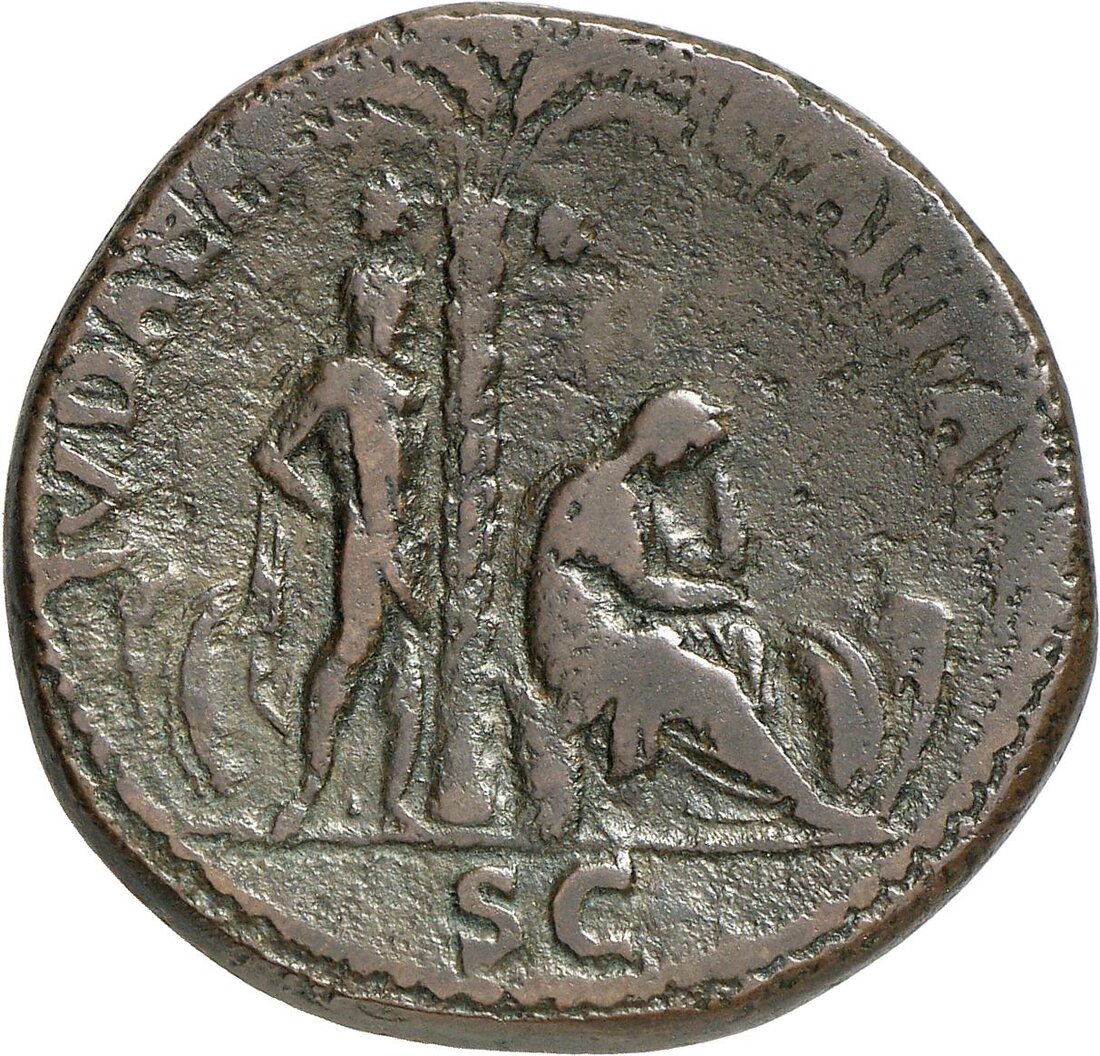
The reverse of a Vespasian sestertius of the IVDAEA CAPTA series (RIC II.1 159): a palm tree at the centre, a bound captive standing to the left, the mourning figure of Judaea seated right, and SC in the exergue. Roman triumph over the Jewish revolt, struck in bronze at the scale where every detail registers.
IKMK network via Online Coins of the Roman Empire (OCRE) ric.2_1(2).ves.159 — Public Domain (PDM 1.0)
Hendin’s Guide to Biblical Coins catalogues the full range of the series across all denominations and mints.3 Meshorer provides the broader context within Jewish numismatic history.4 Between them, these two references cover the territory more thoroughly than RIC alone, which treats the Judaea types as one group among many rather than as the signature series they are.
Denominations
Sestertii. The large orichalcum sestertii are the most visually dramatic. At 33–34mm and 24–27 grams, they carry the Judaea imagery at a scale where every detail registers: the curve of the palm fronds, the chains on the captive, the texture of the soldier’s armour. These are the coins that appear in museum displays and auction catalogue covers. The full IVDAEA CAPTA legend typically reads across the field or in the exergue. At auction, VF examples with readable legends and clean surfaces run $3,000–8,000. Exceptional examples (sharp strike, attractive patina, fully legible) have exceeded $15,000 at CNG and Roma Numismatics.
Denarii. The silver Judaea Capta denarii are more accessible. The imagery is compressed onto a smaller flan (18–19mm), but the composition adapts well: captive and trophy flanking a palm, or a seated mourning figure alone. The legends vary, some carry the emperor’s titulature on the reverse alongside the type, others rely on IVDAEA or the captive imagery alone to identify the series. Market: $400–1,200 in VF depending on variant and strike. Scarcer types push higher.
Aurei. Gold Judaea Capta pieces exist and are genuinely scarce. They surface at major sales a few times per year. Expect $10,000 or more for a VF example, with exceptional pieces competing at $30,000+. For most collectors, these are coins to study in auction catalogues rather than purchase.
Provincial issues. Caesarea Maritima in Judaea itself struck bronzes with related imagery under Roman authority. These are catalogued in Roman Provincial Coinage Volume II.10 They lack the IVDAEA CAPTA legend of the imperial issues but carry the palm tree and captive motifs. Prices are modest ($50–300) and they connect the collector directly to the province that the coins commemorate.
Denominations and Metals
Vespasian inherited Nero’s debased monetary system and set about restoring it. The reform was not dramatic in the way that Augustus’s had been, there was no new denominational structure to introduce. Instead, Vespasian raised the silver content of the denarius and stabilised the weight of the gold aureus, signalling fiscal discipline to a population that had watched the currency deteriorate under Nero.9
The denominational system he operated was the same Augustan framework, now roughly a century old.
At the top, the gold aureus: approximately 7.2–7.3 grams under Vespasian, lighter than the Augustan standard of roughly 7.9 grams but consistent within its own framework.9 One aureus equalled 25 silver denarii. The denarius (Vespasian’s workhorse denomination) weighed about 3.3–3.5 grams and ran at roughly 80–90% fine silver, depending on the mint and the analytical method, Walker’s traditional figures run higher, while Butcher and Ponting’s more recent metallurgy suggests the Rome mint struck closer to 80%.9 Nero had reduced the denarius weight from roughly 3.8 grams to about 3.4 grams; Vespasian’s contribution was stabilising that reduced weight and slightly tightening quality control.9 The difference across reigns is subtle but detectable through precise weighing, and collectors who care about metallurgy can confirm a Vespasianic denarius by its density and ring.
The base metal coinage continued unchanged. The orichalcum sestertius (four asses) and dupondius (two asses) in golden-yellow brass, the copper as, and the smaller semis and quadrans. Vespasian’s sestertii are among the finest in the Roman series for their combination of broad flans, detailed engraving, and the range of reverse types they carry. The Judaea Capta sestertii are the headline, but the non-Judaean issues (Pax, Roma, Spes, Annona) are worth the attention of anyone who values skilled die work.
Suetonius records that Vespasian placed a tax on urine collected from public latrines, the fullers used it for processing wool. When Titus objected to the indignity of the revenue source, Vespasian reportedly held a coin under his nose and asked if it smelled. Pecunia non olet, “money does not smell.”6 The anecdote captures the Flavian attitude toward revenue: anything that funded the state was legitimate. The restored denarius weight was the visible proof that the policy was working.
| Denomination | Types in catalog |
|---|---|
| Sestertius | 381 |
| As | 359 |
| Denarius | 331 |
| Dupondius | 219 |
| Aureus | 189 |
| Quadrans | 39 |
| Quinarius | 38 |
| AE Small | 9 |
| AE Medium | 8 |
| AE Large | 8 |
| Quinarius Aureus | 7 |
| Semis | 4 |
| Cistophorus | 2 |
Where the Coins Were Made
The mint structure under Vespasian differs from both the centralised Augustan system and the sprawling network of Constantine I. Rome was the primary mint for all denominations throughout the reign. But the circumstances of Vespasian’s rise (proclaimed in the east, fighting a civil war, with Rome under Vitellian control through December 69) meant that supplementary mints operated during the early years and left their mark on the coinage record.
Rome struck the overwhelming majority of Vespasian’s coinage: gold, silver, and base metal. The Rome mint’s output dominates dealer stock and auction lots. Die quality was consistently high, the portrait engraving during the mature period (71–76 AD) ranks among the finest in first-century Roman coinage. Rome mint coins carry no mint mark; identification relies on style and, for the base metal coinage, the presence of SC (Senatus Consulto) on the reverse.
Lugdunum (Lyon) continued to operate as a secondary precious-metal mint, as it had under Augustus and the Julio-Claudians. Lugdunum denarii of Vespasian are distinguishable by a small globe or pellet at the base of the bust, a feature that Carradice and Buttrey discuss in the RIC II.1 introduction.1 They are less common than Rome mint issues but not rare.
Tarraco (Tarragona, Spain) struck denarii and possibly aurei in the early years, roughly 69–70 AD. The attribution of some Spanish-style issues remains debated. These are scarce coins and carry a premium when they appear.
Antioch struck both silver and base metal. Antioch denarii have a distinctive style: the portraits tend to be sharper-featured and more angular than Rome’s rounded treatment. Antioch also produced tetradrachms to the local weight standard, continuing the tradition of large silver for eastern commerce. These are catalogued in Roman Provincial Coinage Volume II.10
Ephesus operated as a temporary mint during the civil war period and into the early reign. Ephesus denarii are rarer than Antioch and command a premium. The style has a Hellenistic refinement that Rome lacks.
Alexandria struck its own distinct coinage in billon (debased silver) tetradrachms on the Ptolemaic standard, continuing a tradition that had run since the Roman annexation of Egypt. Alexandrian tetradrachms of Vespasian are common and affordable: $30–100 for presentable examples. They are catalogued in Roman Provincial Coinage and in specialised references for the Alexandrian mint (Emmett, Dattari).
Caesarea in Cappadocia struck silver didrachms and drachms for regional circulation. These carry Vespasian’s portrait and titles but are on a different weight standard from the imperial denarius. They are relatively affordable and underappreciated.
| Mint | Types in catalog |
|---|---|
| Rome | 1,115 |
| Lugdunum | 191 |
| Ephesus | 132 |
| Tarraco | 44 |
| Antiocheia Pisidia | 25 |
| Alexandreia Egypt | 8 |
| B0 | 4 |
| B8 | 2 |
| B4 | 2 |
| B5 | 2 |
| B6 | 2 |
| B7 | 2 |
| B2 | 1 |
| B9 | 1 |
| B3 | 1 |
| B1 | 1 |
Key Types to Know
Beyond the Judaea Capta series, Vespasian’s coinage carries a range of reverse types that track the political programme of the Flavian dynasty. What follows covers the types you will encounter most often at dealers and in auctions, not a complete catalog, but the core material.
Pax and the end of civil war
PAX AVG and related Pax types are among the most common Vespasian reverses. Pax stands or sits, holding an olive branch and caduceus or cornucopia. The message is blunt: the civil wars are over, stability has returned, and this emperor is the reason. The type appears on denarii, aurei, and base metal. Common denarii with Pax reverses run $150–300 in VF. They are the default entry point for a Vespasian collection: historically significant, available, and well within reach.
.ves.1142/db0e303a67a66c9f_reverse.jpg?width=400&resize=contain)
Dupondius, Lugdunum
RIC II, Part 1 (second edition) Vespasian 1142 · 71 AD
Victory types
VICTORIA AVGVSTI: Victory advancing or standing, sometimes placing a wreath on a trophy, sometimes writing on a shield. These are generic victory types, not specifically tied to Judaea, though the political context makes any Flavian Victory coin implicitly about the eastern campaigns. Denarii: $150–350 in VF. Sestertii with Victory types are scarcer and more expensive.
.ves.1431/0214e8a178ca4214_reverse.jpg?width=400&resize=contain)
Denarius, Ephesus
RIC II, Part 1 (second edition) Vespasian 1431 · 71 AD
Fortuna and prosperity
FORTVNA AVGVST: Fortuna standing with rudder and cornucopia, embodying the good fortune of the emperor and, by extension, the state. A standard type on Vespasianic denarii, available for $150–300 in VF. The seated Fortuna variant, where she rests her hand on a ship’s prow, is slightly less common and carries a modest premium.
.ves.1216/999a2e51093880e3_reverse.jpg?width=400&resize=contain)
Dupondius, Lugdunum
RIC II, Part 1 (second edition) Vespasian 1216 · 77 AD-78 AD
The eagle
Eagle on cippus, the Roman eagle perched on a small altar or pedestal. A military type signalling legionary loyalty and Roman martial identity. It appears on both denarii and aurei. The eagle types from the early reign are sometimes associated with the legions that proclaimed Vespasian in the east. Denarii: $200–500 in VF depending on variant and strike.
.ves.1471/3584f2785cb0292b_reverse.jpg?width=400&resize=contain)
Denarius, Ephesus
RIC II, Part 1 (second edition) Vespasian 1471 · 76 AD
Dynastic types: Titus and Domitian
Vespasian used his coinage to mount the most systematic dynastic succession programme Roman numismatics had yet seen. Augustus had placed Gaius and Lucius on his coinage, but Vespasian went further: both Titus and Domitian appear on coins struck in Vespasian’s name, with legends identifying them as Caesar (heir designate). CAESAR AVG F COS or CAESARIS AVG F on the reverse, with the portrait or attributes of one of the sons, makes the succession plan visible to everyone who handled money.
This was calculated. The Year of the Four Emperors had shown what happened when an emperor died without a clear successor. Augustus had faced the same problem and solved it imperfectly, his chosen heirs kept dying. Vespasian had the advantage of two grown sons who both survived him. The coins made sure nobody could overlook that fact.
.ves.1563/068ddea8b21f4bc5_reverse.jpg?width=400&resize=contain)
Denarius, Antiocheia Pisidia
RIC II, Part 1 (second edition) Vespasian 1563 · 72 AD-73 AD
Temple types
Several reverse types show temples and architectural subjects. The Temple of Vesta appears on denarii, a round temple with columns and a figure of the goddess within. The Templum Pacis (the Temple of Peace, dedicated by Vespasian in 75 AD to house the spoils from Jerusalem) appears on sestertii. Architectural types are generally scarcer than figural types and carry a premium among collectors of Roman architecture on coins.
Modius types
The modius (a Roman grain measure) appears as a reverse type on asses and occasionally denarii, symbolising the grain supply and civic welfare. These are among the simpler Vespasianic types, affordable ($40–100 on base metal), and historically instructive: the grain supply was a political lifeline for any Roman emperor, and advertising it on the coinage was standard practice.
Identifying Your Coin
You have a coin (Vespasian or possibly Vespasian) and need to determine exactly what it is. Here is the sequence that produces results.
Confirm the ruler. This matters because Vespasian, Titus, and Domitian all struck coins that can look similar, especially in worn condition. The obverse legend separates them:
- IMP CAES VESP AVG P M or IMP CAESAR VESPASIANVS AVG (Vespasian
- T CAES IMP VESP P TR P or IMP TITVS CAES VESPASIAN AVG) Titus
- CAES AVG F DOMIT or CAESAR AVG F DOMITIANVS, Domitian as Caesar
Read the legend letter by letter. On worn coins, the distinction between VESP and VESPASIAN can be the difference between father and son.
Check the portrait. Vespasian’s portrait is distinctive enough that it often identifies him before you read a single letter. The broad, lined face with the receding hairline is unlike any other Flavian portrait. Titus is younger, fuller-faced, with more hair. Domitian as Caesar is young with a prominent chin and a fuller head of hair than either his father or brother.
Determine the denomination. Gold aureus: approximately 7.2–7.3g, 19–20mm. Silver denarius: 3.3–3.5g, 17–19mm. Orichalcum sestertius: 24–27g, 33–35mm. Orichalcum dupondius (radiate crown on obverse): 12–14g, 27–29mm. Copper as (laureate): 9–12g, 26–28mm.
Read the reverse legend and type. The reverse legend carries information about the coin’s date. Vespasian’s titles accumulated year by year: the consular number (COS III, COS VIII) and tribunician power (TR P, TR POT X) changed annually, allowing coins to be dated to within a year or two. The reverse type (Pax, Victory, Judaea, eagle, temple) narrows the RIC reference.
Look it up. The printed reference is RIC II.1 (Carradice and Buttrey, 2007), organised by denomination, then by date within each denomination.1 The older RIC II (Mattingly and Sydenham, 1926) is frequently cited in older dealer descriptions and price databases, but the numbering differs from the second edition, always check which edition a dealer is referencing.2 Online, OCRE provides free searchable access to the RIC data with specimen photographs. Filter by ruler, denomination, and reverse type for the fastest route to an answer.
Or search NumisLens Coin Identification, which covers Flavian types and can narrow to a reference from a legend fragment and reverse type.
Market and Collecting
Vespasian sits in a productive zone of the ancient coin market: historically significant, visually distinctive, available in enough volume that a collection can be built with patience, and priced below the Julio-Claudian emperors who precede him. A serious collector can build a meaningful Flavian cabinet without the five-figure entry ticket that Augustus or Nero demands.
Price reference
The table below consolidates current market ranges for the main Vespasian denominations. Prices reflect recent auction results and dealer stock from CNG, Roma Numismatics, VCoins, and acsearch.info. All ranges assume authentic coins with no damage, cleaned or tooled examples sell for less.
| Denomination | Fine (F) | Very Fine (VF) | Extremely Fine (EF) | Notes |
|---|---|---|---|---|
| Aureus (gold) | : | $5,000–9,000 | $10,000–25,000+ | Judaea Capta aurei significantly higher; common types from $5K |
| Denarius (common types | $60–120 | $150–400 | $500–1,200 | Pax, Victory, Fortuna reverses most available |
| Denarius) Judaea Capta | $200–400 | $400–1,200 | $1,200–3,000 | Premium for fully legible legend and sharp palm tree |
| Denarius (eastern mints | $150–300 | $300–800 | $800–2,000 | Ephesus and Antioch issues; scarcer than Rome |
| Sestertius) common types | $150–400 | $500–1,500 | $1,500–4,000 | Patina and legend readability drive price |
| Sestertius: Judaea Capta | $800–1,500 | $3,000–8,000 | $8,000–20,000+ | The trophy piece; condition highly sensitive |
| Dupondius / As | $20–60 | $60–200 | $200–600 | Undervalued relative to historical content |
| Alexandrian tetradrachm | $20–50 | $50–150 | $150–400 | Billon; common and affordable entry point |
| Fourrée (ancient forgery) | $15–30 | $30–80 | , | Collected for study; don’t pay genuine prices |
These ranges reflect the market as of early 2026. Condition grading varies across dealers, one shop’s VF is another’s gF. Always examine the specific coin, not just the grade label. For denarii, centering and legend completeness affect salability as much as wear. For sestertii, patina colour and the absence of tooling or smoothing are the real price movers.
Getting started, under $500
Buy one good denarius. The Pax type is the natural choice: common enough that decent VF examples appear constantly, historically significant as Vespasian’s statement that the civil wars were over, and visually strong when the strike cooperates. Spend $200–350 on a VF with complete legends and a centred portrait from a reputable dealer. Handle it. Study the portrait, you are looking at one of the most realistic faces in Roman coinage.
A Judaea Capta denarius is the obvious second purchase if the budget allows. At $400–800 in VF, it is more expensive than the common types but puts one of the most historically significant ancient coin series in your hand. Alternatively, an Alexandrian billon tetradrachm at $30–80 provides a second denomination, a different mint, and a different metal, all for the price of a reference book.
Building depth: $1,000–5,000
Now you can be selective. Two approaches work well.
Reverse-type collection. One example each of Pax, Judaea Capta, Victory, and an eagle or architectural type. Four or five denarii that cover the major themes of the Flavian programme. Budget: $1,500–3,500 for VF examples. Add an as or dupondius with a modius or Aequitas reverse to bring the base metal into the set.
The Judaea set. A Judaea Capta denarius paired with a Judaea sestertius is one of the most satisfying two-coin combinations in ancient numismatics. The denarius for the silver and the historical significance; the sestertius for the visual drama at full scale. Budget: $3,000–6,000 depending on condition targets.
The premium path
EF-to-near-mint denarii run $500–1,200 for common types. Judaea Capta denarii at EF push $1,500–3,000. At this level, provenance carries weight. A coin from a published collection (ex Hess-Leu, ex NAC, ex M&M Basel) adds both security and pedigree. Provenance means prior expert examination.
Gold enters the picture. Common aurei in VF start around $5,000. A Judaea Capta aureus commands $10,000 or more. The supply of Flavian gold is limited, and demand from both institutional buyers and advanced private collectors has tightened the market over the past decade. Prices for Vespasian aurei have trended upward since 2018.
Where to buy
CNG (Classical Numismatic Group), biweekly e-auctions and quarterly feature sales. Flavian material appears regularly. CNG’s online archive of past sales is itself a research tool.
Roma Numismatics and Leu Numismatik: high-end ancients, strong photography, detailed lot descriptions. Expect market price or above, but the material is genuine and well-documented.
VCoins and MA-Shops, fixed-price platforms with vetted professional dealers. Good for filling specific gaps at known prices. Return guarantees standard.
NAC, Nomos, Künker, European houses carrying top-end ancient material. For Judaea Capta sestertii and Flavian gold, these sales are worth watching.
Heritage Auctions, Roman material in their world coin sales, largest US bidding pool for ancients.
Start Your Vespasian Collection
Track your coins, record attributions, and build a searchable cabinet. NumisLens handles cataloguing, insurance exports, and price tracking so you can focus on the collection.
Create Your CabinetFakes and Forgeries
Vespasian denarii at $200–400 sit in the range where counterfeiting becomes economically viable. Judaea Capta pieces, with their collector premium, are particularly targeted. The gold is faked as aggressively as any first-century Roman gold.
Modern fakes
Cast copies are the most common threat. Made by pressing a genuine coin into a mould and casting replicas in a base-metal alloy, sometimes plated. The signs: soft, mushy detail on the hair and portrait wrinkles, a slightly porous surface under magnification, rounded letter edges instead of sharp struck ones, and sometimes a visible seam on the rim. The weight may be close (forgers tune the alloy) but the feel is wrong. Struck coins have a crispness and directional flow to the metal that castings never replicate.
Die-struck counterfeits from workshops in Bulgaria, Turkey, and Lebanon are rarer and harder to detect. The die style is usually the giveaway: letters too regular, wrinkles too schematic, everything slightly too clean. Real ancient dies were cut by hand, and the small irregularities of handwork (a letter slightly tilted, a wrinkle that thickens unevenly) are missing from modern copies. For Judaea Capta pieces above $1,000, buy from dealers who guarantee authenticity in writing and compare the die to confirmed examples on OCRE or in published auction catalogues.
Tooling and enhancement
At the sestertius price level ($1,000+), tooling becomes a real concern. A sharp instrument re-cuts worn legends or details to simulate a higher grade. Look for features sharper than the surrounding surface would justify, scratches that follow letter forms too precisely, and letters with a different patina colour from the surrounding field, fresh-cut metal oxidises differently from an ancient surface. Price a tooled coin at the grade it would be without the enhancement.
Fourrées: ancient forgeries
Vespasian’s denarii were counterfeited in antiquity too. Fourrées (base metal cores with a thin silver plating) circulated alongside genuine coins. When the silver skin wears through, dark copper or bronze shows through the surface. They are collected in their own right: fourrées provide evidence of ancient counterfeiting operations and sometimes preserve die combinations not recorded among genuine specimens. Budget $20–60 for one. Do not pay genuine prices.
Practical defences
Buy from dealers with return policies and written authentication guarantees. Weigh the coin, a denarius outside the 3.1–3.6g range warrants scrutiny. For purchases over $1,000, third-party authentication from NGC Ancients has practical value. Compare the die to published examples. And remember: a price significantly below market is the most reliable indicator that something is wrong.
Questions Collectors Ask
How much are Vespasian coins worth?
Common denarii (Pax, Victory, Fortuna reverses) sell for $150–400 in VF from reputable dealers. Judaea Capta denarii command $400–1,200 in VF. Gold aurei start around $5,000 for common types. Sestertii range from $300–1,000 for common types to $3,000–8,000+ for Judaea Capta. Base metal asses and dupondii run $40–200 in presentable condition.
What is a Judaea Capta coin?
Coins struck by the Flavian dynasty to commemorate the Roman victory in the Jewish War and the destruction of the Second Temple in 70 AD. The reverse shows a captive seated beneath a palm tree, sometimes with a standing Roman soldier. Produced across multiple denominations at Rome and eastern mints. The sestertii are the most iconic and valuable; the denarii are more accessible.
Are Vespasian coins rare?
As a group, no. Vespasian struck coinage in volume from Rome for ten years. Common denarius types appear in virtually every ancient coin dealer’s stock. But eastern mint issues (Ephesus, Antioch), early civil-war pieces, rare Judaea Capta variants, and gold aurei in good condition can be genuinely scarce.
How do I identify a Vespasian coin?
Start with the portrait: Vespasian’s broad, wrinkled, balding face is distinctive. Read the obverse legend: look for IMP CAES VESP AVG or IMP CAESAR VESPASIANVS AVG. Determine the denomination by metal and size. Cross-reference with RIC II.1 (Carradice and Buttrey, 2007) or OCRE online.
What is the most common Vespasian coin?
Rome-mint denarii with seated Pax, Victory, or Fortuna reverses and COS V through COS VIII consular dates. These account for the bulk of Vespasian denarii on the market. Expect $150–350 for a decent VF.
What catalog should I use for Vespasian coins?
RIC II.1 (Carradice and Buttrey, 2007) is the current standard, replacing the original RIC II (Mattingly and Sydenham, 1926). Online, OCRE gives searchable access at no cost. For Judaea Capta types specifically, Hendin’s Guide to Biblical Coins (5th ed., 2010) is the specialist reference.
Did Vespasian build the Colosseum?
He began construction around 70–72 AD, funded partly by spoils from the Jewish War. He did not live to see it completed: his son Titus dedicated the Flavian Amphitheatre in 80 AD, a year after Vespasian’s death. The Colosseum does not appear explicitly on Vespasian’s lifetime coinage, though related building-programme types (Temple of Peace) do.
Where can I buy Vespasian coins?
CNG, Roma Numismatics, and Leu Numismatik for auction. VCoins and MA-Shops for fixed-price from professional dealers with return guarantees. NAC, Nomos, and Künker for high-end material. Heritage Auctions for the largest US bidding pool. Avoid eBay for expensive pieces unless you can already spot cast copies and tooled coins with confidence.
References
Sources cited throughout this guide. For a full bibliography of Flavian numismatics, see the introduction to RIC II.1.1
- Carradice, I. & Buttrey, T.V. (2007). The Roman Imperial Coinage, Volume II, Part 1 (second edition): From AD 69 to AD 96, Vespasian to Domitian. London: Spink.
- Mattingly, H. & Sydenham, E.A. (1926). The Roman Imperial Coinage, Volume II: Vespasian to Hadrian. London: Spink.
- Hendin, D. (2010). Guide to Biblical Coins, 5th edition. New York: Amphora.
- Meshorer, Y. (2001). A Treasury of Jewish Coins from the Persian Period to Bar Kokhba. Jerusalem: Amphora.
- Sear, D. (2000). Roman Coins and Their Values, Volume I: The Republic and the Twelve Caesars, 280 BC–AD 96. London: Spink.
- Suetonius, Divus Vespasianus. Trans. Rolfe, J.C. (1913). Loeb Classical Library, Harvard University Press.
- Josephus, The Jewish War (Bellum Judaicum). Trans. Thackeray, H.St.J. (1927–1928). Loeb Classical Library, Harvard University Press.
- Tacitus, Historiae, Books I–V. Trans. Moore, C.H. (1925). Loeb Classical Library, Harvard University Press.
- Walker, D.R. (1976–1978). The Metrology of the Roman Silver Coinage, Parts I–III. BAR Supplementary Series 5, 22, 40. Oxford.
- Burnett, A., Amandry, M., & Carradice, I. (1999). Roman Provincial Coinage, Volume II: From Vespasian to Domitian (AD 69–96). London/Paris: British Museum Press / Bibliothèque nationale de France.
- Goodman, M. (2007). Rome and Jerusalem: The Clash of Ancient Civilizations. London: Allen Lane.
- Levick, B. (1999). Vespasian. London: Routledge. The standard modern biography.
Resources
- NumisLens Vespasian Catalog, browse all 1,595 types with images and catalog references.
- Vespasian: Emperor Profile, reign dates, dynasty, coinage timeline, key events, and links to the catalog.
- NumisLens Coin Identification, search by legend, denomination, and reverse type for attribution of Flavian types.
- OCRE (Online Coins of the Roman Empire), searchable RIC database with images.
- Augustus Coins: A Historical Reference, the monetary system Vespasian inherited, three generations earlier.
- Constantine I Coins: A Collector’s Reference, the Roman coinage two-and-a-half centuries later.
Identify Your Vespasian Coins
Search by legend, denomination, and mint to reach a RIC reference. The catalog covers 533 Vespasian types with images.
Try Coin Identification