Trajan Coins: A Collector’s Reference
The coinage of Rome’s greatest military emperor, 1,046 catalogued types from the mint at Rome and beyond, spanning the Dacian Wars, the Parthian campaign, and the empire at its territorial peak. Common denarii from $80, sestertii from $200, gold aurei from $5,000.
Trajan's coinage (98 to 117 AD) is dominated by his Dacian Wars commemoratives and the title OPTIMO PRINC. Common silver denarii sell for $80 to $300 in Very Fine; the DAC CAP sestertius brings $500 to $2,000. Gold aurei begin around $5,000. Standard catalog: RIC II (Mattingly and Sydenham, 1926), or Woytek (2010) for the modern scholarly treatment. Ranges shift as coins trade; put current values on your own Trajan coins when you record them in NumisLens.
Entity: Trajan (Q1425)
About 3.4 grams. That is what a Trajan denarius weighs in your hand: good silver, around 90% fine by metallurgical analysis, struck at Rome on a flan slightly smaller and lighter than the Augustan standard but still carrying real purchasing power.9 Pick one up and you are holding a coin from the reign when the Roman Empire reached its maximum territorial extent: from Britain to the Persian Gulf, from the Danube to the Sahara. Trajan coins record that expansion in metal: Dacian captives on sestertii, Parthian submission on denarii, new provinces personified on gold.
Silver denarii account for the bulk of what collectors encounter. A common type (Victory advancing, or Virtus standing) runs $80–200 in VF from a dealer. The Dacian Wars commemoratives, which are the most historically charged coins in the series, command a premium: $150–400 for a well-centered denarius showing a captured Dacian or trophy of arms. Sestertii start around $200 for worn but legible examples and climb past $1,000 for sharp portraits with natural patina. Gold aurei begin at roughly $5,000 and ascend from there.
This guide reads the Trajanic coinage as both history and collecting series. Each coin appears as evidence within a narrative, not just a picture with a price. For individual type lookups, the full catalog of 1,046 Trajan types is in the NumisLens database, 838 of them with images. What follows here is the context that makes those entries mean something.
Optimus Princeps
Trajan holds a singular position in Roman memory. The Senate awarded him the title OPTIMO PRINC (Optimus Princeps, "Best of Rulers") a distinction no other emperor received before or after.6 The phrase appears on his coins from around 103 AD onward and became the standard reverse legend formula for the second half of the reign. When new emperors took power in centuries to come, the Senate’s traditional acclamation wished them to be felicior Augusto, melior Traiano: "more fortunate than Augustus, better than Trajan."5 That formula survived into the fourth century. No higher standard existed.
For collectors of Trajan coins, this matters because it defines the series. Unlike Augustus, whose coinage is a study in political calculation, or Constantine I, whose coins track a religious revolution, Trajan’s coinage is about military achievement and imperial expansion on a scale Rome had not seen since the Republic. The Dacian Wars, the Parthian campaign, the building programme, the coins commemorate all of it, and the market rewards collectors who understand what they are looking at. A Dacian captive denarius sells for twice what a generic Virtus type does, not because it is rarer, but because collectors know what it represents.
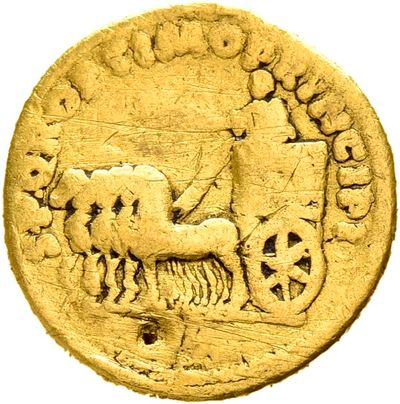
Aureus, Rome
RIC II Trajan 207 · 103 AD-111 AD
A Collector’s History of Trajan
You do not need to be a historian to collect these coins. But a handful of dates and events explain why the coinage looks the way it does, and knowing them protects you from misattributions that cost money.
Marcus Ulpius Traianus was born on 18 September 53 AD at Italica, near modern Seville, in the province of Hispania Baetica.3 His father, of the same name, had been consul and governor of Syria, a distinguished career, but provincial. Trajan was the first emperor of provincial origin, the first whose family was rooted outside Italy. His family was Roman in law and culture, Italian in distant origin (the Ulpii had settled in Spain during the Republic), but Iberian in upbringing. This matters for the coins because it shaped the propaganda: from the beginning, the coinage emphasised military credentials and senatorial approval rather than dynastic blood. Trajan had neither Julian nor Claudian ancestry to lean on. He had a military record.
The path to power ran through the army. Trajan served as a military tribune in Syria, commanded a legion in Spain, was governor of Upper Germany. In October 97, the elderly emperor Nerva ( who had taken power after the assassination of Domitian in 96 and was struggling to control the Praetorian Guard) adopted Trajan as his heir and co-ruler.5 The adoption was political, not sentimental: Nerva needed the legions’ loyalty, and Trajan held the Rhine frontier with the most powerful army in the empire. The early coins reflect this arrangement. Legends reading IMP CAES NERVA TRAIAN AVG GERM preserve both names and Trajan’s Germanic victories. After Nerva’s death in January 98, Trajan dropped his adoptive father’s name from the obverse, but not immediately, and not everywhere at the same time.
Three phases shape the coinage. Understanding them is the fastest route to rough-dating any Trajan coin.
98–101 AD. The early reign. Trajan inherits a stable empire and a full treasury. The coinage is conservative, traditional reverse types (Concordia, Pax, Victoria) with legends that accumulate titles slowly. COS II appears from 98, COS III from 100. Portraits show a relatively young man with clean features and short military hair. If your coin reads COS II or COS III without DAC in the legend, it dates here.
101–112 AD. The Dacian Wars and their aftermath. This is where the coinage becomes extraordinary. Two campaigns against Decebalus, king of Dacia (101–102 and 105–106), produced the most celebrated military coinage since the Republic. DAC CAP types, Dacian captive imagery, trophies of Dacian arms, struck across all denominations. The title DACICVS enters the obverse legend after the First Dacian War, and OPTIMO PRINC appears on the reverse from about 103. The consulship advances: COS IIII from 101, COS V from 103. Trajan’s Column, Forum, and markets are built with Dacian gold. The coinage commemorates all of it.
112–117 AD. The Parthian campaign. Trajan invaded Mesopotamia in 114, took the Parthian capital Ctesiphon in 116, and pushed Roman arms to the Persian Gulf, the furthest east they would ever reach.5 New reverse types appear: REX PARTHIS DATVS (a king given to the Parthians), ARMENIA ET MESOPOTAMIA IN POTESTATEM P R REDACTAE (Armenia and Mesopotamia brought under Roman power), personifications of conquered provinces. The consulship reaches COS VI from 112. These late types are scarcer than the Dacian series, the Parthian campaign lasted only three years before Trajan’s death, and revolts in the newly conquered territories undercut the triumphalist narrative. Trajan died at Selinus (Cilicia) on 8 August 117, probably of a stroke. He was 63.3
His successor, Hadrian, immediately abandoned Mesopotamia and Armenia. The empire would never again reach the borders Trajan had drawn. The Parthian coins mark a high-water mark that lasted roughly two years.
The Portrait
Trajan’s portrait is among the most distinctive in the Roman imperial series. A strong, square jaw. Short, military-cropped hair with no concession to Hellenistic idealism. A straight nose, firm mouth, pronounced cheekbones. Almost always laureate, the wreath of Apollo signalling traditional Roman authority.7 Where Augustus froze his portrait in eternal youth and Hadrian introduced the philosopher’s beard, Trajan presented himself as a soldier who aged honestly. The coins show it.
Three portrait phases are visible across the reign, and recognising them helps date a coin before you read the legend.
Early portraits (98–101). A younger face, relatively lean. The features are strong but not heavy. Hair is short and brushed forward in the military fashion. The bust is usually draped or draped and cuirassed. On denarii, the die work tends to be careful, individual hair strands are sometimes rendered. Compare with the previous emperor, Nerva, whose portrait shows an elderly, thin-faced man with a prominent forehead and hooked nose, the contrast on consecutive coins is stark. The succession was a physical as well as a political change.
Mature portraits (102–112). The face fills out. The jaw becomes more prominent. The overall impression is of solidity and authority, a man in his late forties and fifties who has been on campaign. This is the portrait most collectors encounter, since the Dacian Wars output was large. The engravers at Rome produced consistently strong work during this period; line up ten denarii from 103–110 and the portrait model is recognisably stable, though individual dies vary in quality.
Late portraits (113–117). The features are heavier. Sagging below the jaw. Lines around the eyes and mouth rendered more openly than in any earlier phase. Trajan was in his early sixties, and the die engravers showed it, a degree of honesty that distinguishes his portraiture from the ageless idealisation of Augustus or the formulaic classicism of Hadrian. Late Trajanic portraits on sestertii can be particularly expressive, the large flan giving the engraver room to work. These late pieces are also scarcer, since the Parthian campaign period was shorter than the Dacian years.
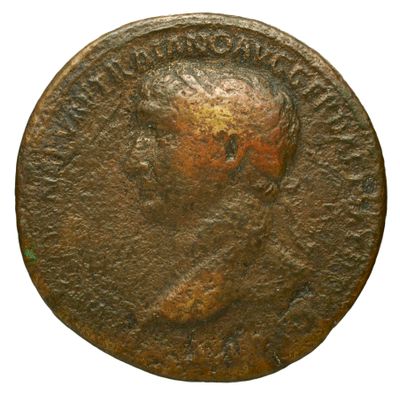
Sestertius, Rome
RIC II Trajan 530 · 103 AD-111 AD
For collectors, portrait quality drives price. A Trajan denarius with a well-struck, fully centred portrait (hair detail visible, jaw defined, wreath leaves distinct) commands a premium over a flat or off-centre strike of the same type. On sestertii, where the larger flan permits more detail, the portrait is the primary selling point: a sestertius with a weak portrait and decent reverse sells for less than one with a sharp portrait and average reverse. The market is buying the face.
The Dacian Wars Series
This is the centrepiece of Trajanic numismatics. The two Dacian Wars (fought in 101–102 and 105–106 AD) produced a commemorative coinage that stands alongside the Augustan SIGNIS RECEPTIS types and the Constantinian commemoratives as among the most historically significant issues in the Roman imperial series. The imagery parallels the roughly 190-metre spiral frieze on Trajan’s Column in Rome, which depicts the campaigns in carved relief. Collectors sometimes call these "the column in miniature," and the comparison is not fanciful: the same iconographic programme (captives, trophies, Victoria, the mourning province) appears on both.12
The First Dacian War (101–102)
Decebalus, king of Dacia, had been a persistent threat on the Danube frontier since the reign of Domitian. He had defeated Roman armies, extracted tribute payments, and built a fortified kingdom in the Carpathian Mountains centred on his capital at Sarmizegetusa Regia.3 Trajan launched his first campaign in the spring of 101 with a force of perhaps 100,000–150,000 troops: legions, auxiliaries, and allied contingents. After hard fighting in the Transylvanian passes, a decisive Roman victory at Tapae, and an advance on Sarmizegetusa, Decebalus sued for peace in 102.
The initial commemorative types are relatively restrained. Victory crowning a trophy. The emperor on horseback spearing a Dacian. These appear on denarii and sestertii dated by the tribunician power to 102–103. The title DACICVS enters the obverse legend (Trajan is now "conqueror of the Dacians") but the reverse imagery does not yet show the full triumph. The war was won; the victory was not yet permanent.
The Second Dacian War (105–106)
Decebalus violated the peace terms almost immediately: rearming, rebuilding fortifications, raiding Roman territory.5 Trajan returned in 105 with a larger army. This time there would be no negotiated settlement. In 106, Sarmizegetusa fell after a siege. Decebalus fled and, cornered by Roman cavalry, cut his own throat rather than submit to capture. The scene is carved on Trajan’s Column. His severed head was brought to Rome and displayed on the steps of the Capitol.5
Dacia became a Roman province. Its gold mines (the richest in the empire) came under Roman control. Ancient sources report that Trajan’s Dacian triumph brought back 500,000 pounds of gold and 1,000,000 pounds of silver, figures preserved by the sixth-century writer Joannes Lydus, which may be exaggerated but that even at a fraction of their stated value represent an enormous influx of bullion.5 The building programme that followed ( Forum Traiani, the Markets of Trajan, Trajan’s Column) was funded with Dacian treasure. So were many of the coins collectors handle today: Dacian gold, melted and restruck as Roman aurei and denarii.
The coins themselves
The commemorative types from the Second Dacian War are some of the most collected coins of the second century. The principal types:
DAC CAP. Dacia Capta, "Dacia captured." A seated Dacian captive, usually male, in native dress (the distinctive Dacian peaked cap, loose trousers), slumped beside a trophy of captured arms.1 This appears on denarii, sestertii, and asses. The sestertius version is the most visually impressive, the large flan accommodates the full scene. Expect $150–400 for a denarius in VF, $500–2,000 for a sestertius depending on portrait quality and patina. The type echoes the AEGVPTO CAPTA and IVDAEA CAPTA reverses of earlier reigns, placing Trajan’s conquest in an established iconographic tradition.
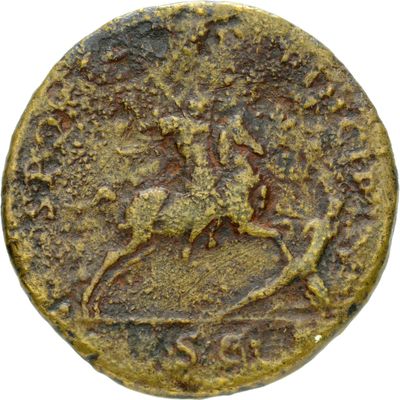
Sestertius, Rome
RIC II Trajan 536 (sestertius) · 103 AD-111 AD
Victoria writing on a shield. Victoria seated, inscribing a shield set on a trophy, sometimes with a captured Dacian seated below. The legend varies: S P Q R OPTIMO PRINCIPI is the standard form. A common denarius type, $80–250 in VF. The best-struck examples show the individual letters Victoria is inscribing, a level of die-cutting precision that repays close examination.

Denarius, Rome
RIC II Trajan 377 · 98 AD-117 AD
Trophy of Dacian arms. A tall trophy (a wooden frame draped with captured armour, shields, and the distinctive Dacian falx (curved sword)) flanked by bound captives. Struck on sestertii and denarii. The falx is a telling detail: the weapon was so effective against Roman troops that Trajan modified legionary helmets with cross-braces to protect against its downward strike.3 A trophy denarius in VF runs $120–350.
The Danube bridge. A rare type showing the great stone bridge that Apollodorus of Damascus designed across the Danube for Trajan’s second invasion. The bridge appears as a reverse type on sestertii, it was the longest bridge in the ancient world and a feat of engineering that Cassius Dio describes in detail.5 Sestertii with this type are scarce and expensive: $2,000 or more when they appear.
Denominations and Metals
The Trajanic monetary system inherited the Augustan framework with only modest adjustments. Gold, silver, and base metal circulated in fixed denominational relationships, and Trajan maintained the system’s integrity more faithfully than many of his successors.
At the top, the gold aureus: approximately 7.2g of high-purity gold, struck at approximately 45 to the Roman pound, lighter than the Augustan standard of 40 to the pound, reflecting Nero’s reduction in 64 AD that Trajan continued.9 One aureus equalled 25 silver denarii. The denarius, about 3.4g, at roughly 89–93% silver, remained the backbone of the monetary system: the denomination that paid soldiers and settled debts across three continents.9 Walker’s metrology confirms that Trajanic denarii held this purity range consistently, resisting the debasement that would accelerate under the Severans a century later.
Below the denarius sat the base metal coinage. The sestertius, in orichalcum (yellow brass), was worth four asses and weighed 25–28g on broad flans up to 34mm across. Trajanic sestertii are among the finest in the Roman series, the large module and careful die-cutting allowed portraits and reverse scenes of remarkable detail. A good sestertius with sharp portrait and natural green or brown patina is one of the most satisfying Roman coins to own at any price.
The dupondius, also orichalcum, was worth two asses. The emperor appears radiate (wearing a crown of rays) rather than laureate, the radiate crown being the visual marker that distinguished the dupondius from the as without having to weigh it. The copper as carried a laureate portrait and weighed roughly 10–12g. Below the as, the semis and quadrans existed but were struck infrequently under Trajan and are scarce on the market.
Gold and silver quinarii (half aureus and half denarius) were produced in limited numbers. Trajan also struck cistophori (large silver pieces on the reduced Attic standard) for circulation in Asia Minor, though these are uncommon and expensive when they appear.
| Denomination | Types in catalog |
|---|---|
| Denarius | 392 |
| Sestertius | 180 |
| Aureus | 167 |
| As | 134 |
| Dupondius | 76 |
| Quinarius | 40 |
| Quadrans | 18 |
| Quinarius Aureus | 16 |
| Semis | 13 |
| Cistophorus | 10 |
Where the Coins Were Made
Trajanic coinage is dominated by Rome. Unlike the late empire, where dozens of mints operated simultaneously, the second-century monetary system was centralised. Rome struck the vast majority of gold, silver, and base metal coinage. A small number of eastern workshops contributed, but their output was modest compared to the capital.1
Rome was the primary mint for all denominations and all metals throughout the reign. Virtually every denarius and aureus a collector encounters will be a Rome product. The mint’s output was organised and disciplined: die studies by Woytek have identified officina sequences and die linkages that allow precise chronological ordering within the reign.2 The quality of the die work is consistently high, though as with any large mint operation, individual dies range from superb to perfunctory.
Eastern mints are less clearly defined. Some Trajanic coins bear stylistic features (flan shape, letter forms, portrait handling) that suggest production outside Rome, perhaps at Antioch or another eastern workshop. The attribution of these eastern issues remains debated. Strack argued for a systematic eastern mint;7 more recent scholarship treats many of these attributions cautiously. For collectors, the practical consequence is straightforward: when a dealer labels a Trajan denarius "eastern mint" or "uncertain mint," the attribution reflects genuine ambiguity in the evidence, not a gap in the dealer’s knowledge.
Trajan also struck provincial coinage, coins produced at local mints in the eastern provinces under Roman authority but following local weight standards and sometimes using Greek legends. These include tetradrachms from Antioch and Tyre, drachms from various eastern cities, and bronze issues from dozens of provincial mints. Provincial coins are covered in Roman Provincial Coinage volumes, not in RIC, and represent a parallel collecting field. Some are affordable ($30–100 for common bronzes), others are rare and expensive. The silver tetradrachms from Antioch are particularly handsome and available for $100–400 in decent condition.
| Mint | Types in catalog |
|---|---|
| Rome | 1,036 |
Key Types to Know
Beyond the Dacian Wars commemoratives covered above, Trajan’s coinage includes a range of historically significant reverse types that collectors should recognise. These are the types that appear most frequently at auction and in dealer stock, along with a few scarcer issues that reward collectors who watch for them.
OPTIMO PRINCIPI types
The legend S P Q R OPTIMO PRINCIPI ("The Senate and People of Rome to the Best of Rulers") became the standard reverse formula from about 103 AD.1 It appears with dozens of different reverse designs: Victory, Pax, Felicitas, Abundantia, Hercules, Genius, military trophies. The formula itself is the constant. When dating a Trajan coin, the presence of OPTIMO PRINC or the full formula places it after 103.
The Alimenta programme
Trajan established the alimenta, a state-funded programme providing food subsidies for poor children in Italian towns, financed through low-interest loans secured against agricultural land.6 Pliny the Younger describes the scheme in his Panegyricus. The coinage commemorates it: reverse types show the emperor distributing food to children or a personified Italia nursing an infant, with legends referencing ALIM ITAL.1 These types are not common among denarii but appear on sestertii, where the scene is rendered with the detail the large flan permits. A sestertius with the Alimenta type in VF runs $400–1,200.
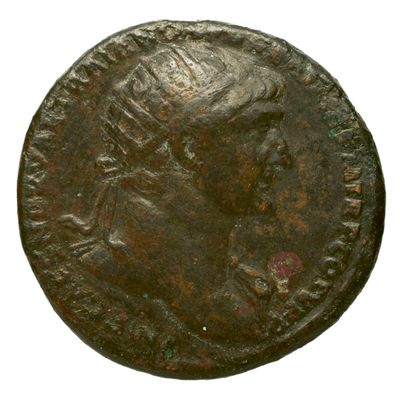
Dupondius, Rome
RIC II Trajan 470 · 103 AD-111 AD
Trajan’s Column and Forum
The Forum of Trajan (designed by Apollodorus of Damascus and funded with Dacian war spoils) was the largest and most splendid of the imperial fora. It included the Basilica Ulpia, two libraries (Greek and Latin), and Trajan’s Column at the centre. The coinage depicts the column on sestertii: a tall spiral column on a high base, topped by a statue of the emperor, with the carved frieze visible as bands circling the shaft.8 These architectural types are scarcer and more expensive than the standard military reverses: $500–2,500 for a sestertius in VF, more for a sharp strike that renders the column’s detail.
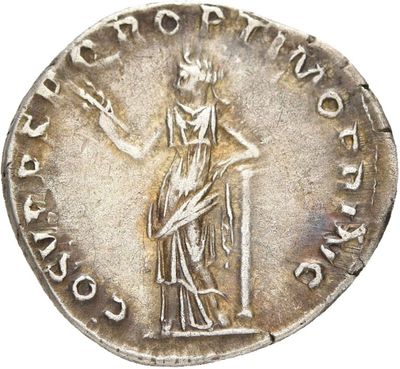
Denarius, Rome
RIC II Trajan 120 · 103 AD-111 AD
The Parthian Campaign types
The last major series of Trajan’s reign. In 114 AD, Trajan invaded Armenia; in 115 he pushed into Mesopotamia; in 116 he took Ctesiphon, the Parthian capital, and reached the Persian Gulf.5 The coins celebrate these achievements with types that are among the most geographically specific in Roman numismatics:
REX PARTHIS DATVS, "A king given to the Parthians." Trajan installed Parthamaspates as a client king on the Parthian throne. The type shows Trajan seated on a platform, crowning the kneeling Parthian king.1 A remarkable coin: one emperor deciding the ruler of another empire. Denarii with this type in VF run $200–600 and are scarcer than equivalent Dacian types because the Parthian campaign lasted only three years.
ARMENIA ET MESOPOTAMIA IN POTESTATEM P R REDACTAE, a long legend that required the full exergue and field to render. The type shows Trajan standing between personifications of Armenia and Mesopotamia, the Euphrates and Tigris as river gods at his feet. Appears on denarii, aurei, and sestertii. The sestertius version is one of the most iconographically dense Roman coins produced.4
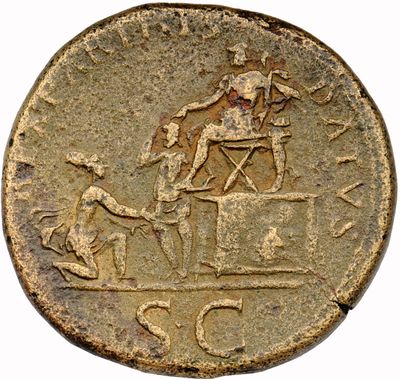
Sestertius, Rome
RIC II Trajan 667 · 114 AD-117 AD
The Parthian types carry a particular poignancy. Within a year of Trajan’s death, Hadrian abandoned every province his predecessor had conquered east of the Euphrates. The coins commemorate an empire at its peak, a peak that lasted roughly two years.
Other reverse types
Abundantia / Annona. Personification of the grain supply, standing with corn ears and cornucopia. Reflects Trajan’s attention to Rome’s food supply, he expanded the harbour at Ostia. Common on denarii, $70–200 in VF.
Pax. Peace standing, olive branch and cornucopia. A standard type produced throughout the reign. $60–180 in VF. Often well-struck, making it a good starter coin for Trajan collectors.
Hercules. Trajan associated himself with Hercules, the divine hero who civilised the world through labour, an appropriate model for an emperor who expanded the empire through personal campaign.6 Hercules types show the hero with club and lion skin or standing in a temple. Less common than Victory or Pax types, $100–350 for a denarius.
Divus Traianus Pater. Coins honouring Trajan’s biological father, deified posthumously. These carry the legend DIVVS PATER TRAIAN and show the elder Trajan’s portrait. Not to be confused with coins of the emperor himself, the legend is the key.1
Plotina and Marciana. Trajan struck coins for his wife Plotina and his sister Marciana. These female portrait coins are scarcer than the emperor’s own issues and command premiums: $300–800 for a Plotina denarius in VF, more for Marciana.
The Restored Coins
Among the most numismatically curious issues of Trajan’s reign is the "restored coins" series: a programme of re-striking coins from predecessors going back to Augustus. Trajan issued denarii reproducing the obverse portraits and reverse types of deified earlier emperors, with the addition of REST or IMP CAES TRAIAN AVG GER DAC P P REST in the legend, indicating that Trajan had "restored" the issue.11
The series covers an extraordinary range. Komnick’s study catalogues restored issues for Augustus, Tiberius, Claudius, Galba, Otho, Vitellius, Vespasian, Titus, and Nerva.11 Each reproduces the original design with enough fidelity to be recognisable, but the die style is clearly Trajanic, the technique of a second-century workshop reproducing a first-century model.
Why did Trajan do this? The restored coins series served multiple purposes. It was an act of dynastic legitimation, placing Trajan in a lineage stretching back to Augustus while pointedly skipping Nero and Domitian, the two emperors whose memory the Senate had condemned (damnatio memoriae). It was numismatic antiquarianism, a collector’s instinct expressed through imperial authority. And it may have served a practical monetary function, replacing worn coins of earlier reigns with fresh issues.11
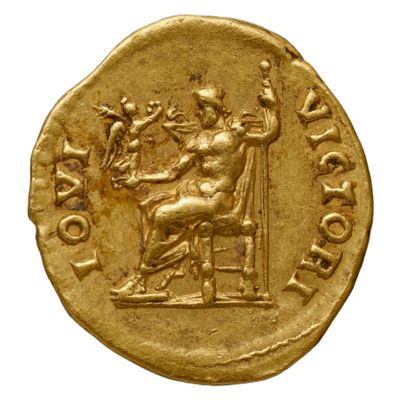
Denarius, Rome
RIC II Trajan 251 · 112 AD-114 AD
For collectors, the restored coins are uncommon and prized. Most are scarcer than standard Trajanic denarii, and the cross-period appeal (a coin that shows both Trajan and Augustus, for instance) drives demand from collectors of both reigns. Expect $400–1,500 for a restored denarius in VF, depending on which emperor is being "restored." The Augustus and Vespasian restorations tend to command the highest prices.
Identifying Your Coin
You have a coin (Trajan or possibly Trajan) in front of you, and need to pin down what it is. Here is the sequence that works.
Confirm it is actually Trajan. This sounds straightforward. It can catch you. Trajan’s portrait can resemble his adoptive father Nerva on worn coins (both laureate, similar profile, though Nerva is thinner-faced and older). More commonly, collectors confuse Trajan with Hadrian, but Hadrian is bearded, which solves it once you look. The obverse legend separates them:
- IMP CAES NERVA TRAIAN AVG GERM, early reign (98–c. 101), retaining Nerva’s name
- IMP CAES NERVA TRAIAN AVG GER DAC (after the First Dacian War (from 102)
- IMP TRAIANO AVG GER DAC P M TR P) mature reign, with tribunician power; the most common formula
- IMP CAES NER TRAIANO OPTIMO AVG GER DAC, late reign, after the Optimus title (c. 114–117)
The progression of titles tells you the approximate date. More titles means later. The consulship number narrows it further: COS II (98–99), COS III (100), COS IIII (101–102), COS V (103–111), COS VI (112–117). Combined with the tribunician power number (TR P through TR P XXI), these provide year-level dating for many issues.1
Determine the denomination. Gold, roughly 19–20mm and 7.0–7.5g: aureus. Silver, roughly 18–19mm and 3.0–3.6g: denarius. Large brass, ~33–34mm and 25–28g: sestertius. Smaller brass, ~27–28mm, radiate crown: dupondius. Red copper, ~25–27mm, laureate: as. The metal and size narrow the field before you read the reverse.
Read the reverse. Match the type against the series in this guide. Check the reverse legend, S P Q R OPTIMO PRINCIPI is the most common formula from 103 onward; earlier types use COS II through COS IIII as the reverse legend or P M TR P COS [number] P P.
Look it up. The printed reference is RIC II (Mattingly and Sydenham, 1926), organised by denomination and then by reverse type.1 Woytek (2010) provides a more detailed and current treatment, but is expensive and less accessible.2 Online, OCRE provides free searchable access to the RIC data with images. Or search NumisLens Coin Identification, which covers Trajanic types and can narrow to a reference from a legend fragment and reverse type.
Collecting and Market
Trajan sits at a favourable position in the market: historically significant, visually strong, and priced below comparable Augustus or Nero material. The denarii are accessible. The sestertii are among the finest in the Roman series. And the historical themes (wars, conquests, building programmes, social welfare) give any collection built around Trajan a narrative coherence that random accumulation never achieves.
Price reference
The table below consolidates current market ranges for the main Trajan coin denominations. Prices reflect recent auction results and dealer stock from CNG, Roma Numismatics, VCoins, and acsearch.info. All ranges assume authentic coins with no damage, cleaned or tooled examples sell for less.
| Denomination | Fine (F) | Very Fine (VF) | Extremely Fine (EF) | Notes |
|---|---|---|---|---|
| Aureus (gold) | : | $5,000–8,000 | $10,000–25,000+ | Common types from $5K; Dacian/Parthian themes at premium |
| Denarius (common types | $40–80 | $80–200 | $300–800 | Victory, Pax, Virtus reverses most available |
| Denarius) Dacian Wars types | $80–150 | $150–400 | $400–1,000 | DAC CAP, captive, trophy types; strong collector demand |
| Denarius (Parthian types | $100–200 | $200–600 | $500–1,500 | Scarcer; REX PARTHIS DATVS and province types |
| Denarius) restored coins | $200–400 | $400–1,500 | $1,000–3,000+ | Scarce; premium varies by which emperor is restored |
| Sestertius | $100–250 | $250–1,000 | $1,000–3,000+ | Patina and portrait quality drive price more than wear |
| Dupondius / As | $20–60 | $60–200 | $200–500 | Good value; same reverse types as denarii on affordable metal |
| Provincial tetradrachm (Antioch) | $50–100 | $100–400 | $400–1,000 | Large silver; attractive and undervalued relative to denarii |
These ranges reflect the market as of early 2026. Condition grading is inconsistent across dealers, one shop’s VF is another’s gF. Always examine the specific coin, not just the grade label. For denarii, centering and legend completeness matter as much as wear grade. For sestertii, patina colour and the absence of tooling marks are the real price movers.
Getting started, under $300
Buy one good denarius. The Dacian captive or Victoria-writing-on-shield types are the natural first choices: historically significant, visually strong when the strike cooperates, and available enough that you can be selective. Spend $120–250 on a VF with complete legends and a centred portrait from a reputable dealer. Handle it. Read the legends letter by letter. Then add an as or dupondius at $30–80 to see the same emperor on a different metal.
Building depth, $500–2,000
Now you can be selective. Two approaches that give the collection structure:
The Dacian Wars set. A denarius with captive type, a denarius with Victoria and trophy, and a sestertius with any Dacian theme. Three coins telling the story of Rome’s last great conquest. Budget: $400–1,200 depending on sestertius quality.
The chronological set. One coin from each of the three reign phases: an early COS II or COS III denarius, a Dacian Wars commemorative, and a Parthian campaign type. Three coins tracking the arc of the reign from cautious inheritance to overextension. Budget: $300–900.
The premium path
EF denarii run $300–800 for common types and climb past $1,000 for Dacian or Parthian themes with strong centering. What you pay for at this level: individual hair strands on the portrait, complete legends to the rim, traces of original lustre on the surfaces. A restored coins denarius in VF or better reaches $500–1,500 and offers dual-ruler appeal.
Sestertii enter the picture seriously at $500 or more. A Trajan sestertius with a good portrait, natural patina, and a legible reverse is one of the most satisfying coins in the Roman series. The large flan rewards examination under magnification, details that disappear on denarii reveal themselves on the sestertius. Prices for high-grade Trajanic sestertii have climbed steadily since 2015; the best examples at CNG and Roma now bring $3,000–8,000.
Gold enters at $5,000 or more. Common Trajan aurei (Victory types, Dacian themes) appear at the major auction houses several times a year. Verify weight before committing: an aureus should land close to 7.2g, and more than 0.3 grams off warrants scrutiny. Trajan gold gets faked regularly enough that due diligence is not optional.
Where to buy
CNG (Classical Numismatic Group), biweekly e-auctions and quarterly feature sales. Strong in second-century material. Their photographic archive makes useful study material even when you are not buying.
Roma Numismatics and Leu Numismatik, high-end ancients, strong photography, detailed descriptions. Expect market price or above, but the material is genuine and well-documented.
VCoins and MA-Shops, fixed-price platforms with vetted professional dealers. Good for filling specific gaps at known prices.
NAC and Nomos, Swiss houses that handle museum-quality ancients. For sestertii and gold above $3,000.
Heritage Auctions, the largest US bidding pool for ancients. Roman material in their world coin sales.
Fakes and cautions
Trajan denarii are faked, though less aggressively than Augustan material because the average sale price is lower. Cast copies (soft detail, porous surface, sometimes a visible rim seam) circulate on eBay and at flea markets. Die-struck counterfeits exist for the more expensive types (Dacian War sestertii, aurei). Your defences: buy from dealers with return policies, compare the die to confirmed examples on OCRE or in CNG’s archive, and be sceptical of prices significantly below market. If a sharp sestertius is offered at half the auction average, something is likely wrong.
Tooling is a concern on sestertii. A sharp instrument re-cuts worn legends or portrait details to simulate a higher grade. Look for scratches that follow letter forms with suspicious precision, or features sharper than the surrounding surface would justify. Artificial patina (applied to hide cleaning damage or tooling) is another warning sign: genuine patina builds unevenly and has depth; artificial patina sits uniformly on the surface.
Start Your Trajan Collection
Track your coins, record attributions, and build a searchable cabinet. NumisLens handles cataloguing, insurance exports, and price tracking so you can focus on the collection.
Create Your CabinetQuestions Collectors Ask
How much are Trajan coins worth?
Common denarii (Victory, Virtus, Pax reverses) sell for $80–200 in VF from reputable dealers. Dacian Wars types command a premium: $150–400 for a well-centered example. Sestertii in decent condition start around $200 and climb past $1,000 for sharp portraits. Gold aurei begin at roughly $5,000.
Are Trajan coins rare?
As a group, no. Trajan ruled for nearly twenty years and Rome’s mint was prolific. Common denarius types appear regularly at auction. But specific types can be genuinely scarce: the restored coins series, certain Parthian campaign types, and the large architectural sestertii survive in smaller numbers.
How do I identify a Trajan coin?
Start with the portrait: strong jaw, short military hair, laureate. Read the obverse legend: look for IMP TRAIANO AVG GER DAC or IMP CAES NERVA TRAIAN AVG. Check the denomination by metal and size. Then cross-reference with RIC II or search OCRE online.
What is the most famous Trajan coin?
The DAC CAP sestertius showing a mourning Dacian captive beside a trophy of arms, commemorating the annexation of Dacia in 106 AD. Sestertii with this type in VF sell for $500–2,000. The denarius version is more affordable at $150–400.
What does Optimus Princeps mean on coins?
"Best of Rulers", a title unique to Trajan. The reverse legend OPTIMO PRINC appears from about 103 AD; the Senate formally bestowed Optimus as a cognomen around 114 AD. No other emperor received this distinction. Later emperors were wished to be "better than Trajan" as the highest possible compliment.
What catalog should I use?
RIC II (Mattingly and Sydenham, 1926) is the traditional reference. Woytek (2010) is the modern scholarly treatment, based on die studies. Online, OCRE gives free searchable access to the RIC data.
What are the Dacian Wars coins?
Coins commemorating Trajan’s two campaigns against the Dacians (101–102 and 105–106 AD). Types include DAC CAP showing captives, Victoria writing on a shield, and trophies of Dacian arms. The imagery parallels Trajan’s Column. Dacian Wars denarii sell for $100–400 in VF.
Where should I buy?
CNG, Roma Numismatics, and Leu for auction. VCoins and MA-Shops for fixed-price from professional dealers. NAC and Nomos for top-end material. Heritage Auctions for the largest US bidding pool. Start with established dealers rather than eBay.
References
Sources cited throughout this guide. For a full bibliography of Trajanic numismatics, see the introduction to Woytek (2010).2
- Mattingly, H. & Sydenham, E.A. (1926). The Roman Imperial Coinage, Volume II: Vespasian to Hadrian. London: Spink.
- Woytek, B. (2010). Die Reichsprägung des Kaisers Traianus (98–117). Moneta Imperii Romani 14. Vienna: Verlag der Österreichischen Akademie der Wissenschaften.
- Bennett, J. (1997). Trajan: Optimus Princeps. London: Routledge.
- Sear, D.R. (2002). Roman Coins and Their Values, Volume II: The Accession of Nerva to the Overthrow of the Severan Dynasty. London: Spink.
- Cassius Dio, Roman History, Books 68–69. Trans. Cary, E. (1925). Loeb Classical Library, Harvard University Press.
- Pliny the Younger, Panegyricus. Trans. Radice, B. (1969). Loeb Classical Library, Harvard University Press.
- Strack, P.L. (1931). Untersuchungen zur römischen Reichsprägung des zweiten Jahrhunderts, Teil I: Die Reichsprägung zur Zeit des Traian. Stuttgart.
- Smallwood, E.M. (1966). Documents Illustrating the Principates of Nerva, Trajan and Hadrian. Cambridge University Press.
- Walker, D.R. (1976–1978). The Metrology of the Roman Silver Coinage, Parts I–III. BAR Supplementary Series 5, 22, 40. Oxford.
- Hill, P.V. (1970). The Dating and Arrangement of the Undated Coins of Rome, AD 98–148. London: Spink.
- Komnick, H. (2001). Die Restitutionsmünzen der frühen Kaiserzeit: Aspekte der Kaiserlegitimation. Berlin: Walter de Gruyter.
- Strobel, K. (2010). Kaiser Traian: Eine Epoche der Weltgeschichte. Regensburg: Verlag Friedrich Pustet.
Further resources
- NumisLens Trajan Catalog, browse all 1,046 types with images and catalog references.
- Trajan: Emperor Profile, reign dates, dynasty, coinage timeline, key events.
- NumisLens Coin Identification, search by legend, denomination, and reverse type for attribution of Trajanic types.
- OCRE (Online Coins of the Roman Empire), searchable RIC database.
- Augustus Coins: A Historical Reference, the founding emperor’s coinage, a century earlier.
- Constantine I Coins: A Collector’s Reference, the empire transformed, two centuries later.
- Vespasian Coins, the Flavian founder, one dynasty before Trajan.
Identify Your Trajan Coins
Search by legend, denomination, and reverse type to reach a RIC reference. The catalog covers 838 Trajan types with images.
Try Coin Identification