The Constantinian Dynasty: Constantine the Great and His House
This house minted the most successful coin in Roman history. It also struck the cheapest real ancient coin a beginner can own, moved the capital east, and put the first Christian symbols on state money far more cautiously than the popular story claims — the solidus, the mass bronze, and the Christianisation that did not happen the way most people think.
The Constantinian dynasty ruled Rome from AD 306 to AD 363 — Constantine the Great, his sons Constantine II, Constans and Constantius II, and finally Julian. Its coinage introduced the gold solidus, the standard that outlasted Rome itself, brought the first Christian symbols onto state money, and struck the mass fourth-century bronze that still floods collector trays today.
Constantine's rise and the new capital
The Constantinian dynasty grows directly out of the system the Tetrarchy built and then tore apart. Constantine was acclaimed by the army at York in AD 306 on the death of his father Constantius Chlorus, fought his way through the collapsing four-emperor college, defeated Maxentius at the Milvian Bridge in 312 — the battle that later Christian tradition tied to a vision and the in hoc signo sign — and finally defeated Licinius in 324 to rule the whole empire alone. In 330 he dedicated Constantinople on the site of Byzantium, and that single decision reorganised the coinage map: a new senior eastern mint, a new political centre, and the beginning of the long divergence that ends in Byzantine money. The dynasty is the bridge page of the late Roman imperial series.
The succession after Constantine's death in 337 is the dynasty's darker theme, and the coinage records it. The army recognised only Constantine's sons; in the months that followed, the collateral male relatives — the half-brothers and nephews Dalmatius, Hannibalianus and their kin — were killed in a purge traditionally laid at the door of Constantius II, though the agency is debated. The empire was divided three ways between Constantine II, Constans and Constantius II, who promptly fought each other: Constantine II was killed invading Constans's territory in 340, and Constans was overthrown by the usurper Magnentius in 350. Constantius II's long sole reign followed, then Julian, whose death in Persia in 363 ended the bloodline and handed the throne, through the brief Jovian, to the Valentinianic house.
The solidus and the silver
The single most consequential coin in this entire reference is the gold solidus. Constantine introduced it in roughly AD 309–312, first at Trier, at about 4.5 grams and one seventy-second of the Roman pound, struck close to pure. It replaced Diocletian's heavier and less reliable aureus with a unit whose weight and fineness the state then held stable for an extraordinarily long time. In the standard scholarly reading the solidus remained the reserve standard of the Mediterranean for roughly seven centuries, passing without a break into the Byzantine nomisma — the through-line the Byzantine coinage hub picks up. No other Roman monetary decision had consequences on that timescale.
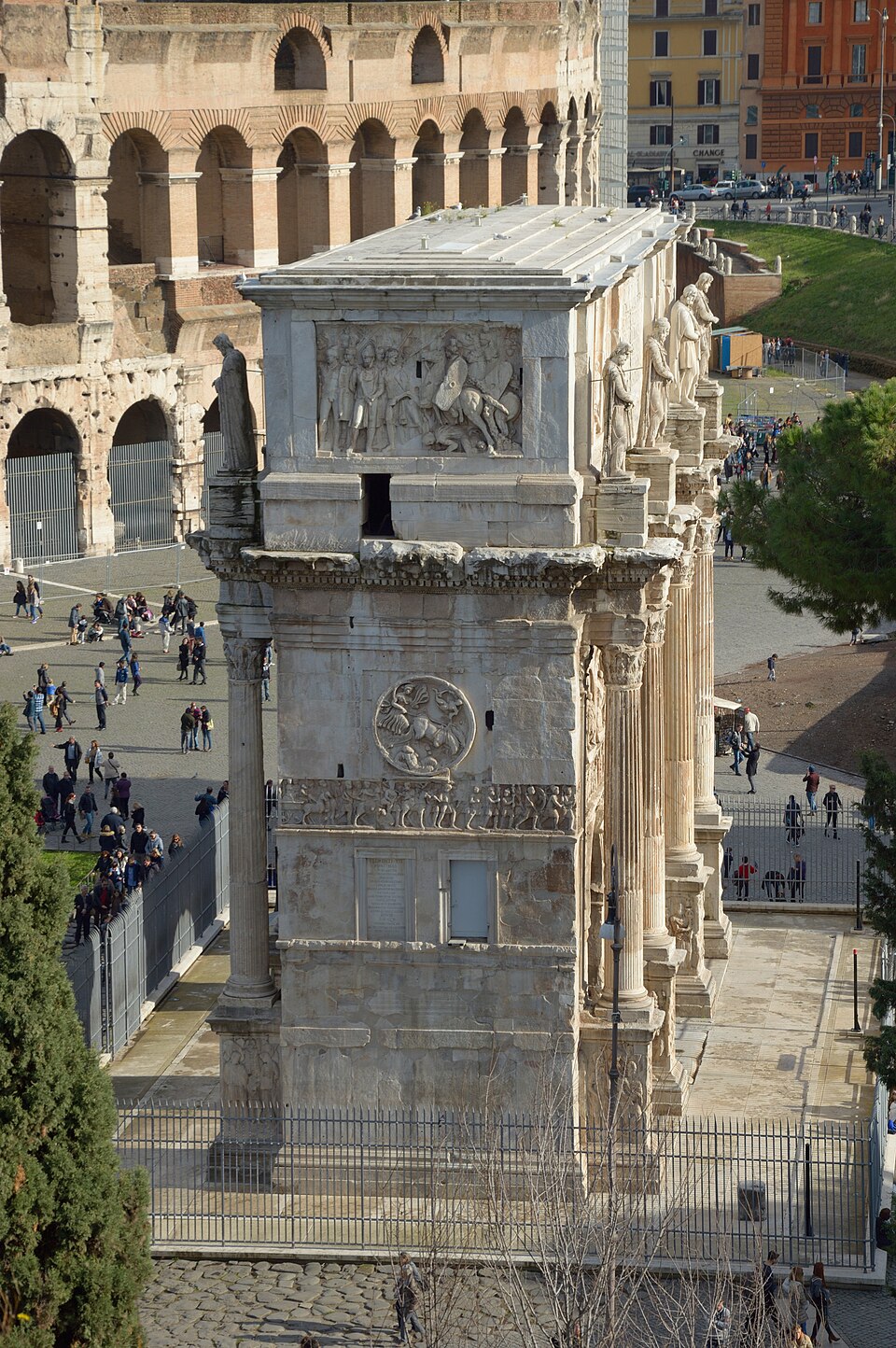
The Arch of Constantine, dedicated AD 315 beside the Colosseum, commemorating the victory at the Milvian Bridge — the regime whose solidus and follis reform this hub describes.
Photo: Livioandronico2013 — CC BY-SA 4.0, via Wikimedia Commons
The silver picture is one of replacement rather than continuity. The short-lived Tetrarchic argenteus fades early in the dynasty, and the late-Roman silver settles into two denominations: the small, thin siliqua and the heavier ceremonial miliarensis. The siliquae of Constantius II are the common collectible silver of the house — available, clearly attributable, and the natural silver target for a dynasty set. NumisLens does not yet carry dedicated siliqua or miliarensis facet pages, so those are described here rather than linked; the gold and bronze below do link straight into the catalogue.
The mass bronze
For all the importance of the solidus, the Constantinian dynasty is its bronze to most collectors, because that is what survives in the millions. The catalogue files this material under the reduced follis and its progressively smaller AE3 and AE4 successors, and the fourth-century reverse programmes are the most legible teaching series in Roman numismatics. They were struck in sequence, each across the whole mint network, and learning them is most of learning to attribute late-Roman bronze:
- GLORIA EXERCITVS — "the glory of the army", soldiers flanking first two standards, then (as the coin shrank) one. The single commonest type of the sons.
- VRBS ROMA and CONSTANTINOPOLIS — the paired commemorative city issues, the she-wolf and twins for Rome, Victory on a prow for Constantinople. Among the most popular single late-Roman types.
- FEL TEMP REPARATIO — "the restoration of happy times", most famously the "falling horseman", the fourth-century everyman bronze.
- VICTORIAE DD AVGG Q NN, SPES REIPVBLICE, GLORIA ROMANORVM — the later programmes as the module contracts toward AE4.
The mint signature in the exergue — mint abbreviation, officina letter, and field control marks — is fully mature by this period; rather than re-teach the whole system the Tetrarchic hub already covers, read it as the same grammar applied across an expanded network. The western mints ran at Trier, Lyon and Arles; the Italian and Balkan ones at Rome, Aquileia, Siscia, Sirmium and Thessalonica; the eastern ones at the new capital Constantinople, Nicomedia, Cyzicus, Antioch and Alexandria. Arles, Aquileia, Sirmium and Heraclea were equally active in the period but do not yet have NumisLens mint facets, so they are named here and not linked.
The dynasty, ruler by ruler
Seven rulers carry the dynasty from the Tetrarchy's wreckage to the pagan reaction of Julian. The portrait programme tracks the politics: Constantine's idealised, increasingly abstract diademed head; the near-identical youthful busts of the sons that make obverse legends necessary for attribution; and Julian's deliberate philosopher's beard, a coin-deep statement of the break he intended.
| Emperor | Reign | Numismatic note |
|---|---|---|
| Constantine I | AD 306–337 | The solidus; the new capital; the cautious Christogram. The Constantine I collector's guide goes deeper. |
| Constantine II | AD 337–340 | Long as Caesar, brief as Augustus; killed invading Constans's West. |
| Constans | AD 337–350 | FEL TEMP series; overthrown and killed by Magnentius. |
| Constantius II | AD 337–361 | The long reign; the falling-horseman bronze; the common collectible siliquae. |
| Magnentius | AD 350–353 | Usurper; the large Chi-Rho double-maiorina, a striking standalone type. |
| Julian | AD 361–363 | The pagan restoration; the SECVRITAS REIPVB bull bronze. A Tier-1 guide is queued. |
| Jovian | AD 363–364 | The brief transition into the Valentinianic house. |
The Constantinian women and Caesars belong to the story even though they did not rule: Helena and Fausta have collectible commemorative bronze, and the executed Crispus and the short-lived Caesars Dalmatius and Hannibalianus are scarce, historically charged issues. Describe them as what they are — family on the coinage, placed there to make a dynastic argument, exactly the technique the imperial series inherited from its first century.
The Christian question
This is the page's differentiated point, and it is worth stating plainly because the popular framing is wrong. Constantine is remembered as the first Christian emperor, and the inference most people draw — that his coinage is full of crosses — is not what the coins show. The overwhelming majority of Constantine's types are traditional: Victory, the camp gate, the army, and above all SOL INVICTVS, the unconquered sun, which stays on his coinage well into the 320s. The genuinely Christian pieces are comparatively rare: the Chi-Rho on a helmet or labarum, the Christogram in a wreath, and the famous and very scarce SPES PVBLIC of Constantinople showing the labarum spearing a serpent. The most pointedly Christian Constantinian coin is arguably posthumous — the VN MR consecration bronze, the veiled emperor in a quadriga reaching toward a hand from heaven. The accurate story is gradual and cautious Christianisation, and a collector who can explain it from the coins knows more than most sale catalogues.
Collecting and the market
No dynasty offers a better first ancient coin, which is exactly why the authentication problem here is not fakery but description. The coins are so cheap and so genuine that the distortion happens in the listing — inflated grades and "scarce" attached to types struck by the hundred million — so the figures below describe honestly graded, correctly common pieces, and the skill to learn first is reading the seller. GLORIA EXERCITVS and the VRBS ROMA / CONSTANTINOPOLIS commemorative AE3 and AE4 of the sons in Very Fine routinely sit in the low tens of dollars, the cheapest honest doorway into a real Roman coin. Choice Constantine I bronze with original silvering, the large Magnentius double-maiorina, and Julian's bull bronze move up into the low hundreds; Constantius II siliquae sit in the mid hundreds; and Constantinian solidi are firmly four to five figures, with the rare Christian-type bronze a connoisseur's rarity. A one-coin-per-ruler dynasty set in nice grade is one of the most satisfying inexpensive projects in the whole field, and it is precisely the kind of structured run — emperor, mint, RIC number, reverse legend — the NumisLens cabinet and insurance export are built to hold.
Two honest cautions. First, fourth-century bronze attribution lives or dies on the mint mark and the reverse legend, not the portrait, so condition language alone tells you little; learn the exergue. Second, the cheap end is heavily picked over and frequently over-graded online — "rare" almost never applies to GLORIA EXERCITVS. The standard references are Bruun's RIC VII and Kent's RIC VIII, with Kent's Roman Coins as background; the open tool is the ANS Online Coins of the Roman Empire, and the late-Roman continuity runs forward through the Valentinianic house toward the Justinianic East.
Questions
Who were the Constantinian emperors?
Constantine I "the Great" (306–337), his sons Constantine II (337–340), Constans (337–350) and Constantius II (337–361), and finally Julian (361–363). The usurper Magnentius and the transitional Jovian are conventionally bundled with the house.
What is the solidus?
The gold coin Constantine introduced around 309–312 at about 4.5 grams and one seventy-second of the Roman pound, close to pure. It held its standard for roughly seven centuries and passed unbroken into the Byzantine nomisma. See the Byzantine coinage hub.
Are Constantine's coins Christian?
Much less than popular history claims. Most use traditional Roman and SOL INVICTVS imagery; the Chi-Rho and labarum are comparatively rare. The cautious, gradual Christianisation is itself the interesting story.
What is FEL TEMP REPARATIO?
"The restoration of happy times", a mid-fourth-century bronze programme — most famously the "falling horseman". One of the most common ancient coins in existence and a classic first late-Roman bronze.
Why is fourth-century bronze so cheap?
It was struck in the hundreds of millions across the whole mint network and survives abundantly. Common Constantinian AE3 and AE4 in Very Fine cost less than a coffee — the most accessible authentic ancient coin there is.