The Flavian Dynasty: Vespasian, Titus, and Domitian
A general who took the throne by force and made his sons emperors after him — the Iudaea Capta victory coinage, the only Roman coin that shows the Colosseum, and a silver recovery that did not last. Three emperors, AD 69 to 96.
The Flavian dynasty ruled Rome from AD 69 to 96 — Vespasian and his sons Titus and Domitian. Emerging from the civil war of AD 69, Flavian coinage is defined by the Iudaea Capta victory series commemorating the Jewish War, the Colosseum sestertius of Titus, and a partial silver recovery after Nero's debasement.
Power taken, not inherited
The Flavians had a problem the Julio-Claudians never did: no blood claim to anything. When Nero's death opened the Year of the Four Emperors in AD 68 to 69, Galba, Otho and Vitellius burned through the throne in months, each funding the contest with hurried legionary coinage, before Vespasian — a competent, unglamorous general of undistinguished family — won the civil war outright. Founding a dynasty by force creates an immediate legitimacy deficit, and Flavian coinage is, more than anything, the instrument built to close it. The message split two ways: military success projected through the Iudaea Capta series, and restored stability projected through Pax and Roma types that told an exhausted empire the wars were over.
Vespasian's other answer was dynastic, and it was new. He engineered the first explicit father-to-son succession in Roman imperial history: his elder son Titus already ruled alongside him as Caesar, and the younger, Domitian, followed. The coinage works hard at this — paired portraits, family types, the sons named and titled while the father still lived — manufacturing the appearance of a natural ruling house where there had been a soldier and a lucky war. It held for a generation, within the broader Roman Imperial tradition the Julio-Claudians had set, until Domitian's assassination in AD 96 and the senatorial damnatio memoriae that followed ended the line and opened the adoptive Nerva–Antonine dynasty.
Iudaea Capta and the Colosseum
Two Flavian types carry the whole dynasty in collector terms. The first is Iudaea Capta, the most extensive victory- commemoration coinage Rome ever produced, struck across gold, silver and monumental bronze by all three emperors to mark the suppression of the First Jewish Revolt. The reverse is consistent and stark: a mourning Judaean captive, very often a seated woman, beneath a trophy or a palm, with a victorious emperor or a bound prisoner alongside, and the legend IVDAEA CAPTA or DEVICTA. It is the Roman side of a history whose Jewish side is the revolt shekels — the Judaean coinage hub carries that other half, and the two are best read together. The sestertii are among the most powerful objects in Roman numismatics; the silver denarii are the affordable way into the theme.
The second is singular. A sestertius of Titus shows the Flavian Amphitheatre — the Colosseum — rendered in elevation, tier on tier, the cavea filled with spectators, the surrounding monuments sketched around it. It is a near-photographic architectural record of the building whose dedication in AD 80 it commemorates, and it is one of the rarest and most expensive single Roman bronze types in existence; the finest specimens reach six figures, and even tired ones are major coins. Titus's brief reign also caught the eruption of Vesuvius in AD 79, and the relief and restoration coinage around both events gives a two-year reign far more numismatic weight than its length suggests. The exact catalogue number sits in the revised RIC II.1 of Carradice and Buttrey, which renumbered much of the Flavian series and is the reference to cite.
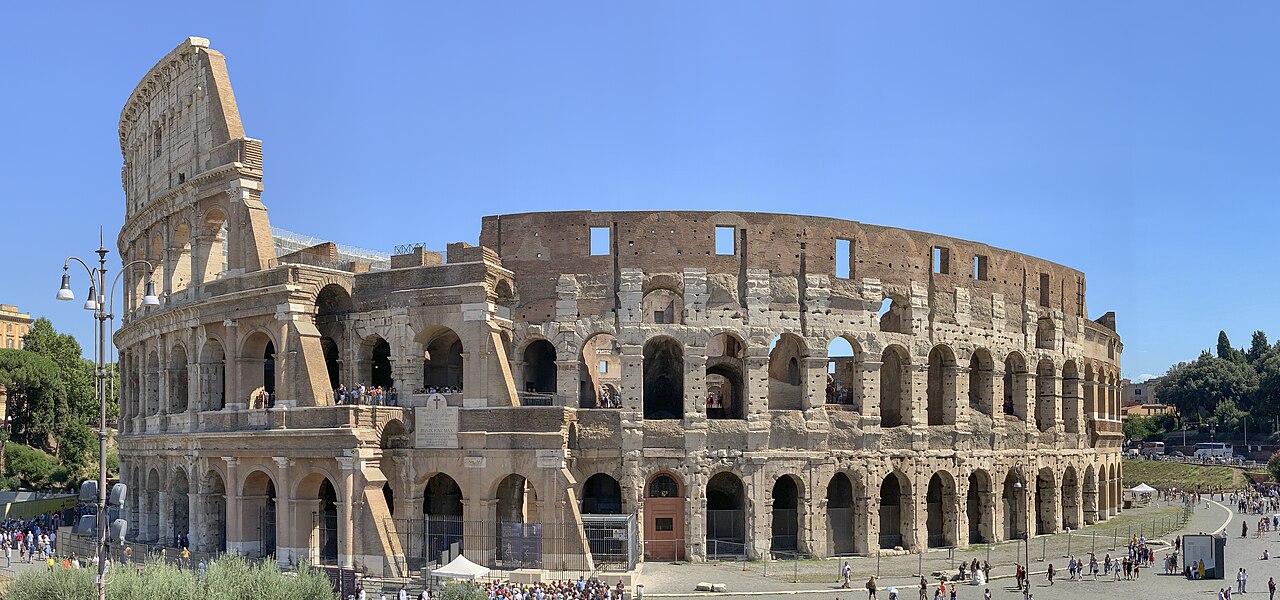
The Flavian Amphitheatre, begun under Vespasian and dedicated by Titus in AD 80 — the building struck on the Colosseum sestertius of Titus.
Photo: Nicholas Hartmann — CC BY-SA 4.0, via Wikimedia Commons
The silver, the portrait, the mints
The silver story is the one that matters structurally. Nero's reform of AD 64 had begun the long debasement, and Vespasian did not reverse it — the modern metallurgical work of Butcher and Ponting finds he held the debased post-Neronian standard rather than restoring fine silver. The genuine recovery is Domitian's: he raised the denarius to near-pure silver in AD 82, a deliberate confidence-signal, then let it fall back toward the Neronian level after about 85 under the ordinary pressure of paying for an empire. The Flavian period is therefore a brief, reversed recovery, not a fix: the trend Nero started resumes after the dynasty, and that is the honest way to describe it rather than as a restoration. The mint network behind it was Rome-centred — Rome dominant for the aureus, denarius and the SC sestertius alike — but Vespasian also ran an active eastern silver programme during the consolidation, at Antioch, Ephesus and a set of uncertain eastern mints whose attribution is still argued, plus the provincial tetradrachms of Alexandria. The uncertain-eastern-mint question is exactly the kind of specialist ground that separates a real reference from a thin one.
The portraiture is a deliberate political statement in itself. Vespasian's coin face is craggy, balding, honest, an old soldier's head — a calculated rejection of Neronian baroque idealism, the look of a man selling competence rather than glamour. Titus and Domitian are smoothed toward an idealised family style, but the resemblance is engineered to read as a dynasty. The Flavians also struck "restored" coinage — Titus and Domitian reissuing Julio-Claudian types, DIVVS AVGVSTVS and the rest — a legitimacy device that borrowed the prestige of the first dynasty and is now a distinct, collectable sub-series — a Titus "restored" DIVVS AVGVSTVS as is a different and scarcer thing from the original it copies, and the two are routinely confused by sellers who have not looked closely.
Domitian's fifteen years are the dynasty's most coherent single programme, and worth knowing in their own right. Minerva, his patron goddess, appears on very nearly every one of his denarii in four standardised reverse postures — learning the four Minerva types is the fastest route into attributing his silver. Around them sit the Germania Capta issues marking the Rhine campaigns, struck in the same captive-under-trophy grammar as his father's Iudaea Capta and clearly modelled on it, and the elaborate Secular Games (LVD SAEC) coinage of AD 88, a religious-revival series with sacrificial and ceremonial reverses that is a small specialist field of its own. Titus's two years, by contrast, are dominated by the Vesuvius-era restoration and relief coinage and by the Colosseum and amphitheatre types — a short reign that strikes far above its length because so much of it commemorated singular events.
The dynasty, ruler by ruler
A compact three-emperor house with an unusually strong narrative spine — civil war won, a wonder of the world built, a family condemned.
| Emperor | Reign | Numismatic note |
|---|---|---|
| Vespasian | AD 69–79 | Iudaea Capta founder; veristic portrait; the eastern silver programme. The Vespasian collector's guide goes deeper. |
| Titus | AD 79–81 | The Colosseum sestertius; the Vesuvius-era coinage; brief but heavy output. |
| Domitian | AD 81–96 | Minerva denarii; Germania Capta; damnatio reduced the surviving bronze. |
The three emperors immediately before the dynasty — Galba, Otho, Vitellius — are not Flavians; they are the AD 69 contest Vespasian won, and their short, scarce coinages are collected as the civil-war prelude to this hub.
Collecting and the market
A satisfying, compact dynasty to collect, and the Iudaea Capta theme gives it a strong spine that ties straight into biblical-coin demand. The entry coin is a common Vespasian or Domitian denarius in Very Fine, the piece most collectors buy first and the line everything dearer is judged against: common Vespasian and Domitian denarii in Very Fine run roughly the high tens to low hundreds; a Vespasian Iudaea Capta denarius is a few hundred to the high hundreds; an Iudaea Capta sestertius runs into the low thousands and well past it by condition; Flavian gold aurei are mid-thousands and up; and the Titus Colosseum sestertius is a five-to-six-figure rarity in any honest grade. Domitian's bronze is quietly undervalued because his reputation depresses demand — a legitimate value angle, stated honestly rather than as a sales line.
Two pointers. The Vespasian eastern-mint silver is a genuine specialist sub-field with live attribution debates — it is where depth of knowledge pays, and where a thin seller is exposed. And Iudaea Capta bronze is condition-driven to an extreme degree: the difference between a flat captive and a sharp one is the difference between a few hundred dollars and several thousand, so grade the reverse hard. The reference to own is the revised RIC II.1 of Carradice and Buttrey, with Hendin's Guide to Biblical Coins for the Iudaea Capta side and Carson's Coins of the Roman Empire for the background; the open tool is the ANS Online Coins of the Roman Empire, and the denomination history runs in full on the forthcoming Roman denarius guide.
Questions
Who were the Flavian emperors?
Vespasian (AD 69–79) and his sons Titus (79–81) and Domitian (81–96), who founded the dynasty after Vespasian won the civil war of AD 69 — the first explicit father-to-son imperial succession.
What is Iudaea Capta coinage?
The Vespasian/Titus/Domitian series marking the suppression of the First Jewish Revolt — a mourning Judaean captive under a trophy or palm. The bronze sestertii are spectacular; the silver denarii accessible. The Judaean coinage hub carries the Jewish side.
Is there really a coin of the Colosseum?
Yes — a sestertius of Titus showing the Flavian Amphitheatre in elevation, packed with spectators. One of the rarest and most valuable Roman architectural types; the finest reach six figures. Catalogued in the revised RIC II.1.
Why is Domitian's bronze scarce?
The post-assassination damnatio memoriae of AD 96 withdrew or defaced much of it, cutting the surviving population against a fifteen-year reign. His reputation also keeps modern prices below the coinage's quality — a real value angle.
Did the Flavians fix Nero's debasement?
Only partly, and not under Vespasian, who held the debased post-Neronian standard. Domitian raised the denarius to near-pure silver in AD 82, then let it fall back after about 85. A brief, reversed recovery — not a durable restoration; the decline resumes after the dynasty.