Judaean Coinage: Prutot, Shekels, and Iudaea Capta
This is two and a half centuries of small coinage from the Holy Land. It also carries some of the most contested identifications in numismatics — the aniconic bronze of the Hasmoneans, the Temple-tax silver of Tyre, the defiant shekels of the First Revolt, Rome's Iudaea Capta answer, the over-struck money of Bar Kokhba — so it is handled here with scholarship, not opinion.
Judaean coinage covers the issues struck in Judaea from the Hasmonean revolt against Seleucid rule (c. 135 BC) through the Bar Kokhba revolt (AD 132–135). It includes the small bronze prutot of the Hasmonean and Herodian kings, the procuratorial bronze of the Roman governors, the silver shekels of the First Jewish Revolt (AD 66–70), and the over-struck bronze and silver of Bar Kokhba. NumisLens does not yet catalogue this series; see Hendin and Meshorer below.
Before Judaea had its own coin
For most of the Second Temple period the silver that mattered in Jerusalem was not minted in Jerusalem. The Temple tax — the half-shekel each adult Jewish male owed annually, the obligation set out in Exodus 30:13 — had to be paid in a specific coin, and the coin the Temple authorities accepted was the Tyrian shekel: a silver piece of Tyre weighing about fourteen grams, in effect a tetradrachm on the Phoenician standard, struck from roughly 126 BC into the first century AD. It carries the head of the god Melkart and an eagle — openly pagan imagery — and the standard scholarly explanation, set out by David Hendin, is that the rabbinic authorities tolerated the imagery because the Tyrian coin held its silver fineness more reliably than any alternative. The same body of scholarship identifies the Tyrian shekel as, almost certainly, the "thirty pieces of silver" of Matthew 26:15. It is worth stating plainly that this is a scholarly identification rather than a thing the coins themselves say, and it is presented here as Hendin and the standard references present it.
The aniconic tradition
When Judaea did strike its own coinage it did something almost no other ancient state did: it left the people off it. The Hasmonean dynasty — the priestly house that came out of the Maccabean revolt against the Seleucid kingdom — issued only small bronze, the prutah, from the later second century BC. (Which Hasmonean struck the first Jewish coin, John Hyrcanus I or Alexander Jannaeus, is genuinely disputed among specialists; Meshorer's revisions moved the consensus more than once, and the honest answer is that it is unsettled.) What is not disputed is the iconography. The prutot carry cornucopias, palm branches, anchors, wreaths, helmets — no human or divine figures — and the standard reading is that this aniconism reflects the contemporary interpretation of the Second Commandment's prohibition on graven images. The everyday coin of Hasmonean and then Herodian Judaea was this small, deliberately imageless bronze.
One prutah, or rather one of its smaller fractions, carries more recognition than the entire rest of the series. The "widow's mite" of Mark 12:42 and Luke 21:1–4 is a lepton, and the collecting and scholarly tradition usually identifies it with the small bronze of Alexander Jannaeus (about 103 to 76 BC), the type with an eight-rayed star within a diadem on one side and an anchor on the other. It was the smallest coin available in the period, which is the entire point of the Gospel account, and it remains one of the most-collected ancient coins for exactly that reason. The Herodian kings continued the small bronze: Herod the Great kept to neutral devices, while later Herodians — Agrippa I, struck around AD 37 to 44 — were the first to put extensive imperial portraiture on Judaean coinage.
Rome's coin in the Temple courts
Between and around the Herodian tetrarchies, Judaea was governed directly by Roman prefects and procurators, and from AD 6 to 66 a series of those governors struck their own small bronze prutot in the province. Most are unremarkable. One is not. Pontius Pilate, prefect of Judaea around AD 26 to 36, struck prutot dated to the sixteenth through eighteenth regnal years of Tiberius — roughly AD 29 to 31 — and the best-known type shows the lituus, the curved augur's wand of Roman state religion, with three ears of grain on the other face. Josephus reports that Roman religious symbolism on objects in and around Jerusalem caused real political offence, and numismatists generally read the lituus coinage in that context. The claim about the offence is given here as Josephus gives it; the coin itself is simply a dated procuratorial bronze that happens to carry a pagan priestly emblem into a city that did not want it there. These governors' coins sit alongside the wider Roman provincial bronze of the eastern cities.
Two revolts and a defeat
The two Jewish revolts produced the most historically charged coinage of the ancient Near East, and it should be described in the terms the standard references use rather than editorialised. The First Jewish Revolt, AD 66 to 70, produced the first independent Jewish silver coinage: a shekel of about fourteen grams with three pomegranates and the legend "Shekel of Israel" on one side and a chalice with the revolt year — Year 1 through Year 5 — on the other, plus a half-shekel and a range of bronze prutot. The Temple was destroyed in AD 70, the fourth year of the revolt; the Year 5 coins, struck as the revolt collapsed, are among the great rarities of all ancient numismatics. Rome's response was its own coinage. The Roman Imperial IVDAEA CAPTA series — struck by Vespasian, by Titus who took Jerusalem, and continued under Domitian — shows a mourning Judaea seated beneath a trophy or a palm, and is the most extensive victory-commemoration coinage Rome ever produced.
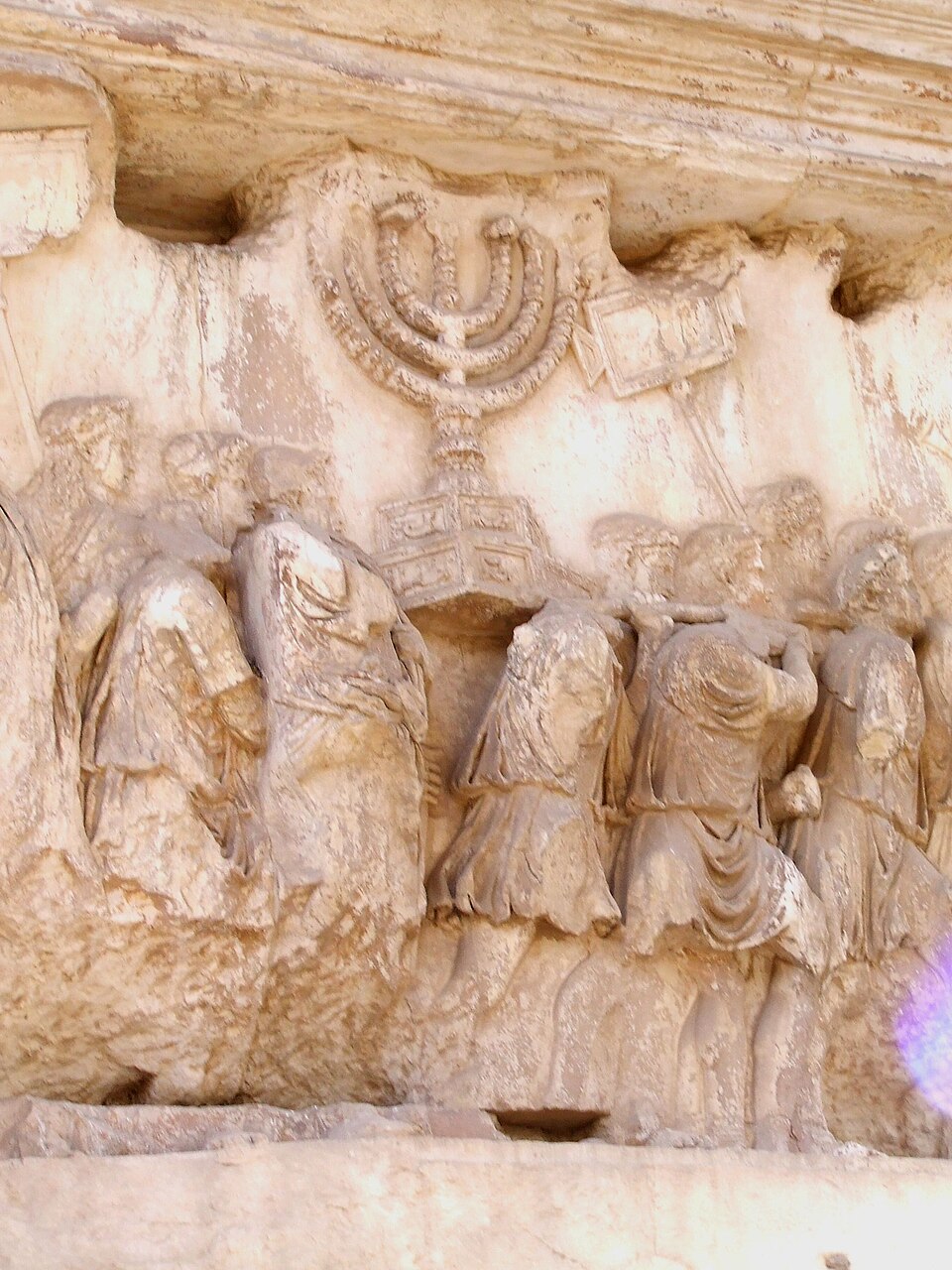
The spoils of the Jerusalem Temple — the menorah, the silver trumpets, the showbread table — carried in Titus's triumph. Relief inside the Arch of Titus, Roman Forum, dedicated c. AD 81.
Photo: Laurel Lodged — Public domain
The Bar Kokhba revolt of AD 132 to 135, against Hadrian, produced the other great revolt coinage. Its silver and bronze were over-struck on existing Roman provincial coins — the host coins are often Antiochene and other eastern tetradrachms and Roman denarii — and the types are explicitly national: the façade of the Temple with the Ark of the Covenant shown within, the lulav and ethrog of the festival liturgy, grape clusters and palms, and legends naming "Shimon" (Simon bar Kosiba, called Bar Kokhba, "son of the star", in the tradition associated with Rabbi Akiva) and "Eleazar the Priest", with "For the freedom of Jerusalem". Leo Mildenberg's The Coinage of the Bar Kokhba War is the standard study and the reference any serious description should follow.
A gap, stated plainly
A word on why this hub points outward. The NumisLens structured catalogue holds Roman and Hellenistic material; the Hasmonean, Herodian, procuratorial, revolt and Bar Kokhba coinages have no rows in it, so a NumisLens denomination or mint page for a prutah or a revolt shekel would be an empty link, and on a series this charged an empty link is the wrong kind of confidence. One connection is real and catalogued, though: the IVDAEA CAPTA coinage is Roman Imperial material, which is why the links above run to the Flavian emperor pages rather than to a Judaean inventory that does not exist here. The standing corpus for the series itself is unusually strong, and it is what you should work from. David Hendin's Guide to Biblical Coins, sixth edition, is the fullest English-language reference; Ya'akov Meshorer's A Treasury of Jewish Coins is the academic standard and the source of the TJC numbers dealers cite; Mildenberg is the Bar Kokhba authority. The open collections are the American Numismatic Society's Judaean holdings, the British Museum, and the Israel Museum. Within NumisLens the related references are the Roman Imperial coinage of the conquest, the Roman provincial coinage that hosted the Bar Kokhba over-strikes, the Greek world of the Tyrian shekel, and the Hellenistic Seleucid kingdom the Hasmoneans broke from.
Collecting and the market
Few fields span as wide a price range as this one, and grade is what moves a coin along it. The same type can be a cheap study piece or a strong example depending almost entirely on how much of the design survived the strike and the centuries: a Hasmonean prutah in Very Fine is one of the cheapest genuine ancient coins there is, often well under a hundred dollars, and the Alexander Jannaeus "widow's mite" sits a little above that with a recognition premium. A Tyrian shekel in Very Fine runs into the high hundreds and beyond, lifted by the "thirty pieces of silver" association. Pilate's bronze is mid-hundreds. The revolt silver is where it climbs steeply — a First Revolt half-shekel is low thousands, a full shekel several thousand to well into five figures by year and grade, and the Year 5 shekels are museum-tier objects that trade rarely and enormously. Bar Kokhba bronze is in the hundreds to low thousands; the silver tetradrachms are five-figure coins.
Provenance is not optional in this field; it is the field. Judaean and Holy Land material is tightly regulated, the Israel Antiquities Authority oversees export, and documented pre-1978 collection history is the line between a coin you can legally and ethically own and one you cannot. Buy only from sellers who publish provenance, and treat a revolt shekel without a paper trail as a problem, not a bargain. The houses with real depth here are Heritage, CNG, Roma and the Israeli specialists, and David Hendin — the author of the standard reference — is himself the name most associated with the American market for the series; their archives on acsearch are the working price guide. Beyond the money, this is a field where reading Hendin and Meshorer first, and buying second, genuinely pays.
Questions
What is the widow's mite?
A lepton, the smallest Judaean bronze, usually identified with the small coin of Alexander Jannaeus (c. 103–76 BC), the star-and-anchor type. The smallest coin in circulation in the period of Mark 12:42 / Luke 21:1–4 — which is the point of the account. Common and inexpensive.
What is a Tyrian shekel?
A silver coin of Tyre, about 14 g, a Phoenician-standard tetradrachm with Melkart and an eagle, struck c. 126 BC into the first century AD. The Temple-tax silver, and the coin most numismatists, following Hendin, identify with the "thirty pieces of silver" of Matthew 26:15.
What does Iudaea Capta mean?
"Judaea captured" — the Roman Imperial series of Vespasian, Titus and Domitian (c. AD 70–96) marking the First Revolt's suppression, with a mourning Judaea under a trophy or palm. The brass sestertii are the spectacular end; the silver denarii the accessible one.
First Revolt or Bar Kokhba — what is the difference?
First Revolt (AD 66–70): silver shekels and half-shekels on fresh flans, pomegranates and chalice, dated Year 1–5. Bar Kokhba (AD 132–135): silver and bronze over-struck on Roman provincial coin, Temple façade with the Ark, "Shimon" / "Eleazar the Priest". Mildenberg is the standard for the second.
Did Pontius Pilate issue coins?
Yes — small bronze prutot as prefect of Judaea (c. AD 26–36), dated to Tiberius's regnal years 16–18 (c. AD 29–31), the best-known with the augur's lituus and three grain ears. Josephus reports the pagan symbolism gave political offence in Jerusalem.