The Julio-Claudian Dynasty: Rome's First Imperial House
A silver denarius reaches a soldier on the Rhine: one face an emperor he will never meet, the other a line of state argument. That object is the Julio-Claudian invention. This house set the portrait-obverse template every later emperor copied, stamped SC on the bronze as a constitutional fiction, issued the Tribute Penny, and made the reform of AD 64 that began three centuries of decline.
The Julio-Claudian dynasty ruled Rome from 27 BC to AD 68 — Augustus, Tiberius, Caligula, Claudius and Nero. Its coinage established the template that all later Roman imperial money followed: the emperor's portrait as the obverse, dynastic and political messaging on the reverse, and a tri-metallic system of gold aureus, silver denarius, and brass-and-copper bronze.
The house that invented the emperor
The Julio-Claudians did not just rule Rome first; they decided what an imperial coin was, and every emperor for the next four centuries worked inside their template. When Augustus settled the constitution in 27 BC and built the Principate, he also turned the coinage into the empire's primary mass medium. A denarius in a soldier's hand in Gaul carried the emperor's face and a one-line political claim to a population that would never see a statue or hear a speech. That is the invention: the obverse portrait, the reverse message, the coin as state communication. It descends directly from the late-Republican imperatorial coinage — the Roman Republican hub covers how Caesar broke the no-living-portrait taboo — but the Julio-Claudians made it the permanent grammar of the Roman Imperial series.
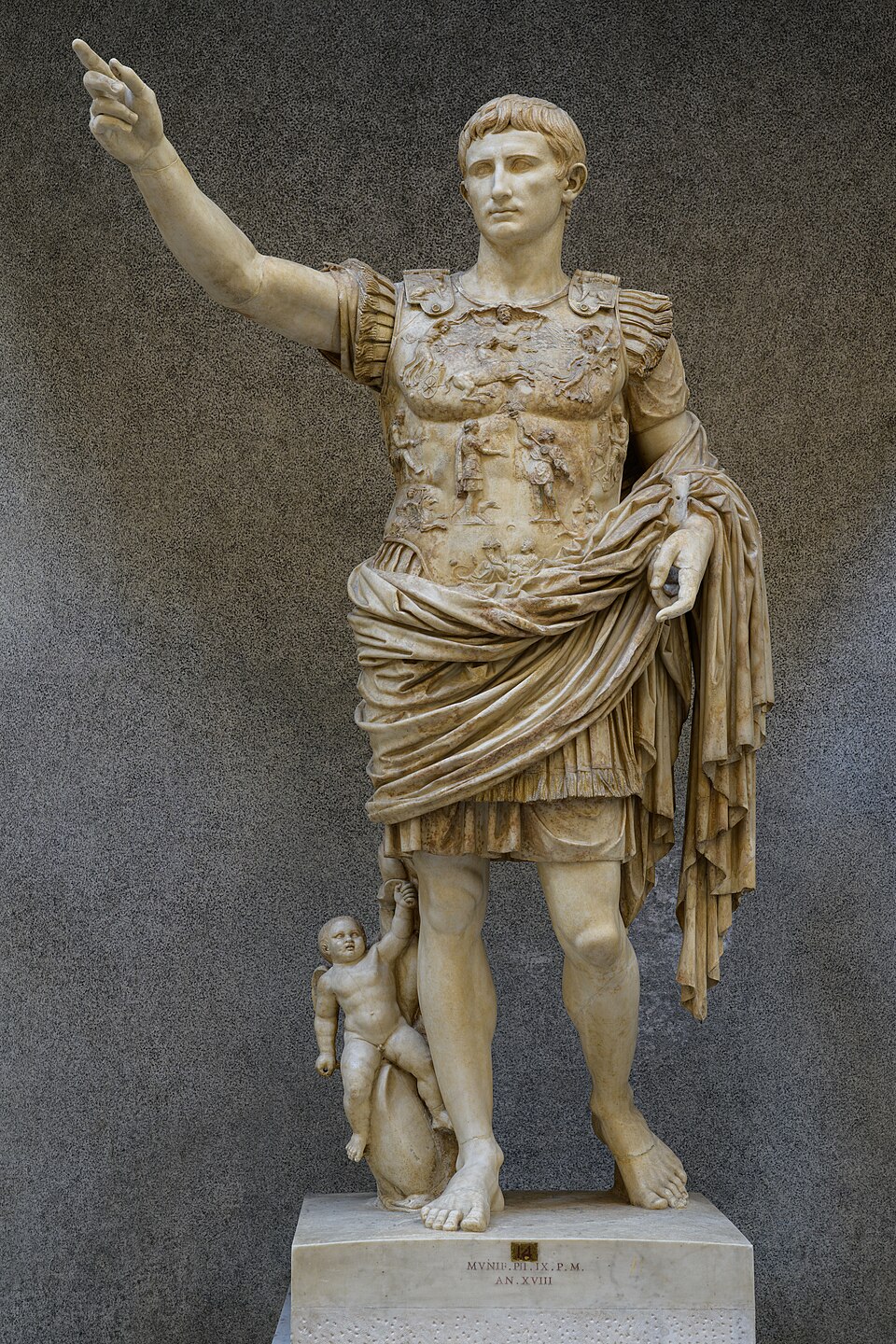
The Augustus of Prima Porta — the idealised image of the first emperor whose 27 BC settlement turned the coinage into the mass medium of the Principate.
Photo: Justin Benttinen — CC BY-SA 4.0, via Wikimedia Commons
The succession is the dynasty's other coinage theme, because it was never clean and the money had to paper over the joins. Augustus left no son; the throne passed to his adopted stepson Tiberius, then to Tiberius's great-nephew Caligula, then — after Caligula's murder — to Caligula's uncle Claudius, hauled out by the Praetorian Guard, and finally to Claudius's adopted stepson Nero. Each accession had a legitimacy problem, and each answered it on the coinage: dynastic family types, the deified predecessor, and a Julio-Claudian innovation that outlived the house — the women. Livia, Agrippina the Elder and Agrippina the Younger appear on the coinage in their own right, placed there to anchor a bloodline claim. No Republican moneyer would have put a living woman on a coin; the Julio-Claudians made imperial women part of the visual argument for who should rule.
The reverse types are where that argument is actually made, and they repay close reading. Augustus advertised his intended heirs on the commonest denarius of the whole period — the young princes Caius and Lucius Caesar with shields and spears between them — a succession plan the coinage kept promoting even after both boys were dead. The deified predecessor is the other constant: DIVVS AVGVSTVS consecration types under Tiberius establishing the new ruler as the son of a god. Claudius put the conquest of Britain on the record with the DE BRITANN triumphal arch, a concrete military claim from an emperor the army had improvised into power. Nero turned the reverse into civic theatre — the great sestertii of the harbour at Ostia crowded with ships, or the Temple of Janus with its doors shut to declare universal peace. Read across the five reigns the reverses are one continuous argument that this family, and only this family, should hold Rome.
The system, codified
Augustus fixed the denomination structure that the rest of Roman history is measured in. Gold aureus of about 7.9 grams; silver denarius of about 3.9 grams at roughly ninety-eight percent fine; the big brass orichalcum sestertius and dupondius; the copper as and its fractions. The tariff — one aureus to twenty-five denarii to one hundred sestertii — is the spine of every Roman price, wage and fortune you will ever read about. Get the system in your head once and the whole empire's economy becomes legible.
The mint geography is just as worth knowing. Under Augustus and Tiberius the precious metal — gold and silver — came largely from Lugdunum, modern Lyon, while Rome struck the senatorial bronze. That bronze carries a large SC, Senatus Consulto, "by decree of the Senate" — the constitutional fiction that the Senate controlled base-metal coinage while the emperor held gold and silver. The SC is not decoration; it is one of the first things you read to attribute and authenticate an early imperial bronze. The eastern provinces ran in parallel: provincial silver and bronze from Antioch, cistophoric tetradrachms from Ephesus and Pergamon, and the closed-system tetradrachms of Alexandria, all of it part of the wider Roman provincial coinage struck under the same five emperors.
The dynasty, ruler by ruler
Five emperors, every one of them a household name two thousand years later, which is exactly why a one-coin-per-emperor Julio-Claudian set is the classic first Roman collection. The portrait style is a chronology in itself: idealised Augustan classicism, the harder Tiberian face, Caligula's brief sharp issues, Claudius restored to volume, and Nero's late fleshy baroque heads on some of the finest bronze Rome ever struck.
| Emperor | Reign | Numismatic note |
|---|---|---|
| Augustus | 27 BC–AD 14 | The template-setter. The Caius-and-Lucius-Caesars denarius is the commonest type; the Augustus collector's guide goes deeper. |
| Tiberius | AD 14–37 | Conservative output dominated by the "Tribute Penny" denarius. |
| Caligula | AD 37–41 | Short reign, partial damnatio — scarce and premium in every metal. |
| Claudius | AD 41–54 | British-conquest types; abundant contemporary bronze imitations. |
| Nero | AD 54–68 | The AD 64 reform; the Port of Ostia and Temple of Janus sestertii are high points of Roman bronze art. |
Nero's suicide in AD 68 did not pass the throne to a relative — it ended the bloodline and opened the Year of the Four Emperors. Galba, Otho and Vitellius are not Julio-Claudians; they are the civil-war interregnum whose coinage funded the contest the Flavian dynasty finally won, with the military- emperors hub carrying the wider civil-war framing. The adoptive period that follows the Flavians is the Nerva–Antonine dynasty.
The Tribute Penny and Nero's reform
Two Julio-Claudian facts every collector meets early. The first is the Tribute Penny: the silver denarius of Tiberius with a seated figure and the PONTIF MAXIM legend, catalogued as RIC I 30, traditionally identified with the coin in Mark 12:15–17 — "render unto Caesar". It is the commonest Tiberian denarius and one of the most collected single Roman types anywhere, purely on that biblical association, which puts a real and durable premium on decent examples. State it as what it is: a traditional identification, widely repeated, not a thing the coin itself proves.
The second is structural and the more important of the two. In AD 64 Nero reduced the weight of the aureus to about 7.2 grams and the denarius to about 3.4 grams, and lowered the denarius's silver fineness. That is the first systematic debasement of Roman currency, and in the standard scholarly reading it is the structural beginning of the three centuries of monetary decline that the Roman Imperial story then becomes. Everything in the catalogue after this — the antoninianus, the third-century collapse, Diocletian's reform — is downstream of a decision Nero took to pay for a budget shortfall. The denomination history is told in full on the Roman denarius guide and the aureus guide as they are published.
Collecting and the market
This is the most "historically resonant" Roman dynasty for a new collector, because every name carries its own story, and a focused Julio-Claudian set is exactly the kind of collection the NumisLens cabinet and insurance export are built around. The coin that sets the floor is a Very Fine Claudius or Nero bronze, the affordable way to put a Julio-Claudian face in the cabinet, and everything else prices off it: Claudius and Nero bronze in Very Fine sits roughly in the high tens to low hundreds; Augustan denarii a few hundred; the Tiberian "Tribute Penny" denarius runs from the mid hundreds into four figures, lifted by biblical demand and by quality; anything of Caligula is scarce and priced well above its grade; and Julio-Claudian gold aurei are firmly four to five figures.
Two honest cautions. Claudius bronze has an enormous population of contemporary imitations — Gallic and British copies struck where official bronze was short. They are collectable in their own right and historically interesting, but they must be described as what they are, and a seller who calls an obvious imitative as an official Rome-mint coin is either careless or worse. And Nero sestertii are a connoisseur's field where the portrait style and the strike, not the grade letter, drive order-of-magnitude price differences — learn the dies before you spend. The standard references are Sutherland's revised RIC I and his Roman History and Coinage 44 BC–AD 69, with Carson's Coins of the Roman Empire as the background; the open tool is the ANS Online Coins of the Roman Empire, and the major-house archives on acsearch are the price guide that actually reflects the market.
Questions
Who were the Julio-Claudian emperors?
Augustus (27 BC–AD 14), Tiberius (14–37), Caligula (37–41), Claudius (41–54) and Nero (54–68) — the first Roman imperial dynasty, from the Julian house of Caesar and Augustus and the Claudian house of Tiberius.
What is the Tribute Penny?
The seated-figure PONTIF MAXIM denarius of Tiberius (RIC I 30), traditionally identified with the coin of Mark 12:15–17. The commonest Tiberian denarius and a perennial biblical target, with a real price premium. Traditional identification, not a certainty.
Why are Caligula's coins expensive?
Under four years on the throne and a partial damnatio after his murder cut the surviving population. Even worn Caligula bronze carries a premium; his gold and silver are firmly rarities.
What does SC mean on the bronze?
Senatus Consulto, "by decree of the Senate" — the constitutional fiction that the Senate authorised base metal while the emperor held gold and silver. A core attribution and authenticity mark on early imperial bronze.
What was Nero's reform?
In AD 64 Nero cut the weight of the aureus and denarius and lowered the denarius's fineness — the first systematic Roman debasement and, in the standard reading, the structural start of three centuries of decline.