The Nerva–Antonine Dynasty: The Five Good Emperors
It reads like a stable hereditary house, four reigns of calm succession; it was not. For most of the second century Rome chose its emperors by adoption rather than blood, and the coinage — Trajanic Dacian gold, Hadrian's Travel Series, the Antonine portrait peak — argues that case until Commodus, the biological son, breaks the chain.
The Nerva–Antonine dynasty ruled Rome from AD 96 to 192 — Nerva, Trajan, Hadrian, Antoninus Pius, Marcus Aurelius, Lucius Verus and Commodus. The era of the “Five Good Emperors” produced the artistic peak of Roman portrait coinage, the Trajanic Dacian-victory series, and Hadrian's geographic Travel Series.
Government by adoption
For most of the second century Rome did something no hereditary monarchy manages for long: it picked its rulers on competence. From Nerva through Marcus Aurelius the throne passed by adoption — the reigning emperor selecting and formally adopting the ablest available man rather than handing power to a son. Gibbon called the result the period in human history during which the condition of the human race was most happy and prosperous, and whatever one makes of that verdict, the coinage worked hard to sell it. PROVIDENTIA, the forethought of choosing a successor; CONCORDIA, the harmony of the imperial house; paired Caesar-and-Augustus types announcing the heir while the senior emperor still lived. The Flavian dynasty had manufactured a bloodline; the Nerva–Antonines advertised the opposite — that no bloodline was needed.
It started as damage control. Nerva, an elderly senator, was installed after Domitian's assassination in 96 to calm a frightened Senate; his short, scarce reign matters less for its coinage than for one decision, the adoption of the general Trajan, which set the precedent the next four reigns followed. The chain ran Trajan to Hadrian to Antoninus Pius to Marcus Aurelius, each adoption ratified on the money. Then it broke, and the coinage records that too. Marcus Aurelius had a biological son, Commodus, and he did not adopt past him. Commodus inherited as a son, ruled as an autocrat, styled himself Hercules on the coinage, and was murdered in 192 — which opened the civil war of 193 and brought in the Severan dynasty. The whole arc, from chosen succession to dynastic collapse, is legible in the legends if you read across the century inside the wider Roman Imperial series.
The artistic peak
This is the dynasty's real distinction, and it is not a marketing claim: second-century Roman die-engraving is widely regarded as the artistic high point of the entire imperial coinage. The relief is high, the anatomy confident, the reverse compositions genuinely narrative rather than emblematic. An Antonine sestertius in fine style — a Hadrian, an Antoninus Pius, a Marcus Aurelius — stands with the best small-scale relief sculpture Rome produced. For a reference that wants to argue depth over breadth, this is the strongest single case in the Roman series, and it is why connoisseurs who tire of everything else keep coming back to the Antonines.
Trajan's reign is the volume story behind the art. His Dacian wars ended with the seizure of the Dacian royal treasury and the opening of the Dacian gold and silver mines, and the coinage shows it — an enormous, exceptionally well-struck output of denarii, sestertii and aurei, Dacian-captive reverses, the Forum and Column of Trajan rendered as architecture in metal. Trajan also struck the "Restored" series: famous Republican and early-Imperial types reissued with his own legend, an antiquarian gesture that is now a distinct collecting sub-field and a good example of an emperor using the coinage to claim continuity with the whole Roman past. The Trajan collector's guide covers the reign's coinage in depth, and the forthcoming Marcus Aurelius guide will do the same for the war coinage at the other end of the dynasty.
Hadrian's Travel Series
Hadrian did not expand the empire; he toured it, and he turned the tour into the most distinctive reverse programme in all of Roman coinage. The Travel Series personifies the provinces he visited — BRITANNIA seated with shield and spear, AEGYPTOS reclining with ibis and sistrum, AFRICA in her elephant-skin headdress, HISPANIA, GERMANIA, and the rest — and pairs them with two relational types: ADVENTVS, the emperor's ceremonial arrival in a province, and RESTITVTORI, the emperor literally raising a kneeling provincial figure to her feet. Read together it is a coined atlas of a single reign's geography and ideology, and it is collected as a self-contained theme by specialists who pursue nothing else. It is the natural subject of the planned Hadrian collector's guide, and the provincial side of these reigns — the abundant, precisely regnal-year-dated Alexandrian tetradrachms of Trajan, Hadrian and the Antonines — sits in the Roman provincial coinage.
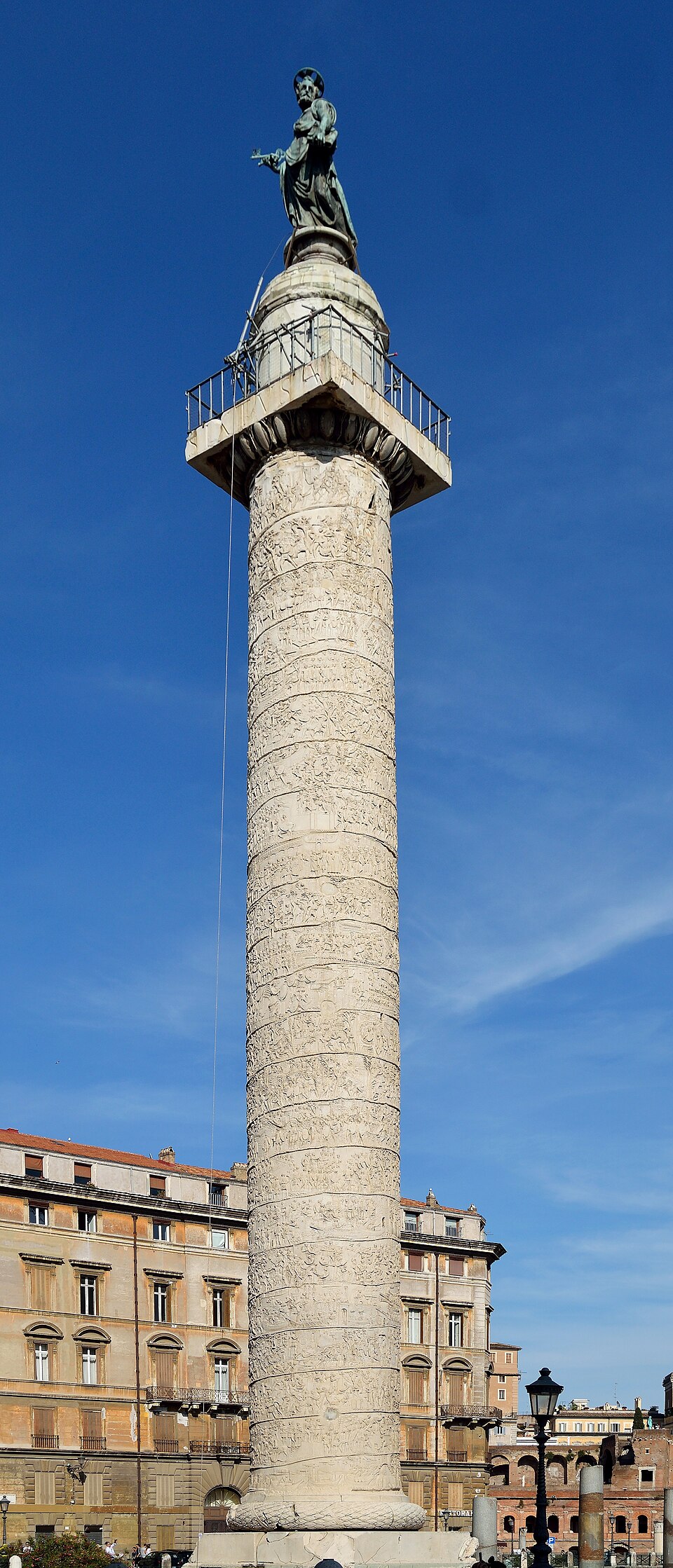
Trajan's Column, dedicated AD 113, recording the Dacian Wars — the campaigns whose captured gold underwrote the dense Trajanic aureus and sestertius coinage.
Photo: Livioandronico2013 — CC BY-SA 4.0, via Wikimedia Commons
On the mint side the dynasty is overwhelmingly a Rome story — gold, silver and the great SC bronze all came from the capital in volume across the whole century — with the eastern picture carried by Alexandria, whose regnal-year-dated billon tetradrachms of these emperors are among the most precisely datable Roman-era coins, and Antioch for the Syrian silver struck during the eastern campaigns. The denomination spine is unchanged from the denarius and the orichalcum sestertius set by the early Principate, with the as and its fractions below; what moves under the Antonines is the silver fineness, which keeps quietly falling, and the bronze output, which swells as Marcus Aurelius pays for the Marcomannic wars against the strain of the Antonine Plague. The aureus holds its prestige throughout.
The dynasty, ruler by ruler
Seven rulers, and an unusual amount of the coinage is of women. The dynasty's imperial women — Faustina the Elder, Faustina the Younger, Lucilla — have extensive coinage in their own right, including the consecration types and the PVELLAE FAVSTINIANAE issues tied to the charitable foundation for poor girls, which is one of the better social-history hooks in the whole Roman series. They are covered within the relevant reigns rather than on separate pages.
| Emperor | Reign | Numismatic note |
|---|---|---|
| Nerva | AD 96–98 | Short, scarce; the adoptive-principle precedent. |
| Trajan | AD 98–117 | The Dacian-gold flood; the Restored series. Collector's guide live. |
| Hadrian | AD 117–138 | The Travel Series — the most distinctive Roman reverse programme. |
| Antoninus Pius | AD 138–161 | Long peaceful reign; rich personification reverses; the Faustina I consecration coinage. |
| Marcus Aurelius | AD 161–180 | Marcomannic-war coinage; the Antonine Plague backdrop; the philosopher's portrait. |
| Lucius Verus | AD 161–169 | The first formal co-Augustus; Parthian-war types; very high search interest, very accessible prices. |
| Commodus | AD 177–192 | Broke the adoptive chain; the HERCVLI ROMANO lion-skin self-portrait. |
One row deserves a flag. Lucius Verus draws very high modern search interest — on the order of several thousand queries a month in the Numista gap data — while his coinage is genuinely common and inexpensive. That mismatch makes his page one of the better-value entry points in the whole Roman series for a collector who wants a famous co-emperor without a famous price.
Collecting and the market
What you pay for here is condition in an unusually demanding sense: on Antonine bronze, style of engraving moves price as much as the wear grade does, and the ranges below assume sound, well-attributed examples before any premium for a fine portrait. Common Antonine denarii — Trajan, Hadrian, Antoninus Pius, Marcus, the Faustinas — sit in the low-to-mid tens to low hundreds in Very Fine; a choice high-relief sestertius in fine style runs several hundred to a few thousand; a Hadrian Travel Series sestertius in good style climbs from the high hundreds well into four figures; Nerva carries a short-reign premium; Lucius Verus is conspicuously affordable for his fame; and Nerva–Antonine gold aurei are firmly four to five figures, more for the finest portraits.
Two pointers. On the sestertii, two coins of the same emperor, same type and same technical grade can differ by an order of magnitude on die quality alone — the Antonine market prices the engraver, not just the wear, so train your eye before you spend. And the Faustina and Lucilla coinage is systematically under-collected relative to its historical interest and its share of the dynasty's output; a focused Nerva–Antonine-plus-women set is exactly the kind of structured, attributable collection the NumisLens cabinet and insurance export are built for. The reference standards are RIC II and III, with Beckmann's Diva Faustina for the consecration coinage and Toynbee's Roman Medallions for the Antonine medallic art; the open tool is the ANS Online Coins of the Roman Empire, and the denomination history runs in full on the forthcoming Roman denarius guide.
Questions
Who were the Five Good Emperors?
Nerva, Trajan, Hadrian, Antoninus Pius and Marcus Aurelius — Machiavelli's phrase, popularised by Gibbon. Lucius Verus (Marcus's co-emperor) and Commodus (Marcus's son) finish the dynasty but fall outside the label.
What is the Hadrianic Travel Series?
Hadrian's coinage personifying the provinces he toured — province figures, ADVENTVS arrivals, RESTITVTORI types raising a kneeling province. The most distinctive reverse programme in Roman coinage and a self-contained collecting theme.
Why is Antonine coinage prized?
Second-century die-engraving is the technical and aesthetic peak of Roman coinage — high relief, confident anatomy, narrative reverses. Fine-style Antonine sestertii are among the most admired objects in the whole field.
Are Lucius Verus coins rare?
No — well represented and generally affordable, despite very high modern search interest. One of the best-value ways to own a famous named co-emperor and a good entry into the dynasty.
How did the dynasty end?
Commodus, Marcus Aurelius's biological son, broke the adoptive succession. His assassination in AD 192 triggered the Year of the Five Emperors in 193 and brought in the Severan dynasty.