Marcus Aurelius Coins: Values, Types & Identification
The coinage of the philosopher emperor, 1,819 catalogued types struck mostly at Rome across nineteen years of Parthian war, plague, and the long campaigns on the Danube. Common denarii from $80, sestertii from $150, gold aurei from about $3,000.
Marcus Aurelius (161 to 180 AD) struck most of his coinage at Rome, and it reads as a record of crisis: the Parthian war, the Antonine plague, and the long Marcomannic Wars on the Danube. Common silver denarii run $80 to $250 in Very Fine; sestertii with good portrait and patina $150 to $600; gold aurei start around $3,000 to $5,000. Standard catalog: RIC III (Mattingly and Sydenham, 1930); the modern die-study reference is Szaivert’s MIR 18 (1986). Faustina II coinage is abundant and cheap. Prices move with each auction season; value your own Marcus Aurelius coins in NumisLens as you catalog them.
Entity: Marcus Aurelius (Q1430)
Hold a denarius of Marcus Aurelius and you are holding about 3.3 grams of debased silver from the reign that breaks the long Antonine peace. The portrait is calm. The history behind it is not. This is the emperor who wrote the Meditations in a tent on the Danube while the Marcomanni pressed across the river, whose army carried a pandemic back from the East, and who had imperial furniture auctioned in the Forum of Trajan to pay for the war.6 The coins are the official version of those nineteen years: measured, confident, and quietly revealing if you read the legends in order.
Most of what collectors meet is silver. A common Rome-mint denarius with a standing personification, Salus feeding a snake, Providentia with a globe, Aequitas with scales, runs $80–250 in Very Fine depending on centering and surface. The war commemoratives, the ones that actually mean something historically, cost more: $150–400 for a sharp denarius naming victory over the Germans or Sarmatians. Sestertii run from about $150 worn or cleaned to $800–2,000 for a problem-free coin with original patina. Gold begins around $3,000–5,000 and climbs from there. Faustina II silver, struck in staggering quantity for his wife, is some of the cheapest Roman denarii you can buy at $40–120.
This guide reads the coinage as both history and collecting series. Every type appears as evidence inside the story, not as a picture with a price tag. For individual lookups, the full catalog of 1,819 Marcus Aurelius types is in the NumisLens database, 657 of them with images. What follows is the context that makes those entries legible.
The Philosopher at War
The paradox sits on the obverse. The bearded, inward face that becomes more lined with every issue belongs to a man whose private notebook argues that power is vanity and that the only thing in your control is your own judgement.10 The same man spent the last decade of his life commanding the largest concentration of Roman troops since Trajan, on the Marcomannic frontier, and his mint advertised those campaigns in the ordinary language of Roman victory: trophies, bound captives, the legends DE GERMANIS and DE SARMATIS. There is no contradiction to resolve here. It is simply what the evidence shows, and it is the reason this coinage rewards attention: the propaganda and the philosophy were produced by the same administration in the same years.
Marcus did not seek any of it. He inherited a settled empire from Antoninus Pius in 161 AD and almost immediately faced a Parthian invasion in the East and, within a few years, sustained pressure on the Danube. The numismatic record of his reign is therefore not a record of conquest in the Trajanic sense. It is a record of response: titles earned defending what already existed, congiaria to steady the city, deifications as the family died around him. Read in sequence, the reverses are less a triumph than a ledger of a difficult job done conscientiously.
A war reverse from the NumisLens catalog:
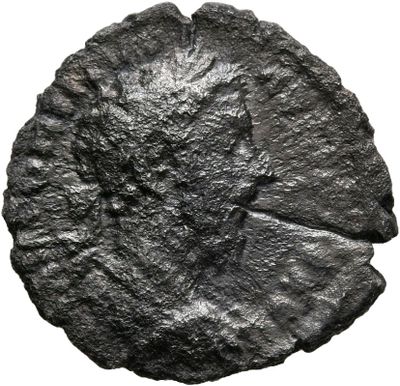
Denarius, Rome
RIC III Marcus Aurelius 279 · 172 AD-173 AD
A Collector’s History of Marcus Aurelius
He was born in Rome on 26 April 121 AD as Marcus Annius Verus, into a wealthy senatorial family of Spanish origin.5 The succession that brought him to power was engineered a generation in advance: the dying Hadrian arranged for Antoninus Pius to be adopted on the condition that Pius in turn adopt both Marcus and Lucius Verus. Marcus took the name Aurelius, served as Caesar through the long, quiet reign of Pius, and held tribunician power from the late 140s, the dating device that makes his later coins chronologically precise.1
Pius died on 7 March 161 AD. Marcus succeeded and did something no Roman emperor had done before: he made his adoptive brother Lucius Verus a full co-Augustus, the first formal joint principate.6 The arrangement was tested at once. A Parthian war broke out in the East and ran from 161 to 166, prosecuted in Verus’s name and by capable generals; Marcus stayed mostly in the West. Victory brought the titles ARMENIACVS, PARTHICVS MAXIMVS and MEDICVS onto the coinage in the mid-160s. It also brought back something else.
The returning eastern army carried an epidemic, the Antonine plague, which spread through the empire from about 165–166 and recurred for years. Mortality estimates are debated and ancient figures are not reliable, so treat the scale as uncertain; what is clear is that it coincided with the start of serious trouble on the Danube. From the late 160s the Marcomanni, Quadi and Sarmatian Iazyges pushed across the frontier, at one point raiding deep into northern Italy. Marcus spent most of the 170s on campaign there. Lucius Verus had died, suddenly, in early 169; the Historia Augusta says of a stroke, but the cause is uncertain and modern historians often suspect the plague.7 In 175 the eastern governor Avidius Cassius revolted on a false report that Marcus was dead; the rising collapsed within months when the report proved wrong, and it left almost no numismatic trace, so be sceptical of anything sold as an “Avidius Cassius coin.”
Victories over the Germans and Sarmatians added GERMANICVS (172) and SARMATICVS (175) to his titles, and those words date the late coinage. Marcus raised his son Commodus to Caesar in 166 and to co-Augustus in 177, ending the run of adoptive succession that the eighteenth century admired. He died on 17 March 180 AD on the northern frontier; the ancient tradition is divided between Vindobona (Vienna) and Sirmium, and the question is genuinely unsettled, so the honest statement is that he died on campaign in the north, not in a named city. Commodus made peace and went home.
Two episodes matter for the collector because they explain the texture of the coinage rather than appearing on it. First, the war finance: ancient tradition reports that in 169 AD, rather than impose new taxes on an empire already hit by plague, Marcus auctioned imperial property, palace furniture, plate, his wife’s silk and jewels, in the Forum of Trajan, and later refunded buyers who wished to return what they had bought.7 The story may be polished in the telling, but it fits a reign whose silver was quietly debased and whose mint kept advertising stability it had to work for. Second, the Avidius Cassius affair of 175: the senior eastern commander was proclaimed emperor on a false report that Marcus had died, held the East for roughly three months, and was killed by his own side when the report proved wrong. It left no meaningful coinage. Treat any coin offered as an “Avidius Cassius” issue with deep suspicion; this is a name that sells tooled or misattributed Antonine bronze.
The Portrait
Marcus is one of the easier Roman emperors to recognise, and the portrait itself is datable evidence. As Caesar under Pius, before 161, he is young and either bare-faced or lightly bearded, with the legend AVRELIVS CAESAR AVG PII F (“Aurelius Caesar, son of Antoninus Pius Augustus”). These Caesar-period coins are a distinct, often overlooked collecting area; expect prices roughly in line with, sometimes a little above, common imperial denarii at comparable grade, not a discount.
As Augustus the beard fills out into the tight, deeply drilled curls of mid-second-century court style, and the face is calm and idealised. Over the 170s the engravers let it age. The late portraits, struck while the Meditations were being written, show heavier lids and a drawn, tired set to the mouth. Whether that reflects deliberate “warts and all” realism or simply the drift of die-cutting over twenty years is a fair question, and numismatists do not fully agree; either way the effect is unmistakable when you line an early denarius next to a late one.
The classic confusion is with the other bearded Antonines. Antoninus Pius is older-looking with a different beard shape and almost always reads ANTONINVS AVG PIVS. Lucius Verus has a fuller, more luxuriant beard and a distinctive swept hairstyle, with L VERVS AVG or IMP L AVREL VERVS. When the portrait is worn, the legend decides it. Read the legend.
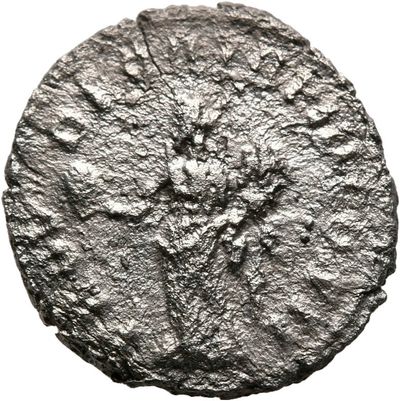
Denarius, Rome
RIC III Marcus Aurelius 491A · 162 AD-163 AD
The Wars on the Coins
Three crises define the reign and all three are on the coinage, though not equally and not always in the way collectors expect.
The Parthian War (161–166). Because the war was fought in Verus’s name, much of the explicit victory imagery, Armenia seated and mourning, the legend ARMEN, VIC PAR for Victoria Parthica, runs under Verus and the joint titulature. On Marcus’s own coins the war shows up mainly as the new titles in the obverse legend rather than as a dedicated battle scene. There is also a body of eastern silver, didrachms and drachms from Caesarea in Cappadocia, tied to the Armenian campaign; these are Roman provincial issues and sit in RPC, not RIC, a distinction worth keeping straight when you attribute one.
The Antonine plague. Collectors sometimes ask for “the plague coin.” There isn’t one. No Roman type names or depicts the epidemic. What exists is a noticeable prominence of SALVS (health personified, feeding a serpent from a patera) and of Apollo through the plague years, and some scholars read that as a response to the crisis. That reading is plausible and worth knowing, but it is interpretation, not something the coin states, and an honest guide should label it as such.5
The Marcomannic Wars. This is where the coinage commits. From the early 170s the reverses carry VICT GERM (Victoria Germanica), DE GERMANIS and DE SARMATIS with arms and trophies, bound captives, and Victory inscribing a shield. The famous “rain miracle,” where a storm is said to have saved a trapped Roman force, is carved on the Column of Marcus Aurelius in Rome; that scene itself is not a coin type. There is, though, a scarce Rome sestertius of about 172–173 reading RELIG AVG, Mercury in an Egyptian-style temple (Cohen 535, Sear RCV 4996), that scholarship connects to the episode through the tradition of the Egyptian Harnuphis calling on Mercury.4 So a “rain-miracle sestertius” is a real, catalogued type, as long as you treat it as a scholarly association rather than a scene the coin actually shows. The RESTITVTORI and provincial-restoration legends of the late reign present Marcus as the man who put the frontier back together.
The sequence, roughly, is worth holding in your head because the titles date the coins. The first major phase of Danubian war runs from about 167–168 into the early 170s; the title GERMANICVS enters the titulature around 172 and the explicit German-victory reverses cluster after that. The Sarmatian Iazyges were forced to terms around 175, which brings SARMATICVS and the DE SARMATIS trophy types. A second northern war reopened in the late 170s and was still running when Marcus died in 180. Exact campaign chronology is debated among historians and the coin-to-campaign matching is not always tidy, so use the obverse titles as a terminus, the coin cannot predate the title it carries, rather than as a precise battle date. BMCRE IV gives the British Museum specimens for the period if you want to see the run of victory legends laid out.3
An eastern-war reverse from the catalog:

Aureus, Rome
RIC III Marcus Aurelius 511 · 163 AD-164 AD
Denominations and Metals
The system Marcus used was the one Augustus had built and the second century had inherited largely intact. The aureus is gold, approximately 7.2 grams in this period and continuing its slow, long-term decline in weight; it was worth 25 silver denarii. The denarius is the workhorse, roughly 3.2–3.4 grams, and the coin you will actually handle. Below it the sestertius is a large orichalcum (brass) coin, the big bronze every collector wants for its portrait; then the dupondius and the copper as. One denarius equalled four sestertii or sixteen asses.
The number that matters for collectors, and the one most often stated wrongly, is the silver fineness. The denarius was debased under Marcus relative to Antoninus Pius, part of the long imperial slide rather than one dramatic devaluation. How far is genuinely uncertain. Walker’s older surface-analysis figures put it in the high seventies to low eighties of a percent,9 but Butcher and Ponting demonstrated that surface analysis systematically reads too high, because the minting process enriches silver at the surface of the flan, so bulk-metallurgy values are lower and the older numbers should be treated as soft.8 The honest summary: the coin is visibly good silver, it is measurably worse than under Pius, and any single confident percentage you see quoted is probably an artefact of method. Hold the line on that when someone tells you a Marcus denarius is “83.5% fine.”
A practical note on the middle bronze, because it trips beginners. The dupondius and the as are close in size, and the quick discriminator is the imperial crown: a radiate (spiked) crown on the bronze portrait usually signals a dupondius, a laurel wreath an as, with the dupondius the yellower orichalcum and the as the redder copper. It is a rule of thumb, not a law, but it resolves most tray coins in a second. Above the regular denominations sit the bronze and silver medallions, larger presentation pieces struck in small numbers for the court and for New Year gifts; genuine Antonine medallions are scarce, expensive, and a specialist field of their own. And at the eastern edge, as noted, the Caesarea didrachms and Alexandrian tetradrachms are a separate provincial-silver economy that should never be priced against Rome-mint denarii.4
Denominations represented in the NumisLens catalog for this reign:
| Denomination | Types in catalog |
|---|---|
| Sestertius | 546 |
| Denarius | 514 |
| As | 277 |
| Aureus | 269 |
| Dupondius | 171 |
| Quinarius Aureus | 18 |
| Quinarius | 12 |
| AE Small | 5 |
| Semis | 3 |
| Dupondius Or As | 2 |
| Quadrans | 2 |
Where the Coins Were Made
For the imperial gold, silver and bronze the answer is short: Rome. Effectively the entire RIC III output for Marcus is Rome-mint, and you do not need to worry about western branch mints the way you do for the third and fourth centuries. Where mint geography matters is at the edges: the eastern silver from Caesarea in Cappadocia connected to the Armenian campaign, and the Alexandrian tetradrachms, both of which are provincial coinage catalogued in RPC rather than RIC. If a “Marcus Aurelius” coin in a tray is billon and looks Egyptian, it is an Alexandrian tetradrachm and a different collecting field with its own price structure.
Mints attested in the NumisLens catalog for this ruler (catalog attribution; the great majority is Rome):
| Mint | Types in catalog |
|---|---|
| Rome | 1,814 |
| Caesareia Cappadocia | 4 |
Key Types to Know
You do not need to memorise RIC. You do need to recognise a handful of families, because ninety percent of what you will see falls into them.
The standing personifications. Salus, Providentia, Aequitas, Felicitas, Annona, Fortuna, Pax, Pietas, Victory: a single figure, an attribute or two, a short legend, dated by the TR P and COS numbers in the legend. These are the bulk of the denarii and the cheapest way into the reign. Learn to read the tribunician number and you can date most of them to within a year.
Here is the method on a real-shaped legend. Take a denarius reading M ANTONINVS AVG TR P XXV on the obverse and IMP VI COS III with a Victory on the reverse. The tribunician power, TR P, was renewed annually, and Marcus took it from the late 140s, so a high TR P number places the coin deep in the reign; combined with the third consulship (COS III, held from 161) and the running imperatorial acclamation (IMP VI), the legend brackets the coin to a single year in the early 170s. You do not need to memorise the conversion; you need to know that the numbers are the date and to look them up against the catalog. Get the exact year-by-year table from Szaivert’s MIR 18, which is built on precisely this evidence.2
The war commemoratives. DE GERMANIS, DE SARMATIS, VICT GERM, trophies and seated captives. Fewer, dearer, and the historically meaningful ones.
It helps to know what the personifications were saying, because Roman reverses are political language, not decoration. Salus (health) and Providentia (foresight) reassure a population living through plague and war. Annona, the grain supply, and Aequitas with her scales speak to the food and the coinage holding. Concordia, often a clasped-hands or two-figures type, is the dynastic-marriage and joint-rule message, Marcus and Verus, then Marcus and the family. Mars and Victory carry the frontier. Fortuna Redux, the luck that brings the emperor safely back, means exactly what it says for a ruler who spent his last decade away from Rome. None of this is hidden; the mint expected the user to read it. Once you see the reverses as sentences the reign assembled in order, a tray of “common” denarii becomes the official diary it was meant to be.
The liberalitas and congiarium types record the cash handouts to the Roman plebs, an emperor managing the city while he was away fighting. The consecration coinage closes the reign: CONSECRATIO with an eagle, a funeral pyre, or Marcus carried up by an eagle, struck under Commodus after the deification in 180, with the obverse DIVVS M ANTONINVS.
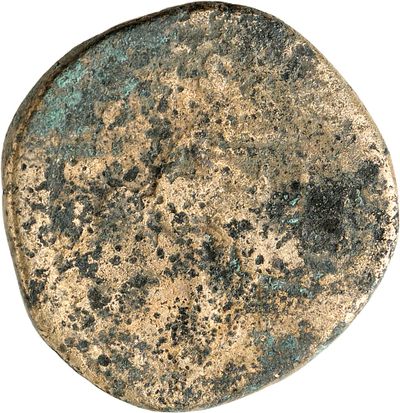
As, Rome
RIC III Marcus Aurelius 1670 · 161 AD-176 AD
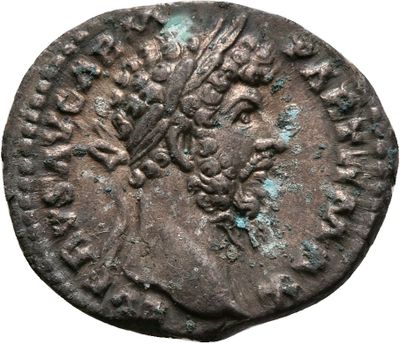
Denarius, Rome
RIC III Marcus Aurelius 546 · 165 AD-166 AD
A posthumous consecration type:
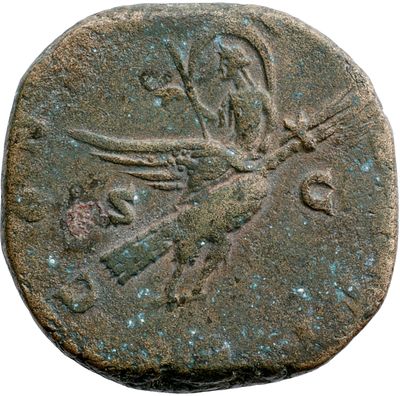
Sestertius, Rome
RIC III Marcus Aurelius 1702 · 176 AD-180 AD
The Antonine Family
You cannot collect Marcus without running into his family, because the mint struck for all of them and the dynastic coinage is half the surviving material. Faustina II, his wife and first cousin, has an enormous coinage: FECVNDITAS (fertility, often with children, she bore many), SAECVLI FELICIT with infants, IVNONI REGINAE, VENVS. Faustina II denarii are among the most common and most affordable Roman silver in existence, which makes them an excellent and honest entry point.
The deified Faustina I, Pius’s widow, continued to be struck in quantity with DIVA FAVSTINA and consecration types well into Marcus’s reign. Lucius Verus has his own imperial coinage from the joint reign, and after his death the DIVVS VERVS consecration issues. Lucilla, Marcus’s daughter and Verus’s wife, has a substantial and collectible series. And Commodus appears first as Caesar under his father, then as co-Augustus from 177, so a late “Marcus period” coin may actually be an early Commodus.
Lucius Verus deserves a line of his own because his coinage is a genuine collecting target, not a footnote to Marcus. From the joint reign there are Verus denarii and sestertii with the Parthian-war reverses the senior partner’s coins mostly lack, TR P ... ARMEN, Armenia seated and mourning, Victory, and after his death in 169 the CONSECRATIO and DIVVS VERVS issues struck under Marcus. Verus denarii in VF sit in roughly the same band as common Marcus silver, with the explicit Armenian-victory types carrying a modest premium. Lucilla, Marcus’s daughter married to Verus, has a clean, recognisable series, VENVS, IVNO, PIETAS, often confused at a glance with Faustina II until you read the legend. The disambiguation that actually works in the tray: DIVA FAVSTINA with a consecration reverse is Faustina I (struck long after her death in 141); FAVSTINA AVGVSTA with fertility and family reverses is Faustina II, Marcus’s living wife. The portrait hairstyles differ too, but the legend is faster and never wrong.
A Faustina II type from the catalog:
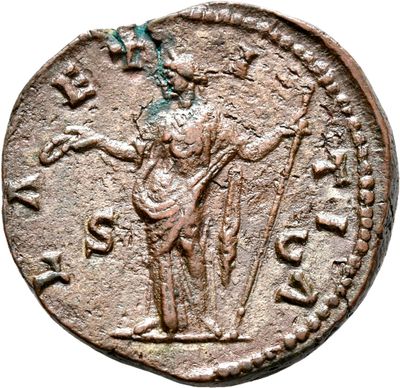
As, Rome
RIC III Marcus Aurelius 1656 · 161 AD-176 AD
Identifying Your Coin
The workflow is the same one a dealer uses, in order. One: denomination by metal and size, gold aureus around 7 grams, silver denarius around 3.3, large brass sestertius 23–27, copper as around 10. Two: obverse legend. M ANTONINVS AVG is the core; extensions like ARMENIACVS, GERM, GERM SARM, or DIVVS M ANTONINVS immediately bracket the date. AVRELIVS CAESAR means a pre-161 Caesar issue. Three: reverse legend and figure. Identify the personification and read the TR P / COS / IMP numbers, which pin the year. Four: match it in the NumisLens Marcus Aurelius catalog, in RIC III, or for tight chronology in Szaivert’s MIR 18.2 OCRE reproduces RIC III with images if you want a free first pass.
Walk a real example. Silver coin, 18 mm, 3.2 g, so a denarius by metal and weight. Obverse: a bearded laureate head, legend M ANTONINVS AVG GERM SARM, the face mature and a little drawn. The GERM SARM places it after the Sarmatian settlement, so 175 or later, the back third of the reign. Reverse: a draped figure with scales and cornucopia, the legend TR P XXX IMP VIII COS III and AEQVITAS; that is Aequitas, and the tribunician number pins the year while COS III is consistent with the late reign. Your conclusion before opening a book: a Rome-mint denarius of Marcus as Augustus, c. 175–176 (TR P XXX), Aequitas reverse. Then you look it up in the catalog or RIC III to attach the exact number, rather than guessing from the portrait. Metal and weight, obverse legend and titles, reverse legend and figure, then catalog: that order is the entire skill.
The common misattributions are predictable: Marcus confused with Lucius Verus or Antoninus Pius from the beard alone (use the legend), a Faustina II read as Faustina I (check the reverse and the DIVA marker), and an early Commodus filed under his father. None of these survive a careful reading of the obverse legend, which is why that is step two and not step five. If you would rather not do it by hand, the NumisLens identification tool will take a photo and propose an attribution to check against the catalog, and The Case walks the same legend and reverse logic interactively.
Collecting and Market
Marcus Aurelius is one of the best-value major emperors in Roman numismatics. He is historically central, he wrote a book people still read, and yet his silver is common enough that a sound denarius costs less than a dinner out. A focused reign collection, one good denarius from each phase, Caesar, early Augustus, the war years, plus a sestertius, a Faustina II, and a consecration type, is achievable for a few hundred dollars total if you buy patiently and grade honestly.
A concrete way to build that set, in the order that gives the most reign for the least money. Start with a common Rome-mint denarius, a standing personification, in solid VF; that is your anchor coin and your eye-training coin. Add a Faustina II denarius next, because it is cheap, ubiquitous, and teaches you the dynastic side of the coinage. Then reach for one war coin, a DE GERMANIS or VICT GERM denarius, the piece with a story. A Marcus-as-Caesar denarius gives you the young portrait and the contrast. A consecration type closes the reign with the death of the man. The stretch purchase, when you are ready, is one sestertius bought for its patina and portrait, not its grade label. Six coins, the whole arc of the reign, and you can do it for a few hundred dollars if you wait for the right examples instead of buying the first one offered. Track the set in your NumisLens catalog so you are not buying duplicates by accident.
Price Reference
Prices below reflect the recent market through retail dealers and auction; treat them as orientation, not quotes, and always tie the number to a grade and to the specific coin in front of you, since one dealer’s VF is another’s gF. Research current results on CNG, acsearch, and Leu before you commit on anything above $300.
- Common denarius (standing personification), VF: roughly $80–250 at the dealer floor; well-struck good-VF examples and better reverses regularly reach $250–450 at auction. Centering, surface and an unbroken legend drive the spread more than the reverse type.
- War-commemorative denarius (DE GERMANIS / DE SARMATIS / VICT GERM), VF: roughly $150–400 for a well-struck example.
- Sestertius: a worn or harshly cleaned coin runs $150–350; a problem-free good VF with intact green or brown patina typically $800–2,000, and a strong portrait or a Marcomannic-War type higher still. This is the denomination where surface, not the wear grade, sets the price.
- Aureus, VF: generally from about $3,000–5,000, more for scarce types or high grade; gold price and numismatic quality both move it.
- Faustina II denarius, VF: roughly $40–120. Some of the most affordable genuine ancient silver there is.
- Marcus-as-Caesar denarius, VF: broadly in the common-imperial band, occasionally a modest premium for the scarcer young portrait.
- CONSECRATIO type (denarius), VF: a collectible, historically resonant coin; priced with the common-denarius band, a little more for a sharp eagle or pyre.
The base-metal point is worth repeating because it costs people money: sestertii are priced on patina and portrait, not on the wear grade alone. A “VF” sestertius that has been stripped to bare metal is worth a fraction of a genuinely VF coin with intact surface. Buy the surface.
Fakes and Forgeries
Three categories matter for this series. Modern cast fakes of sestertii and aurei: look for a soft, grainy surface, a seam on the edge, and mushy legend detail where a struck coin is crisp. Renaissance “Paduans”, after-the-fact medals of Antonine sestertii produced by Giovanni da Cavino and his circle in sixteenth-century Padua, are a well-documented category; they are genuinely old, sometimes collected in their own right, but they are not ancient coins and should never be sold as such. And tooled or smoothed bronze, where a real but worn sestertius has had its portrait re-cut, which is the hardest to catch and the reason you buy big bronze from dealers who guarantee it. The bearded Antonine portrait is one of the most reproduced in the field. On anything expensive, provenance and a return policy matter as much as the coin.
Start Your Marcus Aurelius Collection
Browse 1,819 catalogued types, 657 with images and catalog references, and track what you own in NumisLens.
Browse the Marcus Aurelius CatalogQuestions Collectors Ask
Is a Marcus Aurelius coin a good first ancient coin?
Yes, and specifically a Rome-mint denarius with a standing personification reverse. It is genuine silver, historically central, widely available, and cheap enough ($80–250 in VF) that a beginner mistake is not expensive. A Faustina II denarius at $40–120 is an even lower-risk entry to the same period and reign.
What does the beard tell me?
Less than the legend. The full curled beard places the coin in his reign as Augustus, but Antoninus Pius and Lucius Verus are also bearded and are regularly confused with him on worn coins. Use the portrait to get close and the obverse legend to be certain; the legend always wins.
Is there a coin about the Antonine plague?
No type names or shows the epidemic. There is a visible prominence of Salus and Apollo through the plague years, and some scholars connect that to the crisis, but that is interpretation rather than something the coin states. Be cautious of anything marketed as “the plague coin.”
How do I date a Marcus denarius precisely?
Read the TR P (tribunician power) number in the reverse legend; it advanced roughly once a year, so it brackets the coin to within twelve months. The COS and IMP numbers and obverse titles like GERM or GERM SARM narrow it further. Szaivert’s MIR 18 is the reference for tight chronology.
Are the Marcomannic War coins worth the premium?
For a collector who cares about the history, yes: they are the coins that connect directly to the Meditations years and the Column of Marcus Aurelius. Expect $150–400 for a well-struck war denarius against $80–250 for an ordinary one. If you only want one Marcus coin with a story, this is the one to stretch for.
Where did Marcus Aurelius die, and is there a coin for it?
He died on 17 March 180 AD on the northern frontier; the ancient sources disagree between Vindobona and Sirmium, so a careful guide will not state one as fact. The relevant coinage is the posthumous CONSECRATIO series struck under Commodus, with an eagle or funeral pyre and the obverse DIVVS M ANTONINVS.
Is Alexandrian or Caesarea silver the same as his Roman coinage?
No. Alexandrian tetradrachms and the Caesarea (Cappadocia) didrachms tied to the Armenian campaign are Roman provincial coinage, catalogued in RPC, with their own fabric, market and price structure. They are collectible but should not be attributed against RIC III or priced like Rome-mint denarii.
Where should I buy?
CNG, Roma Numismatics, Leu and Nomos for auction; NAC and Künker for top-end gold and sestertii; VCoins and MA-Shops for fixed-price from vetted dealers; Heritage for the largest US bidding pool. Common denarii and Faustina II silver are everywhere. For sestertii and gold, buy from dealers who guarantee authenticity and take returns, and be careful on eBay, where Antonine fakes and Paduans circulate.
References
Sources cited in this guide. For the modern die-based chronology and a full bibliography of Antonine numismatics, see Szaivert’s MIR 18.2
- Mattingly, H. & Sydenham, E.A. (1930). The Roman Imperial Coinage, Volume III: Antoninus Pius to Commodus. London: Spink.
- Szaivert, W. (1986). Die Münzprägung der Kaiser Marcus Aurelius, Lucius Verus und Commodus (161–192). Moneta Imperii Romani 18. Vienna: Verlag der Österreichischen Akademie der Wissenschaften.
- Mattingly, H. (1940). Coins of the Roman Empire in the British Museum, Volume IV: Antoninus Pius to Commodus. London: British Museum.
- Sear, D.R. (2002). Roman Coins and Their Values, Volume II: The Accession of Nerva to the Overthrow of the Severan Dynasty. London: Spink.
- Birley, A.R. (2000). Marcus Aurelius: A Biography, revised edition. London: Routledge.
- Cassius Dio, Roman History, Books 71–72. Trans. Cary, E. (1927). Loeb Classical Library, Harvard University Press.
- Scriptores Historiae Augustae, Marcus Antoninus. Trans. Magie, D. (1921). Loeb Classical Library. The Historia Augusta is late and unreliable in detail; used here only where it is corroborated.
- Butcher, K. & Ponting, M. (2014). The Metallurgy of Roman Silver Coinage: From the Reform of Nero to the Reform of Trajan. Cambridge University Press. Cited for the demonstration that surface analysis systematically overstates silver fineness.
- Walker, D.R. (1976–1978). The Metrology of the Roman Silver Coinage, Parts I–III. BAR Supplementary Series 5, 22, 40. Oxford. Surface-analysis figures; superseded on method by bulk metallurgy.
- Marcus Aurelius, Meditations. Trans. Hard, R. (2011). Oxford World’s Classics. Cited for biographical context, not numismatic evidence.
Further resources
- NumisLens Marcus Aurelius Catalog, browse all 1,819 types with images and catalog references.
- Marcus Aurelius: Emperor Profile, reign dates, dynasty, coinage timeline, key events.
- NumisLens Coin Identification, search by legend, denomination, and reverse type for attribution of Antonine types.
- OCRE (Online Coins of the Roman Empire), searchable RIC database with images.
- Trajan Coins: A Collector’s Reference, the soldier-emperor a generation earlier.
- Augustus Coins: A Historical Reference, the founder of the system Marcus inherited.
- The Roman Denarius, the denomination most Marcus coinage is struck in.
Identify Your Marcus Aurelius Coins
Search by legend, denomination, and reverse type to reach a RIC reference. The catalog covers 657 Marcus Aurelius types with images.
Try Coin Identification