Hadrian Coins: Values, the Province Series & Identification
The first bearded emperor, and the one whose mint turned the empire itself into a coin series: 6,652 catalogued types across the travel, province and army reverses of a reign spent on the road. Common denarii from $80, ordinary sestertii from $150, province bronzes and gold far higher.
Hadrian (117 to 138 AD) is the bearded emperor and the one whose coinage maps the empire: the famous “travel series” personifying provinces, the army, and the emperor’s arrivals. Common silver denarii run $80 to $250 in Very Fine; ordinary sestertii a few hundred worn, with choice patinated examples reaching four figures, while province and EXERCITVS sestertii are blue-chip. Gold aurei start around $3,000 to $6,000. Standard catalog: RIC II (1926); the modern revision is RIC II.3 (2019). Antinous coins are Greek provincial, not Roman imperial. To place a figure on a specific piece, track what your Hadrian coins are worth in your NumisLens cabinet.
Entity: Hadrian (Q1427)
Two things make a coin of Hadrian recognisable across a crowded dealer tray. The first is the beard: he is the emperor who put facial hair back on Roman money after a century and a half of clean-shaven rulers, and every bearded emperor after him is following his lead. The second is what is on the back. No other Roman reign turned the empire itself into a catalogue of coins, named provinces reclining with their attributes, the armies of Britain and Syria, the emperor arriving and the emperor restoring. Hadrian spent more than half his twenty-one years on the road, and the mint made a series out of it.
For the collector that produces an unusual market. A plain denarius is cheap, $80–250 in Very Fine. But the travel and province reverses carry real premiums, and the large province bronzes, the Britannia sestertius, the EXERCITVS army types, are blue-chip objects that serious collectors hunt for years and that cost into four and five figures. Few reigns spread so wide a price range over a single portrait. Gold aurei start around $3,000–6,000. Sabina, his wife, gives you the imperial family cheaply.
This guide reads the coinage as both history and collecting series. Every type appears as evidence inside the story. For individual lookups, the full catalog of 6,652 Hadrian types is in the NumisLens database, 1,538 with images. What follows is the context that makes those entries mean something.
The Travel Series
Start here, because it is why people collect Hadrian. From the 130s the Rome mint produced a sustained programme of reverses built around the empire as a place rather than the emperor as a victor. There are four families and they are worth knowing by name.
The province types (AEGYPTOS, AFRICA, HISPANIA, DACIA, NILVS and more) show a province as a personification, reclining or standing, with local attributes: Egypt with ibis and sistrum, Africa in an elephant-skin headdress, the Nile reclining with a cornucopia. The adventus types (ADVENTVI AVG of a named province) mark the emperor’s arrival, usually Hadrian and the province personification with an altar between them. The restitutor types (RESTITVTORI) show him raising a kneeling province by the hand, the emperor as restorer. And the army types (EXERCITVS of a province) show Hadrian on horseback addressing soldiers, the most specialised and sought-after sub-series of the lot.
The reason this matters beyond aesthetics: these are the first coins to treat the provinces as dignified partners rather than conquered captives, a visual politics very different from Trajan’s Dacian prisoners a generation earlier.10 You can read the change in your hand. A collector who wants one Hadrian coin with an idea behind it should buy a province type.
A province type from the NumisLens catalog:
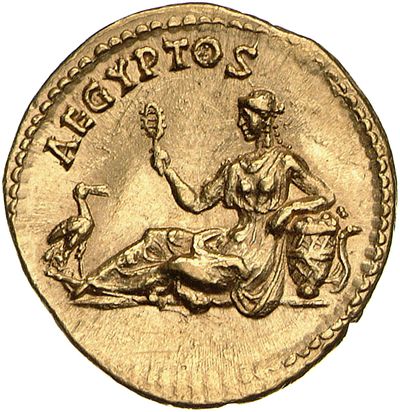
Aureus, Rome
RIC II Hadrian 296j · 134 AD-138 AD

As, Rome
RIC II Hadrian 577B · 119 AD-122 AD
A Collector’s History of Hadrian
He was born Publius Aelius Hadrianus on 24 January 76 AD, into a family with roots at Italica in Spain; whether he was actually born there or at Rome was disputed already in antiquity, so a careful guide leaves it open.5 He was a relative and ward of Trajan, and on Trajan’s death in the East in August 117 he became emperor through a deathbed adoption that contemporaries questioned, with Trajan’s widow Plotina suspected of managing the paperwork. The coinage does not argue the point, but the early ADOPTIO and consecration-of-Trajan types belong to that delicate first year.
What defined the reign was the opposite of Trajan’s. Hadrian gave up the new eastern conquests, fixed the frontiers, and spent the 120s and 130s travelling the empire end to end, Gaul, Britain (where the Wall was begun around 122), Spain, Greece, Egypt, the Danube and the East. The famous objects of his life are mostly buildings and the man Antinous, not battles: the Pantheon rebuilt, the Temple of Venus and Roma, the villa at Tivoli, and the Greek world cultivated as a cultural ideal. The hard exception was the Bar Kokhba revolt in Judaea, a brutal war of the 130s that ended with the province renamed and Jerusalem refounded as a colony, an episode the coinage passes over in the way official coinage passes over difficult things.
The end of the reign is a succession story that runs straight into the next two centuries of the catalog. Hadrian first adopted Lucius Aelius Caesar, who died at the start of 138 before he could succeed, leaving a short, scarcer body of L AELIVS CAESAR coinage that collectors prize for exactly that reason. Hadrian then adopted Antoninus Pius on the condition that Pius in turn adopt the young Marcus Aurelius and Lucius Verus. He died in July 138 at Baiae on the Bay of Naples. The DIVVS HADRIANVS consecration coinage was struck under Antoninus.
The journeys are the reign, and they explain the coinage, so a collector should hold the rough shape of them. The early-to-mid 120s took him through Gaul and Germany to Britain, where the Wall was laid out; the later 120s and early 130s through Spain, North Africa, Greece, where he was lavish with Athens and built a Panhellenic league around it, and Asia Minor; and the East and Egypt around 130, the journey on which Antinous drowned in the Nile. Cassius Dio is the main narrative source for the reign, written a century later and only partly preserved.6 The Historia Augusta life is fuller but late and unreliable in detail, which is why dates from it should be treated with caution rather than quoted as fact.7 The travel coinage maps these movements; it is the mint turning an itinerary into a programme.
The Beard
This is the most purely numismatic section in the guide, because here the coins are the primary evidence for a change in how Roman power chose to look. Augustus, the Julio-Claudians, the Flavians, Trajan: clean-shaven, every one, for a century and a half. Hadrian is bearded from the start of his coinage and stays bearded, and the emperors who follow him, Pius, Marcus, Verus, the Severans, keep the beard for another hundred years. He set a fashion you can see turn over on the metal.
The standard reading is philhellenism: the beard as a Greek and philosophical marker, fitting an emperor who rebuilt Athens and surrounded himself with Greek culture. Ancient gossip adds that it hid skin blemishes; you do not have to choose, and an honest guide should not pretend the motive is settled. What is not in doubt is the practical payoff for a collector: a bearded laureate head with HADRIANVS in the legend is one of the fastest secure identifications in Roman coinage. The portrait itself is idealised and calm, Greek in feeling, and it barely ages across the reign, which is the opposite of the careworn late Marcus Aurelius portrait two generations later.
There is more portrait variation than the calm first impression suggests, and it is worth training your eye on it because it helps with both dating and authentication. Early issues run closer to a Trajanic head with a shorter beard; the mature reign settles into the idealised, fuller-bearded type that became the model for the rest of the second century; the bust can be bare-headed, laureate, draped or cuirassed, and the drape/cuirass and the truncation are exactly the details a tooler softens, so a portrait that looks too smooth against the catalogue plates is a warning. The British Museum volume is the easiest place to compare a run of genuine Hadrian heads side by side.3
.hdn.116/5b4c180ff027b273_reverse.jpg?width=400&resize=contain)
Denarius, Rome
RIC II, Part 3 (second edition) Hadrian 116 · 118 AD
The Province Coinage Up Close
A practical pass through the families, because the legends do the work for you. The province personifications name themselves on the reverse and are usually unmistakable once you learn the attributes: Egypt with ibis, Africa in the elephant headdress, Hispania reclining with a rabbit, Britannia seated with a spear and shield. The ADVENTVI AVG arrivals and the RESTITVTORI raisings are emperor-plus-province compositions, dated by the obverse titles rather than by the scene.
The EXERCITVS army series is the connoisseur’s corner: Hadrian on horseback addressing the troops of a named province, struck mainly in bronze, scarce in good condition, and a sub-series some collectors spend a career assembling. The DISCIPLINA AVG type belongs with it, the army as an institution rather than a victory. And the BRITANNIA sestertius, a seated, helmeted figure that is the direct ancestor of the Britannia who still appears on British coinage, is the single most iconic coin of the reign and priced accordingly. None of these is a triumph type. That is the point of the whole programme.
The internal chronology of the travel series, when each province group was struck and in what order, was worked out largely by Strack and refined since; it does not map neatly onto the journeys themselves, so resist the temptation to date a coin to the year Hadrian set foot in the province it names.8 The compositions repay a close look. The ADVENTVI AVG arrivals are a small ceremony in metal: the emperor and the province personification face each other across a lit altar, sometimes with a sacrificial victim, the same scene reused with the province name swapped. The RESTITVTORI types invert the old conqueror image entirely, instead of a captive trodden underfoot, a kneeling figure raised by the hand. Once you have seen a few you can read an unlabelled fragment from the posture alone.
An arrival or restorer type:
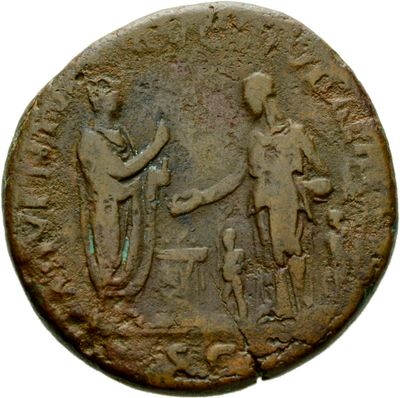
As, Rome
RIC II Hadrian 892 (as) · 134 AD-138 AD
An army (EXERCITVS) type:
.hdn.414/8d868db5fd8edb91_reverse.jpg?width=400&resize=contain)
Sestertius, Rome
RIC II, Part 3 (second edition) Hadrian 414 · 120 AD-121 AD
Denominations and Cistophori
The system is the imperial standard of the high second century. The aureus is gold, about 7.2 grams, worth 25 silver denarii. The denarius is the everyday coin, roughly 3.2–3.4 grams of good silver; precisely how fine is a question you should not answer with a single confident number, because the older surface-analysis figures (Walker) read high and bulk metallurgy has shown surface analysis systematically overstates silver content.9 The sestertius is the large orichalcum coin that carries the best province portraits and the highest prices; the dupondius and copper as sit below it, the radiate crown the usual quick tell for the dupondius against the laureate as.
One Hadrianic wrinkle worth knowing: the cistophori. These are large provincial silver pieces struck mainly for the province of Asia, with a later issue from Bithynia, roughly tariffed against the denarius system, with Greek-style reverses, temples, cult statues, the legend often just COS III. They are catalogued with Hadrian’s imperial coinage but they are a distinct fabric and a distinct collecting taste, broader and thinner than a sestertius, and they trade on their own terms. Do not price a cistophorus against a Rome denarius. The Alexandrian tetradrachms are a separate Egyptian provincial economy again.4
Below the as the small change, the semis and the quadrans, exists for Hadrian but is a specialist crumb, often anonymous and rarely the reason anyone collects the reign. At the other end sit the bronze and gold medallions, large presentation pieces struck in small numbers, scarce, expensive, and a field of their own. The practical point for a buyer is that the value spread within a single Hadrian denomination is unusually wide: a worn common as is pocket money, while a choice province sestertius of the same metal era is a five-figure coin. With Hadrian, the denomination tells you far less about the price than the reverse type and the surface do.
Denominations represented in the NumisLens catalog for this reign:
| Denomination | Types in catalog |
|---|---|
| Denarius | 2,027 |
| Sestertius | 1,643 |
| As | 1,362 |
| Aureus | 669 |
| Dupondius | 481 |
| Cistophorus | 105 |
| Quinarius Aureus | 70 |
| Semis | 59 |
| Quinarius | 57 |
| Quadrans | 48 |
| Uncia | 2 |
Where the Coins Were Made
For the gold, silver and bronze you will actually handle, the answer is Rome. The travel series did not follow the emperor around on a mint cart; it was struck at Rome and is best understood as Roman comment on the provinces rather than provincial coinage. The cistophori belong to mints in Asia Minor, and the Alexandrian tetradrachms and the Antinous bronzes are provincial issues outside RIC entirely. Some die-group and chronology attributions within the Rome output have been re-argued by the modern catalogue, which is one reason a careful listing now carries both an old RIC II number and a RIC II.3 number.2
Mints attested in the NumisLens catalog for this ruler (catalog attribution; the great majority is Rome):
| Mint | Types in catalog |
|---|---|
| Rome | 6,290 |
| Eastern Mint Ric | 231 |
| Ephesus | 70 |
| Antiocheia Syria | 16 |
| Pincum | 1 |
Key Types to Know
Three groups cover almost everything you will see. The standard personifications, Salus, Fortuna, Aequitas, Felicitas, Pietas, Pax, Roma, dated by the COS and tribunician numbers; these are the bulk of the denarii and the cheap way in. The travel and province families above, which carry the premium and the interest. The early reign types, ADOPTIO, the consecration of Trajan, PROVIDENTIA, the liberalitas and congiarium issues, which document the contested accession and the new regime settling in.
That first group rewards a second look because it is the coinage doing political work in real time. The ADOPTIO type asserts the legitimacy that contemporaries doubted; the consecration coinage for the deified Trajan, and the DIVIS PARENTIBVS issues honouring Trajan and Plotina together, tie the new emperor publicly to the predecessor whose choice of him was questioned. A PROVIDENTIA (“foresight”) reverse in year one is not a neutral abstraction; it is the mint insisting the succession was foreseen and orderly. You do not have to take the message at face value, the ancient sources did not, but knowing what the early types are arguing turns a cheap accession denarius into one of the more eloquent coins of the reign.
A useful collector distinction: Hadrian’s reign uses a long stretch of COS III in the legend (he held the third consulship from 119 and never took a fourth), so the consulship will not date a coin finely the way it can for some emperors. Lean on the tribunician power and the portrait style, and on the modern catalogue’s chronology, rather than on COS III alone.
Walk an example. Silver coin, 18 mm, 3.3 g, so a denarius. Obverse: a bearded laureate head, HADRIANVS AVG COS III P P. Reverse: a reclining female figure with an ibis at her feet and a sistrum in her hand, legend AEGYPTOS. Before any book: a Rome-mint denarius of the mature reign, the Egypt province type from the travel series, so a premium coin rather than a common personification. Conclusion reached from the legend and attributes alone; only then do you open the catalogue to attach the number, and here the catalogue itself is the catch. The original RIC II (1926) and the fully revised RIC II.3 (2019) number the reign differently, so an honest listing now often shows both, and a price “for RIC 297” means little until you know which RIC.1 Take the RIC II.3 number as the authority and keep the old one only as a cross-reference.
.hdn.276/2ab41b1804ef32a1_reverse.jpg?width=400&resize=contain)
Dupondius, Rome
RIC II, Part 3 (second edition) Hadrian 276 · 119 AD-120 AD
Sabina, Aelius and Antinous
Sabina, Hadrian’s wife, has a substantial and affordable coinage, CONCORDIA, VENVS, PVDICITIA, CERES, and is the cheap way to add the imperial household; her denarii are inexpensive, broadly in the common-silver range though a touch dearer than a plain Hadrian personification. Lucius Aelius Caesar, the first heir, has a short coinage from 137 cut off by his death at the start of 138, which makes it scarcer and dearer than Hadrian’s own common silver; collectors want it precisely because the man never reigned.
Antinous needs care, because the name attracts both money and fakes. Hadrian’s favourite drowned in the Nile in 130 and was deified; the coins that commemorate him are Greek provincial bronzes and medallions, struck in Bithynia, at Alexandria and elsewhere, never Roman imperial RIC issues. Genuine Antinous pieces are among the most prized and most heavily forged objects in the entire field, routinely four to five figures, and they belong to provincial catalogues. If a coin is offered as a “Hadrian RIC Antinous,” the attribution is wrong before you even look at the coin. Treat the whole Antinous area as a specialist, buyer-beware field separate from this guide.
A Sabina type from the catalog:
.hdn.2502/7f27fcee6c76dc02_reverse.jpg?width=400&resize=contain)
Denarius, Rome
RIC II, Part 3 (second edition) Hadrian 2502 · 130 AD-133 AD
Identifying Your Coin
The order is the usual one. One: denomination by metal and size, gold aureus around 7 grams, silver denarius around 3.3, large orichalcum sestertius, copper as; a broad thin silver piece with a Greek-style temple reverse is a cistophorus, not a denarius. Two: obverse legend. IMP CAESAR TRAIAN HADRIANVS AVG is early; HADRIANVS AVG COS III P P is the long mature form; DIVVS HADRIANVS is posthumous under Antoninus. Three: reverse legend and figure, and with Hadrian the reverse often names itself, a province, an army, an arrival. Four: match it in the NumisLens Hadrian catalog, in RIC II, or in the revised RIC II.3, which renumbered much of the reign, so expect to reconcile an old and a new number.2 OCRE gives a free first pass with images.
Walk one. Brass coin, 32 mm, 25 g, so a sestertius. Bearded laureate head, HADRIANVS AVG COS III P P. Reverse: a seated helmeted female figure with a spear and a shield bearing a saltire-like pattern, legend BRITANNIA, with S C in the field. Before any book: a Rome-mint Britannia sestertius of the mature reign, the iconic type, and a coin to authenticate carefully because it is forged and tooled more than almost any other Hadrian bronze. Now you look it up to attach the exact RIC II and RIC II.3 numbers and to check it against known genuine dies, rather than trusting the seller’s label.
Common misattributions: a bearded Hadrian taken for Antoninus Pius or Marcus Aurelius on a worn coin (the legend separates them instantly); a provincial Antinous or Alexandrian piece filed under RIC; a cistophorus described and priced as a heavy denarius. The NumisLens identification tool will propose an attribution from a photo to check against the catalog, and The Case walks the same legend logic.
Collecting and Market
Hadrian is two markets wearing one portrait. The ordinary coinage is accessible: a sound denarius for the price of a meal, a common sestertius for a few hundred. The travel and province coinage is a connoisseur market where condition, the specific province, and originality of surface drive prices into four and five figures. Decide which collection you are building before you spend, because the gap is enormous and a budget set for the first will not touch the second.
A sensible build: one common denarius in solid VF as your anchor; a Sabina denarius for the family; one affordable province denarius (Aegyptos, Africa and Hispania turn up at sane money) for the idea of the series; a common sestertius bought for its patina. Then, if the travel series grips you, save and wait for one good province or EXERCITVS bronze rather than buying three mediocre ones. Track the set in your NumisLens catalog so you are not buying duplicates by accident.
Price Reference
Orientation only, not quotes; tie every figure to a grade and judge the specific coin, since dealer grading varies. Research current results on CNG, acsearch and Leu before committing above $300, and on anything in the province series get a recent comparable, the spread is wide.
- Common denarius (standard personification), VF: roughly $80–250 at the dealer floor; well-struck good-VF examples and better reverses reach more at auction.
- Province / travel denarius, VF: a premium over common silver; the popular provinces command the most, and price varies sharply by which province and how well centred.
- Common sestertius, VF: a worn or cleaned coin runs a few hundred; a choice example with intact original patina can reach four figures. Surface, not the wear grade, sets the price.
- Province / Britannia / EXERCITVS sestertius: blue-chip. Strong examples reach several thousand and well beyond; the iconic Britannia and the army types are career-coins, not casual buys.
- Aureus, VF: generally from about $3,000–6,000, more for travel types and high grade; gold price and numismatic quality both move it.
- Sabina denarius, VF: inexpensive, broadly in the common-silver range though a touch dearer than a plain Hadrian personification; an easy way to add the imperial family.
- Lucius Aelius Caesar denarius, VF: a clear premium over common Hadrian silver for the short, never-reigned coinage.
- Antinous: a separate provincial field, typically four to five figures genuine and a heavy forgery target; do not treat it as a Hadrian RIC purchase.
Fakes and Forgeries
The high-value Hadrian types attract the high-effort fakes, so this matters more here than for most reigns. Modern cast fakes of province sestertii and aurei show a soft grainy surface, an edge seam, and mushy legends. Renaissance Paduans, after-the-fact medals of Antonine and Hadrianic sestertii from the circle of Giovanni da Cavino, are old and sometimes collected in their own right but are not ancient coins and must never be sold as such. Tooled and re-cut bronze is the real hazard on the Britannia and province sestertii, where a genuine but worn coin has had its portrait or province figure sharpened by hand; it is the hardest to catch and the reason these coins are bought from dealers who guarantee them. And the entire Antinous area is a minefield: forged since the Renaissance, faked at every price point, and not to be touched without specialist help and ironclad provenance. On anything expensive, provenance and a return policy matter as much as the coin in hand.
Read a province sestertius before you buy it, in this order. Look at the fields first, not the portrait: a genuine struck coin has slightly uneven, flowing metal in the open field, while a cast shows a faint orange-peel texture and often a hair-thin seam at the edge. Then the high points, the province figure’s face and the emperor’s beard and hair, because that is where a tooler works; detail that is sharper and crisper than the surrounding wear, or that does not quite match the catalogue plates, is the tell. Check the legend letters for the same: re-cut letters sit on top of the surface rather than in it. Last, the patina, an even, hard, glassy surface that follows the relief is right; a flat, powdery, or suspiciously uniform green that pools in the wrong places is a repatination over a cleaned or tooled coin. None of this replaces a guarantee, but it will keep you from the obvious mistakes, and on a four-figure province bronze the ten minutes are the best-paid ten minutes in the hobby.
Start Your Hadrian Collection
Browse 6,652 catalogued types, 1,538 with images and catalog references, and track what you own in NumisLens.
Browse the Hadrian CatalogQuestions Collectors Ask
Is a Hadrian coin a good first ancient coin?
A common Hadrian denarius is an excellent first coin: genuine silver, a famous emperor, an instantly recognisable bearded portrait, and $80–250 in VF so a beginner mistake is cheap. Resist starting with a province sestertius; those are a connoisseur market with serious forgery risk, not a starter purchase.
Why does Hadrian have a beard when earlier emperors don’t?
He is the first emperor regularly shown bearded, breaking a century and a half of clean-shaven portraits. The usual reading is philhellenism, the beard as a Greek philosophical marker; ancient gossip adds it hid blemishes. The motive is not settled, but the effect is: every bearded emperor after him follows the fashion he set, and the beard plus the name is one of the fastest secure IDs in Roman coinage.
Which Hadrian coin should I most want?
For meaning on a budget, an affordable province denarius (Aegyptos, Africa, Hispania). For the iconic object, the Britannia sestertius, the ancestor of the modern Britannia, though it is expensive and heavily faked. For the connoisseur, an EXERCITVS army bronze in honest condition. All three say something no plain personification type does.
RIC II or RIC II.3 — which number is right?
Both, in practice. RIC II (1926) is the old reference still quoted in older listings; RIC II.3 (2019) is the fully revised modern standard that re-studied and renumbered the reign. A careful dealer now cites the new number and often the old one too. Use RIC II.3 as the authority and treat the old RIC II number as a cross-reference.
Are Antinous coins Hadrian coins?
No. Antinous has no Roman imperial coinage; the Antinous coins are Greek provincial bronzes and medallions struck after his death, catalogued in provincial references, not RIC. They are very expensive and very heavily faked. A coin sold as a “Hadrian RIC Antinous type” is misattributed.
What is a cistophorus and is it the same as a denarius?
A cistophorus is a large provincial silver coin struck for the province of Asia under Hadrian, broader and thinner than a denarius, with Greek-style reverses and usually just COS III as the legend. It is catalogued with the imperial coinage but trades on its own terms. Do not price one as a heavy denarius; it is a different market.
Where was Hadrian born, and does it matter for the coins?
Italica in Spain by tradition, Rome according to one ancient source; it was disputed in antiquity and is not settled, so a careful guide leaves it open. It has no bearing on attribution, the coins were struck at Rome, but it is the kind of “fact” worth not stating too confidently.
Where should I buy?
CNG, Roma, Leu and Nomos for auction; NAC, Künker and NGSA for top province bronzes and gold; VCoins and MA-Shops for fixed-price from vetted dealers; Heritage for the largest US pool. Common denarii and Sabina silver are everywhere. For province sestertii and anything Antinous, buy only with an authenticity guarantee and a return policy, and be very careful on eBay.
References
Sources cited in this guide. For the modern numbering and a full bibliography of Hadrianic numismatics, see RIC II.3.2
- Mattingly, H. & Sydenham, E.A. (1926). The Roman Imperial Coinage, Volume II: Vespasian to Hadrian. London: Spink.
- Abdy, R.A. & Mittag, P.F. (2019). The Roman Imperial Coinage, Volume II, Part 3, second fully revised edition: Hadrian. London: Spink.
- Mattingly, H. (1936). Coins of the Roman Empire in the British Museum, Volume III: Nerva to Hadrian. London: British Museum.
- Sear, D.R. (2002). Roman Coins and Their Values, Volume II: The Accession of Nerva to the Overthrow of the Severan Dynasty. London: Spink.
- Birley, A.R. (1997). Hadrian: The Restless Emperor. London: Routledge.
- Cassius Dio, Roman History, Book 69. Trans. Cary, E. (1925). Loeb Classical Library, Harvard University Press.
- Scriptores Historiae Augustae, Hadrianus. Trans. Magie, D. (1921). Loeb Classical Library. The Historia Augusta is late and unreliable in detail; used here only where corroborated.
- Strack, P.L. (1933). Untersuchungen zur römischen Reichsprägung des zweiten Jahrhunderts, Teil II: Die Reichsprägung zur Zeit des Hadrian. Stuttgart: Kohlhammer.
- Butcher, K. & Ponting, M. (2014). The Metallurgy of Roman Silver Coinage: From the Reform of Nero to the Reform of Trajan. Cambridge University Press. Cited for the demonstration that surface analysis overstates silver fineness.
- Toynbee, J.M.C. (1934). The Hadrianic School: A Chapter in the History of Greek Art. Cambridge University Press. On the province personifications.
Further resources
- NumisLens Hadrian Catalog, browse all 6,652 types with images and catalog references.
- Hadrian: Emperor Profile, reign dates, dynasty, coinage timeline, key events.
- NumisLens Coin Identification, search by legend, denomination, and reverse type for attribution of Hadrianic types.
- OCRE (Online Coins of the Roman Empire), searchable RIC database with images.
- Trajan Coins: A Collector’s Reference, the predecessor and the empire at its widest.
- Marcus Aurelius Coins, the philosopher emperor, two adoptions later.
- The Roman Denarius, the denomination most Hadrian coinage is struck in.
Identify Your Hadrian Coins
Search by legend, denomination, and reverse type to reach a RIC reference. The catalog covers 1,538 Hadrian types with images.
Try Coin Identification