Hellenistic Coinage: The Successor Kingdoms
A Hellenistic tetradrachm looks like the Greek city silver that came before it. It is not. The face on the obverse is no longer a god or a civic badge but a living king, the weight may have been cut to wall a kingdom off, and reading the reverse tells you which successor struck it.
Hellenistic coinage covers the kingdoms that broke out of Alexander the Great's empire after his death in 323 BC — the Ptolemies of Egypt, the Seleucids of Syria and Iran, the Antigonids of Macedon, the Attalids of Pergamon, and the Greek kings of Bactria — down to the Roman annexation of Egypt in 30 BC. Its signature is the silver portrait tetradrachm and the long-running posthumous Alexander.
After Alexander
Alexander died in Babylon in 323 BC with no working heir, and his generals spent the next forty-odd years fighting over the pieces. The Wars of the Diadochi — the Successors — run roughly from 323 to 281 BC, and they end with the map of the Hellenistic world more or less set: Ptolemaic Egypt, the vast Seleucid realm from the Aegean to the Iranian plateau, Antigonid Macedon, Attalid Pergamon, and, further east, the Greek kingdoms of Bactria. This is the world that ancient Greek coinage turns into after the city-state era closes, and the one Rome will absorb piece by piece.
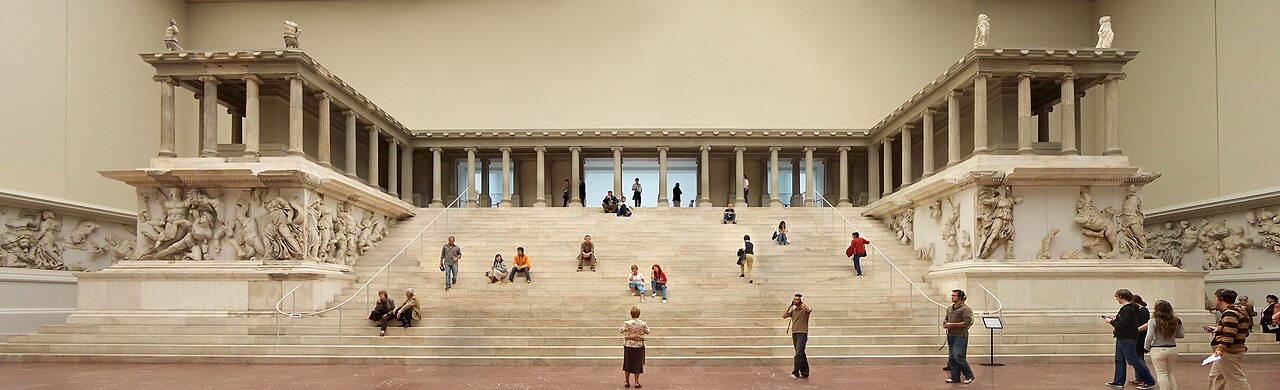
The Great Altar of Pergamon, built under the Attalids in the 2nd century BC — the wealth of the kingdom whose silver cistophoric coinage is one of the Hellenistic signatures.
Photo: Lestat (Jan Mehlich) — CC BY-SA 3.0, via Wikimedia Commons
The numismatics tracks the politics with unusual precision, because the first thing every Successor did was not put his own face on the money. They kept striking Alexander's coinage — his types, his name — because that was the trusted international currency and changing it would have cost them. The portrait coinage comes later, once a dynasty is secure enough to assert itself, and when it comes it is the single most consequential change in ancient money: the living ruler's head on the obverse. The Greek city had put gods and civic badges on its coins. The Hellenistic king put himself, and Rome inherited the habit wholesale.
The terminal dates are a slow Roman tide. Macedon falls at Pydna in 168 BC. Pompey winds up what is left of Seleucid Syria around 63 BC. The Ptolemies last longest, to the death of Cleopatra VII and the Roman annexation of Egypt in 30 BC. Three centuries, one coinage tradition, ending one kingdom at a time.
Two weight standards
Most of the Hellenistic world used one weight standard, and the exception is the one worth learning first. Alexander struck his imperial coinage on the Attic standard — the tetradrachm at about 17.2 grams of silver — and the Seleucids, the Antigonids, the Attalids, the Bactrians, and the Greek cities striking posthumous Alexanders all stayed on it. An Attic tetradrachm is the default Hellenistic coin: heavy, broad, the canvas for a royal portrait.
Then there is Egypt. Ptolemy I pulled the tetradrachm down to a reduced standard of roughly 14.2 grams and shut the border to foreign silver — coin entering Egypt was exchanged for Ptolemaic issues, by law. It was a closed monetary system, the only thoroughgoing one in the ancient Mediterranean, and it has a useful side effect for a collector two thousand years later: a Ptolemaic tetradrachm is noticeably lighter and smaller in the hand than a Seleucid one, before you have even looked at the types. Weigh first, then read. Gold stayed rare across the board — Philip II's and Alexander's gold staters circulated internationally, and the Ptolemies struck spectacular ceremonial gold octadrachms for the dynasty's own festivals, but silver did the work everywhere.
The denominations
The Hellenistic vocabulary is the Greek one, scaled up to royal mints. Links go to the catalogued inventory where it exists.
| Denomination | Rough weight | What to know |
|---|---|---|
| Decadrachm | ~43 g | Rare. Alexander's Indian-campaign "Porus" decadrachms are the famous case. |
| Tetradrachm | ~17.2 g Attic / ~14.2 g Ptolemaic | The dominant unit and the portrait canvas. The whole field turns on this coin. |
| Stater | gold, ~8.6 g | Alexander's gold "Niketai" with Athena and Nike; traded far beyond the Greek world. |
| Didrachm | ~8.6 g | Common in Seleucid and Bactrian silver; the half-tetradrachm of daily larger payments. |
| Drachm | ~4.3 g | Fractional silver, often struck for local circulation rather than long-distance trade. |
| Octadrachm / mnaieion | gold, ~27 g | Large Ptolemaic ceremonial gold (Arsinoe II, dynastic types). Not yet catalogued here. |
| Bronze (AE) | varies widely | Every kingdom struck its own. Seleucid serrated bronze of Antiochus IV is a distinctive case. |
A practical note on the bronze: Hellenistic AE is wildly variable in quality and badly served by old references, and a lot of it cannot be attributed below "Seleucid, second century BC" without specialist literature. Buy bronze for the type you can actually read, not for the bargain. The silver is where the field's value and its scholarship both sit.
Reading the kingdoms
Hellenistic coinage is organised by dynasty, and each major house has a reverse you can learn in a sentence. The Ptolemaic dynasty of Egypt — Ptolemy I through Cleopatra VII — runs the eagle-on-thunderbolt reverse on reduced-weight silver, the most instantly recognisable series in the period and the largest single keyword cluster in collector demand. It was under Ptolemy IV, victor over the Seleucids at Raphia in 217 BC, that this silver kept pouring out even as the kingdom began its long slide. The Seleucid dynasty, from Seleucus I to the last claimants, mostly shows Apollo seated on the omphalos — the Delphic navel-stone — sometimes Zeus enthroned; Antiochus III "the Great" and the serrated bronze of Antiochus IV are the types most collectors meet first.
The Antigonid dynasty in Macedon keeps the old Macedonian shield and Pan imagery; the independent dynasts beside them are where the portrait experiment is boldest. Lysimachus of Thrace put a deified Alexander with the horn of Ammon on his tetradrachms — one of the most beautiful portraits in the whole series, and not even of himself. Demetrius Poliorcetes put his own head on the coin with a bull's horn, the first European ruler to so plainly claim divinity in metal. Further east, the Greco-Bactrian kings — Euthydemus, Eucratides, Menander — produced portrait engraving that arguably never has been bettered, on coins struck a thousand miles past anything Greek city money ever reached. NumisLens does not yet have entity pages for the Bactrians; for now they live in the prose here and in the Greek coin identification guide.
The longest-running coin in antiquity
One type deserves its own section, because a collector meets it before anything else and usually misunderstands it. The posthumous Alexander tetradrachm — Herakles in a lion-skin on the obverse, Zeus seated with an eagle and the name ΑΛΕΞΑΝΔΡΟΥ on the reverse — was struck for more than two and a half centuries after Alexander's death, by Successor kings, by free Greek cities, by mints from Macedon to Babylon to the Black Sea. The lifetime issues are a small fraction of what survives. Most "Alexander tetradrachms" on the market are posthumous, and the difference between a 320s-BC lifetime coin of Alexander III and a 1st- century-BC civic imitation is a difference of hundreds to thousands of dollars that hangs entirely on mint, monogram, and style. This is the single most over-attributed coin in the ancient market. Learn it before you buy it.
The east of this world feeds straight into the next reference hubs. The Seleucid collapse hands the Iranian plateau to the Parthian and then Sasanian empires; the absorbed kingdoms reappear, restruck and provincial, under Roman provincial and then Roman Imperial coinage. The Hellenistic portrait does not die in 30 BC; it just changes whose head it carries.
Collecting and the market
Before any price matters, the authentication question does, because this is the field where the same design spans two centuries and a thousand miles. A coin sold as a lifetime Alexander is far more often a posthumous civic strike, and the gap between the two is money, not pedantry. Establish what the coin actually is, then place it: common posthumous Alexander tetradrachms in Very Fine run roughly two-fifty to six hundred dollars; Ptolemaic eagle tetradrachms of the common Ptolemies sit a little below that; Seleucid tetradrachms of Antiochus III or VII run three hundred to nine hundred. Lifetime portrait silver is where it climbs — a sharp Mithridates VI or an early Seleucid lifetime portrait runs into the low thousands, and good Greco-Bactrian portrait silver (Eucratides, Demetrius) higher again. At the very top, the Ptolemaic ceremonial gold and the unique Eucratides twenty-stater in Paris are objects, not coins, with valuations to match.
Two field habits. First, posthumous Alexanders and Lysimachi were imitated and faked more than almost anything else, in antiquity and since — provenance and a known seller matter as much here as in high Greek silver. Second, the scholarship has moved a long way and old attributions are often wrong; the open references to trust are the American Numismatic Society's Hellenistic Royal Coinages framework and its Seleucid and Ptolemaic online catalogues, with Mørkholm's Early Hellenistic Coinage, Houghton and Lorber's Seleucid SC volumes, and Lorber's Coins of the Ptolemaic Empire as the standard printed works. The major auction houses for the series are Numismatica Ars Classica, CNG, Roma, and Künker; their archives on acsearch are the working price guide. Buy the coin, then buy the book, then check the coin against the book.
Questions
Are posthumous Alexanders the same as his lifetime coins?
Same types — Herakles obverse, seated Zeus reverse, the name ΑΛΕΞΑΝΔΡΟΥ — but struck after 323 BC by Successor kings and Greek cities, for over two centuries. Most surviving Alexander tetradrachms are posthumous; separating them takes mint, monograms, and style.
Why is Ptolemaic silver lighter?
Ptolemy I cut the tetradrachm from about 17.2 g Attic to roughly 14.2 g and closed the border to foreign coin, which was exchanged for Ptolemaic money on entry. The light weight is the system, and the quickest way to spot a Ptolemaic piece by hand.
Seleucid or Ptolemaic — which is which?
Reverse and weight. Seleucid: Apollo on the omphalos or Zeus enthroned, heavier Attic standard. Ptolemaic: eagle on a thunderbolt, lighter reduced standard. The diademed portraits look alike; the reverse and the scale decide.
Which Hellenistic coinage is most collectible?
Lifetime portrait silver of the famous names — Cleopatra VII, Mithridates VI, the Greco-Bactrians, Eucratides above all. Common posthumous Alexanders are the affordable entry point into the same world.
What is Greco-Bactrian coinage?
The Greek kingdom that broke from Seleucid Syria in the mid-third century BC and ruled in modern Afghanistan and northern Pakistan, with bilingual Indo-Greek successors. Its portrait silver is some of the finest engraving in all ancient coinage.