The Ptolemaic Dynasty: Coinage of Hellenistic Egypt
The portrait on a Ptolemaic coin looks like the reigning king. Usually it is not: it is the founder, dead for two centuries, kept on the money the way a sealed currency keeps its borders shut. Out of that closed system run the eagle that held for three centuries and a final chapter written by a queen who ruled in Morocco.
The Ptolemaic dynasty ruled Hellenistic Egypt from 305 to 30 BC — Ptolemy I Soter, one of Alexander's generals, to Cleopatra VII. Its coinage is the most distinctive of the Hellenistic world: a closed monetary system on a reduced standard of about 14.2 g, the eagle-on-thunderbolt tetradrachm, a founder portrait frozen for two centuries, and some of the most spectacular gold struck in antiquity.
Ptolemy I and the closed system
When Alexander died, his general Ptolemy took Egypt — and, famously, hijacked Alexander's funeral cortege so the body would be buried in his territory, not the Successors' chosen one. By 305 BC he had stopped pretending to govern for a dead king and called himself king in his own right. The dynasty he founded ran for nearly three centuries, the longest-lived of all the Hellenistic successor lines, and it ends with the most famous name in ancient history.
Ptolemy I's lasting numismatic decision was monetary, not artistic. He cut the tetradrachm down from the Attic standard of about 17.2 grams — the standard the rest of the Hellenistic world and the Greek city tradition used — to a reduced standard of roughly 14.2 grams, and he closed the border to foreign silver. Coin entering Egypt was exchanged, by law, for Ptolemaic money. This is the only thoroughgoing closed currency zone in the ancient Mediterranean, and it has a consequence a collector can feel two thousand years later: a Ptolemaic tetradrachm is noticeably lighter and tighter than a Seleucid one before you have read a single letter. Weigh the coin first. The standard is the dynasty's signature, not the portrait.
The eagle, the founder, the gold
The reverse almost never changes, and that is the point. An eagle stands on a thunderbolt with the legend ΠΤΟΛΕΜΑΙΟΥ ΒΑΣΙΛΕΩΣ, "of King Ptolemy", and it stays there, recognisably, for three hundred years. Like the Athenian owl, the type was deliberately conservative: a known coin is a trusted coin, and the Ptolemies were running a state-managed currency that depended on that trust. The obverse is usually the diademed head of Ptolemy I, struck long after his death — a frozen founder portrait carried for some two centuries, the way the United States keeps long-dead presidents on its money. Reigning kings and deified queens appear too, but the default Ptolemaic silver coin is the founder's face and the eagle.
Two things break the monotony, and both are worth knowing. The first is the great dynastic gold: the mnaieion or octadrachm, large gold pieces honouring Arsinoe II — sister-wife of Ptolemy II, the pair styled the Theoi Adelphoi, the Sibling Gods — and later Berenike II. These are among the most imposing coins struck in antiquity and sit at the very top of the market. The second is the bronze. Ptolemaic bronze of the third century BC reaches enormous size; the largest modules approach fifty millimetres across and feel like hardware rather than coins. A big Zeus-Ammon-and-eagle bronze of Ptolemy III or IV is one of the most physically impressive objects in ancient numismatics, and a perennial favourite of new collectors for exactly that reason.
The attribution apparatus is the field of control marks — mint letters, monograms, and series symbols carried beside the eagle. Catherine Lorber's Coins of the Ptolemaic Empire (2018) is the definitive modern reorganisation of this material and the reference to own before spending real money; the older Svoronos corpus and the American Numismatic Society's open Ptolemaic Coins Online are the working tools. NumisLens does not yet carry the per-ruler Ptolemaic inventory — the catalogued depth here is the shared tetradrachm, drachm, and didrachm denomination pages and the Hellenistic culture hub above; the per-ruler pages are being built (see below).
The dynasty, ruler by ruler
Fifteen Ptolemies, a row of Cleopatras and Berenikes, co-regencies, expulsions, and at least one king restored by a Roman loan. The later chronology is genuinely contested — treat the dates below as the standard scholarly span, hedged where the co-regencies tangle. The rulers with their own NumisLens biography page (in progress) are linked; the rest are prose for now.
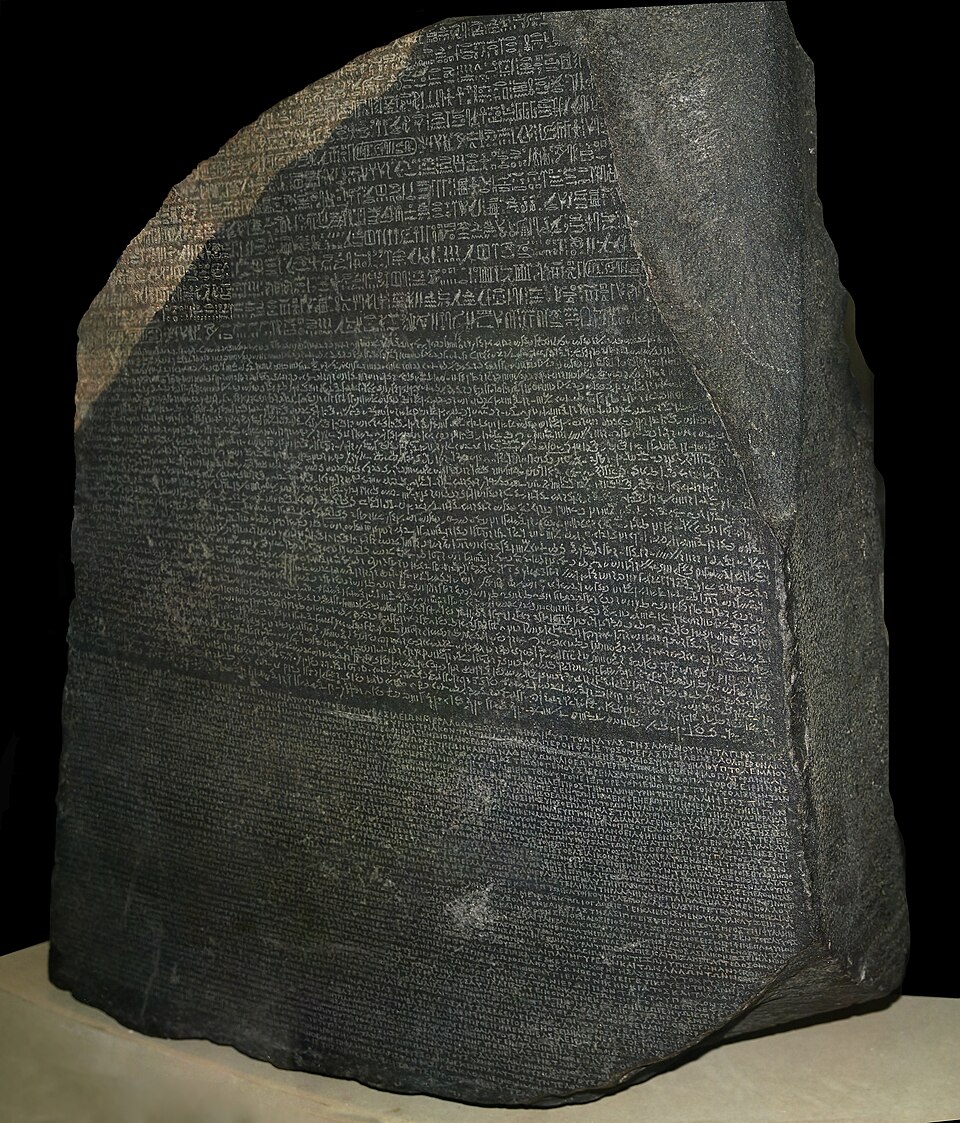
The Rosetta Stone — a priestly decree of Ptolemy V Epiphanes, 196 BC, in hieroglyphic, Demotic, and Greek. The king named on it issued the coinage of this dynasty's middle period.
Photo: Hans Hillewaert — CC BY-SA 4.0, via Wikimedia Commons
| Ruler | Reign (BC) | Numismatic note |
|---|---|---|
| Ptolemy I Soter | 305–282 | Founder. The closed system, the Alexandria mint, the portrait that outlives him by 200 years. |
| Ptolemy II Philadelphus | 284–246 | The Theoi Adelphoi gold; the Arsinoe II octadrachms — the dynasty's numismatic high point. |
| Ptolemy III Euergetes | 246–222 | The colossal bronze. Berenike II coinage. |
| Ptolemy IV Philopator | 221–204 | Raphia, 217 BC — the last great Ptolemaic victory; the dynasty's slow fiscal decline begins. |
| Ptolemy V Epiphanes | 204–180 | The Rosetta Stone king. Loss of the overseas possessions. |
| Ptolemy VI Philometor | c. 180–145 | Civil war with Ptolemy VIII; Roman arbitration of Egypt begins in earnest. |
| Ptolemy VIII Physcon | c. 170–116 | Repeated co-rule and expulsion; debased silver. |
| Ptolemy XII Auletes | 80–51 (interrupted) | Restored to the throne by Roman money. Cleopatra VII's father. |
| Ptolemy XIII | 51–47 | Co-ruler and rival of Cleopatra VII; died in the Alexandrian War. |
| Cleopatra VII | 51–30 | The last pharaoh. Portrait bronze at Alexandria; Levantine silver with Antony. |
| Cleopatra Selene II | c. 25 BC–c. 5 BC | Daughter of Cleopatra VII; queen of Mauretania. The dynasty's afterlife — and its biggest search cluster. |
The two adjacent Hellenistic houses are the Seleucid dynasty of Syria and Iran and the Antigonid dynasty of Macedon; their hubs carry the comparison in detail as they are published.
Cleopatra VII and the end
Cleopatra VII is the reason this hub exists, in search terms, and the numismatic reality is more interesting than the legend. She did issue coins — portrait bronze at Alexandria reading ΚΛΕΟΠΑΤΡΑΣ ΒΑΣΙΛΙΣΣΗΣ, and silver in the Levant struck jointly with Mark Antony, her own hard-featured portrait facing his. The famous "beautiful Cleopatra" is not on the coins; the coins show a sharp-nosed, strong-jawed queen who controlled her own image as a Hellenistic monarch, not a romance. Genuine Cleopatra portrait coins are scarce and fiercely contested at auction; her name premium is the single strongest in ancient numismatics, which also makes her one of the most faked names in the field. Provenance is not optional here.
The political end is quick. Cleopatra and Antony lose at Actium in 31 BC; both are dead by 30 BC; Egypt becomes a Roman province and its coinage continues, restruck, as the Alexandrian tetradrachm system that fed Roman provincial coinage for three more centuries. The closed system outlived the dynasty that built it. A note on scope: Cleopatra VII has a NumisLens biographical page in progress but no separate ruler catalogue or collector guide — she has no body of catalogable distinct coin types to support one, and saying so plainly is more honest than padding a thin inventory page. The Cleopatra VII biography and this hub carry her.
The afterlife in Mauretania
Here is the fact that surprises people: the most-searched ruler in the whole Ptolemaic story is not Cleopatra VII. It is her daughter. Cleopatra Selene II — child of Cleopatra VII and Mark Antony — was spared by Augustus, raised in Rome, and married to Juba II, the scholar-king Rome installed in Mauretania. As queen there, roughly 25 BC to about 5 BC — the exact year of her death is debated, with some scholars arguing for a later date — she struck her own coinage: Ptolemaic and Egyptian motifs — crocodile, sistrum, the dynastic imagery of a kingdom that no longer existed — on the money of a Roman client state in what is now Morocco and Algeria. It is the Ptolemaic dynasty continued by a daughter, in exile, in metal. Her biography page is a D5.2 deliverable; the search demand for her name is the largest single non-Roman ruler cluster in the entire plan, and almost none of it is currently served well anywhere.
Collecting and the market
The forgery risk in Ptolemaic coinage is unusually lopsided, and knowing where it concentrates is most of what protects a new buyer. The eagle tetradrachms and the big bronzes are common enough that faking them rarely pays; the danger is almost entirely in the famous names, where the premium makes a convincing fake worth a forger's time. Buy the workhorse coins with confidence: common eagle tetradrachms of the mid-dynasty Ptolemies (II, III, VI, VIII, IX) in Very Fine run roughly two hundred to five hundred dollars, more for a well-centred coin on a full flan. The big third-century bronzes are the bargain showpiece — a hundred and fifty to six hundred by size and surface, and few ancient coins give you that much physical presence for the money. Ptolemy I lifetime portrait silver runs higher, into four figures for the better types. Cleopatra VII portrait coinage is its own market, scarce and demand-driven into the thousands. The dynastic gold octadrachms are five-figure coins and up.
Two cautions. The late tetradrachms of Ptolemy XII and Cleopatra VII are heavily debased billon, not good silver — that is the dynasty's fiscal exhaustion showing in the metal, and it is normal, not a defect to discount past. And the famous names — Cleopatra above all — carry a forgery problem proportional to their fame. For anything with Cleopatra's name on it, buy from an established auction house with a published pedigree, or do not buy it. The open references to check against are the ANS Ptolemaic Coins Online and Hellenistic Royal Coinages, with Lorber's Coins of the Ptolemaic Empire as the printed standard; the major auction houses are Numismatica Ars Classica, CNG, Roma, and Künker, whose archives on acsearch are the price guide that actually works.
Questions
Who were the Ptolemies?
The Macedonian-Greek dynasty that ruled Egypt from 305 to 30 BC, founded by Alexander's general Ptolemy I Soter and ending with Cleopatra VII. Fifteen kings named Ptolemy plus the queens — Arsinoe II, Berenike II, the Cleopatras — who appear on the coinage in their own right.
Why is Ptolemaic silver lighter?
Ptolemy I cut the tetradrachm from about 17.2 g Attic to roughly 14.2 g and closed the border to foreign coin, which was exchanged for Ptolemaic money on entry. The light weight is the system, and the fastest way to spot a Ptolemaic piece by hand.
Did Cleopatra issue coins?
Yes — portrait bronze at Alexandria reading ΚΛΕΟΠΑΤΡΑΣ ΒΑΣΙΛΙΣΣΗΣ, and Levantine silver struck with Mark Antony. Her coin portrait is sharp and severe, not the legend's beauty. Genuine examples are scarce, in fierce demand, and heavily faked.
Who was Cleopatra Selene II?
Daughter of Cleopatra VII and Mark Antony, married to Juba II and reigning as queen of Mauretania, roughly 25 BC to about 5 BC (the exact death year is debated). Her coinage carries Ptolemaic imagery into Roman North Africa, and her name draws the largest non-Roman ruler search demand in the plan.
What is the eagle on Ptolemaic coins?
An eagle on a thunderbolt with ΠΤΟΛΕΜΑΙΟΥ ΒΑΣΙΛΕΩΣ, "of King Ptolemy" — the dynasty's signature reverse for roughly three centuries, and the most recognisable coin type of the whole Hellenistic world.