Sasanian Coinage: Four Centuries of the Silver Drachm
A broad disc of silver, four grams, a crowned profile on one side and a fire altar on the other. That single coin ran a Persian empire from Ardashir in AD 224 to the last drachm of Yazdegerd III, and its crown names the king while its altar names the faith. NumisLens does not catalogue the series yet; this page explains the coin and where to read it.
Sasanian coinage covers the issues of the Sasanian Persian Empire from Ardashir I's founding in AD 224 to the Arab conquest under Yazdegerd III in 651. It runs on a single dominant denomination — the broad silver drachm — with the king's crowned bust on the obverse and a Zoroastrian fire altar on the reverse, plus mint signatures and regnal years that make it one of the most readable of all ancient coinages. NumisLens does not yet catalogue this series; see SNS and Göbl below.
Where the empire begins
In AD 224 a sub-king from Fars named Ardashir defeated the last Parthian great king in the field and took the title shahanshah, King of Kings. The Arsacid house that had ruled Iran for nearly five centuries was finished; the Sasanian house would hold the plateau for the next four hundred years. Ardashir understood from the start what the coinage was for. It was not only money. It was the most widely distributed political document the state could produce, and he used it deliberately — the elaborate crown asserting a kingship granted by Ahuramazda, the fire altar on the reverse binding the dynasty to Zoroastrian religion as the official creed of the empire.
What follows that founding is unusually continuous. Four centuries, one ruling family, one dominant coin, and a visual formula stable enough that a worn drachm of the seventh century still looks like a worn drachm of the third. The reigns that anchor the series are worth knowing before you handle the coins. Shapur I, roughly 240 to 270, captured the Roman emperor Valerian alive in 260 and had the humiliation carved into the cliff face at Naqsh-e Rustam. Shapur II, 309 to 379, held the throne for about seventy years — by tradition the longest reign in Persian history, and the story goes that he was crowned while still in the womb. Khosrow I "Anushirvan", 531 to 579, was the great administrative reformer. Khosrow II "Parviz", 590 to 628, fought the ruinous war against the Roman emperor Heraclius that left both empires open to the Arab armies. And Yazdegerd III, 632 to 651, the last of the line, was killed near Marv as the plateau was overrun.
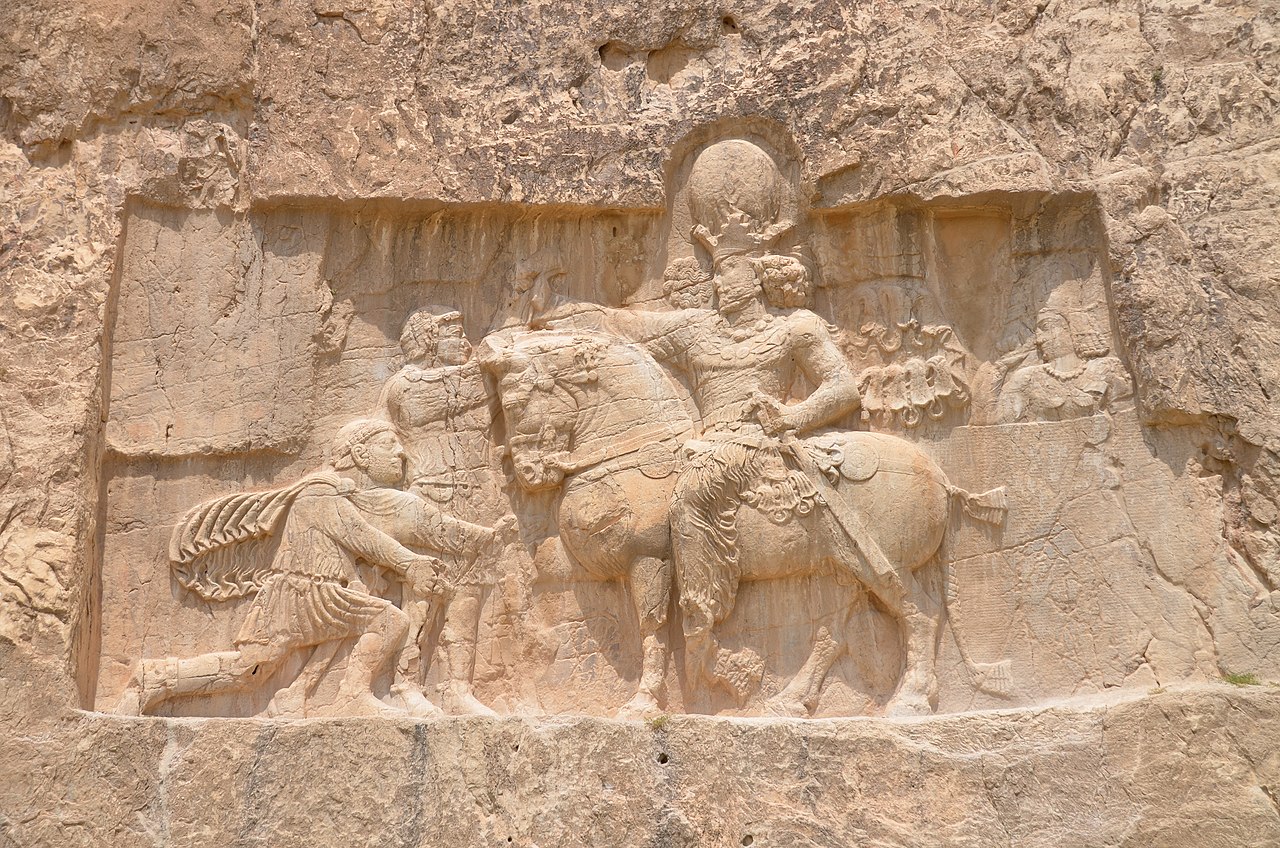
The triumph of Shapur I: the captured Roman emperor Valerian kneels in submission, Philip the Arab stands as supplicant. Rock relief at Naqsh-e Rostam, near Persepolis, c. AD 260.
Photo: Carole Raddato — CC BY-SA 2.0, via Wikimedia Commons
That readability is the point. Because every king's crown is distinct, a Sasanian drachm can usually be attributed from the bust alone, even when the legend is gone. Robert Göbl's Sasanidische Numismatik turned that observation into a working typology, numbering the crown variants king by king. Learn the crowns and you can read most of the dynasty off the obverse, which is exactly the opposite of the Roman problem, where the portrait is generic and the legend does the work.
One coin did almost all the work
Most ancient coinages are a system of denominations. Sasanian coinage is, for practical purposes, one coin: the silver drachm, about four grams, struck on a broad thin flan of roughly twenty-eight to thirty-two millimetres. More than ninety-nine percent of surviving Sasanian coinage is drachms. A single silver unit carried the entire monetary economy of an empire that stretched from Mesopotamia to the edge of Central Asia, which is itself a remarkable fact — Rome needed a ladder of gold, silver, and bronze to do the same job.
Gold existed but barely circulated. The Sasanian dinar, around 7.2 grams from Ardashir I to Shapur III, close to the weight of an early Roman aureus, carried the same king-and-fire-altar types in gold and was issued sparingly — donative and ceremonial money rather than commercial currency. Shapur I dinars are among the most prized objects in the whole field; Khosrow II's are the least rare, which still means rare in absolute terms. Bronze, the pashiz, did the small daily work and gets little respect from anyone: crude, locally struck, often impossible to attribute to a specific reign without context. Scholars largely ignored it for a century and collectors mostly still do, which means it is one of the few genuinely underexplored corners of the series.
The series does not end cleanly at 651. For roughly the next half century the Arab governors of conquered Iran kept striking drachms on the Sasanian standard, with the Sasanian portrait and the fire altar intact, adding only an Arabic Bismillah in the obverse margin. These Arab-Sasanian drachms are the physical record of one monetary world turning into the next, and they are worth understanding before you decide where your collection stops.
The two faces, read in order
Read the obverse first. A crowned royal bust faces right inside a beaded border. The crown is the attribution — mural battlements, a korymbos (the great ball of bound hair above the head), wings, crescents, the specific combination changing king to king and often within a single reign. The Pahlavi legend running round the edge names the king and his Zoroastrian titulature, the Mazda-worshipping King of Kings, but Pahlavi is a hard script on a worn die, so in practice you attribute from the crown and confirm with the legend, not the other way round.
The reverse is a fire altar, and its development tracks the dynasty. The early kings — Ardashir, Shapur I — show the altar with two attendant figures standing to either side, often readable as the king and a deity. Over the later centuries the iconography elaborates: the altar alone, then the altar with a bust in the flames, ribbons, stars and crescents crowding the field. None of it is decoration. The fire is the dynastic religion stamped on every transaction in the empire, four hundred years of state Zoroastrianism pressed into silver.
Mint and year, stamped on the metal
Here is the thing that makes Sasanian numismatics quietly addictive. From roughly the late fifth century — the reigns around Peroz and Kavad I — the two fields on the reverse, left and right of the altar, carry an abbreviated mint name and a regnal year, both written in Pahlavi numerals and letters. That means a great many later Sasanian drachms can be placed not just to a king but to a specific mint and a specific year of his reign. Almost no other ancient coinage offers that as standard.
A caution that the honest references all make. The mint abbreviations are abbreviations, and the expansion of several of them is still argued by specialists. The commonly accepted readings put ML at Marv and WH at Veh-Ardashir, with BBA the court mint that travelled with the king and AY a contested eastern signature; more than thirty Sasanian mints have been catalogued in total, concentrated on the Iranian plateau but reaching into conquered territory. Treat the standard tables as the working consensus, not as settled fact, and cite Göbl or the SNS volumes when it matters. The principle, though, is solid and worth internalising: on a later drachm, read the crown for the king, then the right field for the year, then the left for the mint. Three reads and the coin is placed.
The denominations
A short table, because the system is short. NumisLens does not catalogue these yet — the weights are reference figures, not inventory.
| Denomination | Metal & rough weight | What to know |
|---|---|---|
| Drachm | Silver, ~4 g | The workhorse and, for practical purposes, the whole system. Broad thin flan, 28–32 mm. Over 99% of surviving Sasanian coinage. |
| Hemidrachm / fractional silver | Silver, ~2 g | Half-drachm at a reduced module, same types. Uncommon; mostly earlier kings and Khosrow II. |
| Obol | Silver, small | Scarce minor silver. Rarely the focus of a collection. |
| Dinar | Gold, ~7–7.4 g | Donative and ceremonial, issued sparingly. Shapur I dinars are blue-chip; Khosrow II's are the "common" ones, still rare in absolute terms. |
| Pashiz | Bronze | Subsidiary daily copper. Crude, locally struck, often unattributable without context. Undervalued by scholars and collectors alike. |
| Arab-Sasanian drachm | Silver, ~4 g | 651–c. 700. Continuation type by Umayyad governors: full Sasanian flan and types, Arabic Bismillah added in the margin. A distinct collecting series. |
One practical note. Because the drachm so dominates, a beginner can be tempted to buy a tray of cheap worn Khosrow II pieces and feel they have covered the dynasty. They have not. A clean Ardashir I drachm with a sharp early crown teaches more about the series than fifty tired late ones. Buy fewer, better, earlier.
Kings, and where to read them
The Sasanian dynasty is the only dynasty — there is no second ruling house to file against, so the series is read king by king. The per-king detail will live on the dynasty hub at the Sasanian kings and on the individual ruler pages as they are published. The founding generation is Ardashir I, whose three crown types document his rise from sub-king to King of Kings, and Shapur I, the king who captured a Roman emperor and said so on a cliff. The long fourth-century reign of Shapur II dominates the Persian-Roman frontier finds of its era.
The later high points are administrative and military rather than artistic. Khosrow I, remembered as "Anushirvan", is the reformer whose era consolidated the mint-and-year discipline that makes the series so legible. Khosrow II "Parviz" produced drachms in such quantity, across so many mints, that his coins are the ones a new collector almost always meets first; his thirty-eight-year war with Heraclius is the hinge on which both empires broke. Yazdegerd III is the formal terminus — his drachms are the last official coinage of pre-Islamic Persia, struck while the empire was already being dismantled around him. The immediate predecessor of the whole tradition is the Parthian coinage the Sasanians replaced; the great contemporary rival, and the empire Heraclius's silver war coinage was raised to fight, is the Byzantine coinage on the other side of the frontier. For the deeper Greek-into-Persian background, the Hellenistic coinage hub is the distant ancestor of the eastern silver tradition.
A gap, stated plainly
Why there is no inventory to link down into here: the NumisLens structured catalogue grew out of Roman material first, and the build order has not reached Persia. Sasanian sits ahead on that work, not inside it yet, so a link to a per-king or per-mint NumisLens page would point at something that does not exist — worse than no link. The series itself is in no danger of being under-documented, though, because the standard Sasanian corpus is unusually settled. Göbl's Sasanidische Numismatik is the crown typology that made the dynasty attributable in the first place; the Sylloge Nummorum Sasanidarum volumes from the Austrian Academy are the modern scholarly catalogue; and Sellwood, Whitting and Williams, An Introduction to Sasanian Coins, is the one-volume entry most dealers still hand a new collector. Touraj Daryaee's Sasanian Persia is the history behind the metal. The NumisLens pages that do connect are sideways rather than down: the Byzantine rival, the Parthian predecessor, and the wider Hellenistic world the Persian plateau sat at the eastern edge of.
Collecting and the market
Sasanian is one of the most accessible fields in all of ancient numismatics, and it stays cheap for what it is. Start from one number: a common Khosrow II drachm in Very Fine sits in the range of a nice dinner out; a respectable run of one drachm per major king across the dynasty can be built for somewhere around fifteen hundred to thirty-five hundred dollars, which is remarkable for four centuries of imperial silver. The early and the rare cost real money — Ardashir I drachms in Extremely Fine run into the high hundreds and beyond, Shapur I similarly, and the rarest gold dinars are five-figure coins — but the entry point is genuinely low.
A few field habits. The mint and the year move the price more than the grade does on later drachms, so learn to read the reverse fields before you pay a premium for one. Test strike quality on the crown: the broad thin Sasanian flan was prone to weak striking, and a sharp full crown on an early king is much scarcer than the grade alone suggests. The specialist house for the series is Stephen Album Rare Coins in California, which runs regular dedicated Sasanian and Islamic sales; CNG, Roma, Künker and Numismatik Naumann handle it routinely, and Frank S. Robinson has long carried good inexpensive material. Their archives, searchable on acsearch, are the most honest price guide that exists. The open reference databases worth knowing are the American Numismatic Society's collection search, the British Museum's Sasanian holdings, and Zeno.ru, the open database that is the de facto home of Oriental-coin attribution online. Buy from sellers who publish provenance, and keep your own records as carefully as the empire kept the weight of its drachm.
Questions
How do I identify a Sasanian drachm?
A crowned bust facing right inside a beaded border on the obverse, a fire altar on the reverse — two attendants beside it on early types, the altar alone and elaborated on later ones. Broad thin flan, roughly 28–32 mm, about four grams of silver. If both faces match, it is Sasanian, struck between AD 224 and 651.
Why is so much of it attributed to Khosrow II?
A thirty-eight-year reign, 590 to 628, across the whole mint network, ending in the upheaval of the Heraclian war and the Arab conquest. Hoards of the period are dominated by his drachms. He is by far the most common Sasanian king, which is why a first Sasanian coin is so often his.
What is an Arab-Sasanian coin?
A drachm struck by Arab governors of conquered Iran, roughly 651 to 700, keeping the Sasanian portrait and fire altar and adding an Arabic Bismillah in the obverse margin. The physical record of the monetary transition into the Islamic world, and a distinct collecting series in its own right.
What do the markings beside the fire altar mean?
From roughly the late fifth century, an abbreviated mint name and a regnal year, both in Pahlavi, one in each reverse field. The expansion of several mint abbreviations is still argued, but the principle is unique: most later drachms can be placed to a named mint and a precise year. Cf. Göbl, Sasanidische Numismatik.
Are Sasanian coins legal to collect?
In most jurisdictions yes, with provenance discipline. Iran enforces strict cultural-property law; reputable houses document ownership back to pre-1970 collections under the UNESCO Convention where they can. Sasanian provenance tends to be cleaner than Roman or Greek. Buy with the paperwork.