Alexander III Coins
328 BC-323 BC
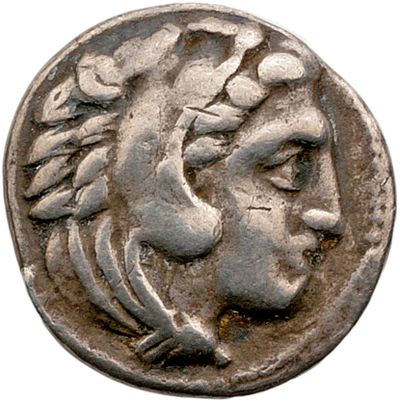
Alexander III of Macedon (336–323 BC), known as Alexander the Great, produced one of the most widely imitated coinages in ancient history. His silver tetradrachms (featuring Heracles in a lion scalp on the obverse and Zeus enthroned on the reverse) were struck at mints from Macedonia to Babylon during his lifetime and continued as a trusted trade currency for over two centuries after his death. The gold staters, showing Athena on the obverse and Nike on the reverse, established a gold standard across the Hellenistic world. Attribution of Alexander's coinage is complex: the same basic types were struck at dozens of mints across the ancient Mediterranean and Near East, and distinguishing lifetime issues from posthumous ones requires careful attention to control marks, monograms, and style. The standard catalog reference is Martin Jessop Price's "The Coinage of Alexander the Great and Philip Arrhidaeus" (1991), known as "Price", hence catalog numbers like Price 3031. Bronze issues are scarcer and more localised than the precious metal coinage. Collectors typically focus on a single mint or period; assembling a comprehensive collection across all mints is a specialist pursuit that requires deep knowledge of die varieties and control marks.
Coin Types (257)


You’ve attributed it. Now catalogue it
Record the attribution, weight, provenance, and photographs in your own NumisLens cabinet, a private catalogue built for ancient coins. Free for your first 50 coins.
Start your cabinet