Ancient Greek Coinage: The City-State Tradition
Coined money was about 250 years old by the time Athens struck its first owl, and barely older when 323 BC closed the Greek series for good. Inside that window sit hundreds of independent city mints, organised by town rather than ruler. This is where a collector finds the entry point.
Ancient Greek coinage runs from the electrum of Lydia in the late seventh century BC to the death of Alexander in 323 BC, after which the successor kingdoms produce Hellenistic coinage. It is overwhelmingly silver, built on the drachm and its multiples — the Attic tetradrachm of about 17.2 g being the great trade coin — and is organised by city, not by ruler.
Where coinage began
Coinage was not a Greek invention. It started in Lydia, in western Anatolia, in the late seventh century BC — lumps of electrum, the natural gold-silver alloy from the Pactolus river, stamped to guarantee weight. King Croesus, around 560 BC, replaced the unpredictable electrum with a bimetallic system of pure gold and pure silver. The Greek cities next door took the idea and ran with it, and within a century coined silver was the money of the entire Greek world.
The conventional close of "Greek" coinage is 323 BC, the year Alexander died. What the successor kingdoms struck after that — Ptolemaic, Seleucid, Antigonid — is catalogued as Hellenistic coinage, a different tradition with royal portraits and far larger mints. Greek coinage proper is the coinage of the independent polis: civic, competitive, and astonishingly varied.
Three phases organise it. The Archaic period (about 600 to 480 BC) is heavy, high-relief, often crude work — incuse-square reverses, animal and badge types, the first owls. The Classical period (480 to 323 BC) is the artistic peak: full portraits of deities, the signed Sicilian masterpieces, fully developed reverse types. Running through both is the colonial spread. Greek cities planted colonies from the Black Sea to Spain, and each struck its own coin: Massalia in southern Gaul, the Sicilian and south-Italian cities of Magna Graecia, the Black Sea foundations like Pantikapaion with its famous gold staters. A "Greek coin" can come from anywhere across that arc, which is why the issuing city, not a date or a ruler, is the first thing to pin down.
Weights and the drachm
There was no single Greek currency. Each city struck to a weight standard, and the standard tells you something about the city's trade orientation. The two that matter most are the Aeginetic (heavier; the stater of Aegina and much of the Peloponnese) and the Attic (the standard of Athens, and later of Alexander and most of the Hellenistic world). On the Attic standard a drachm weighs about 4.3 grams; a tetradrachm, four drachms, about 17.2. Six obols made a drachm. The tetradrachm was the coin of interstate trade and large payments; the drachm and its fractions did everyday work.
Why mostly silver, and so little gold? Because the Greeks had silver and not much gold. Athens financed its navy and its empire from the silver mines at Laurion; the Thracian and Macedonian north drew on the mines around Mount Pangaion. Civic gold is the exception — struck in emergencies, or by the Macedonian kings — not the rule. That single fact shapes the whole field: the Greek coin a collector handles is almost always silver, and its weight standard is the first thing to establish.
The denominations
The vocabulary, large to small. Each links to its catalogued inventory.
| Denomination | Attic weight | What to know |
|---|---|---|
| Decadrachm | ~43 g | Rare commemoratives. The signed Syracusan pieces are the summit of Greek engraving. Deeper: Syracuse decadrachm guide. |
| Tetradrachm | ~17.2 g | The great trade coin: Athenian owls, Syracusan masterpieces. Deeper: tetradrachm guide. |
| Stater | varies | The principal unit on the Aeginetic standard (Corinth's Pegasus, Aegina's turtle). |
| Didrachm | ~8.6 g | Common in the incuse coinage of southern Italy and in archaic Aegina. |
| Drachm | ~4.3 g | The everyday unit. Deeper: Greek drachma guide. |
| Hemidrachm / obol | ~2.1 g and below | Small change — often poorly preserved, easy to misattribute. |
A practical aside: tiny Greek silver (obols, hemiobols) is where beginners lose money. The flans are small, the wear is heavy, and confident attribution often is not possible. Buy the biggest coin your budget allows rather than a handful of unidentifiable scraps.
Cities, not dynasties
The organising principle of Greek numismatics is the mint-city, and the reverse type is usually the city's badge. The owl is Athens. Pegasus is Corinth. The sea-turtle — later a land tortoise, after a political humiliation — is Aegina. The Sicilian Greek cities (Syracuse, Akragas, Gela, Katane) pushed engraving further than anyone, and the signed Syracusan decadrachms are the artistic peak of the entire ancient series. In southern Italy, Sybaris, Kroton, and Metapontum used the unmistakable "incuse" technique: a raised obverse type and the same type sunk into the reverse. One famous city is missing from any list of coin badges: Sparta refused to strike coins at all for centuries, and the story of that refusal — and the rare silver it finally produced — is its own Spartan coins guide.
Two details reward attention. Kyzikos, on the Propontis, kept striking electrum staters and their fractions for centuries after most cities had moved to silver — the Kyzikene "stater" was a recognised international coin in its own right, each type pairing a changing main device with the city's constant tunny-fish badge. And Athens kept its owl deliberately archaic. Long after Greek engraving had mastered three-dimensional portraiture, the Athenian mint was still producing a stiff, old-fashioned Athena, because the owl's value lay in instant recognition by traders from Egypt to the Black Sea. Changing the design would have meant re-earning that trust. The later "New Style" Athenian tetradrachms of the second century BC finally modernised the style but kept the owl — brand continuity, two millennia early.
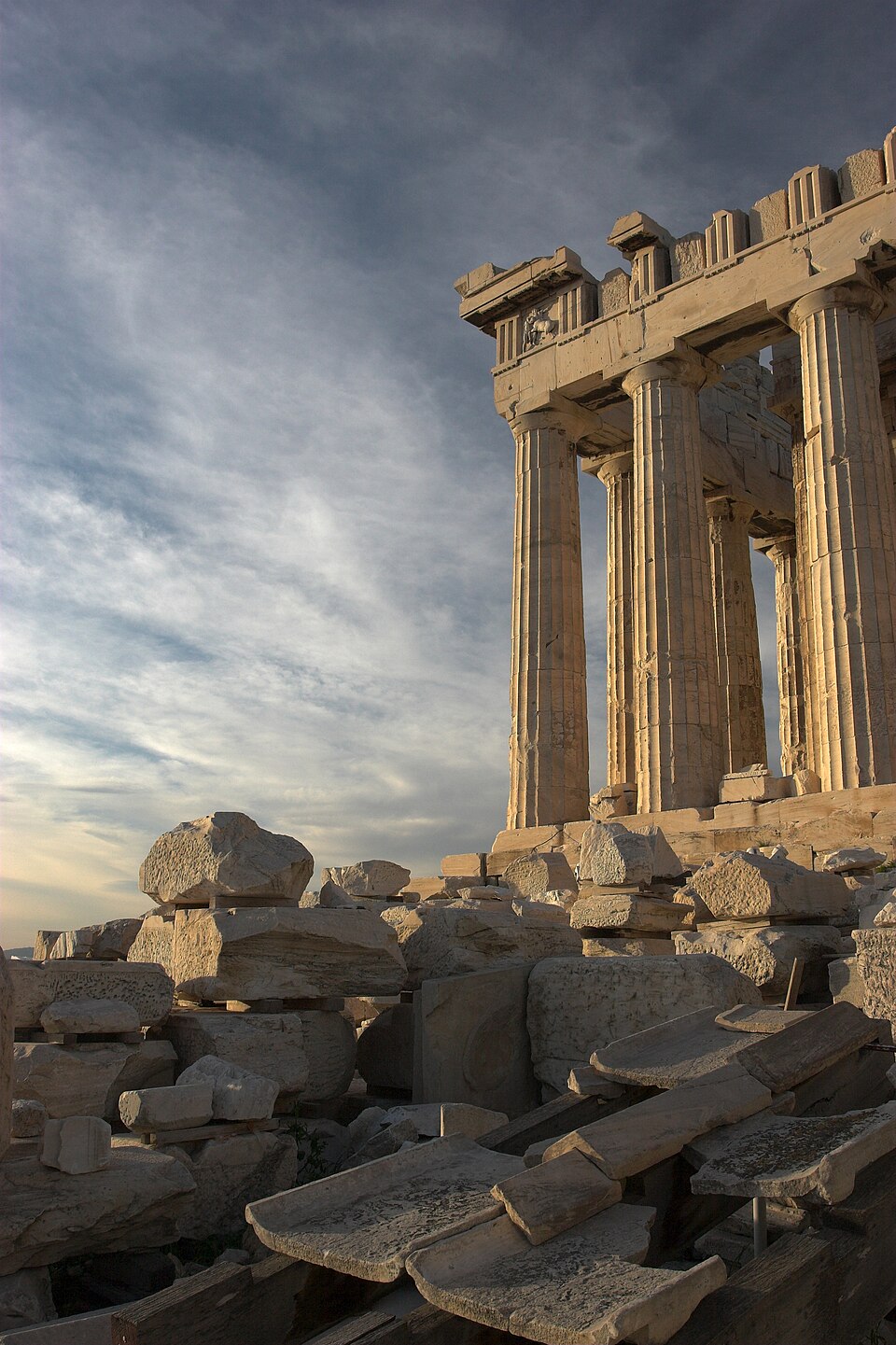
The Parthenon on the Athenian Acropolis, temple of Athena — the goddess whose helmeted head and owl define the Athenian tetradrachm for three centuries.
Photo: Thermos — CC BY-SA 2.5, via Wikimedia Commons
Be aware of a gap. NumisLens's catalogue is built on the Roman series, so the canonical Greek mints — Athens, Corinth, Syracuse, Aegina, Taras — do not yet have catalogue pages. A few Ionian and Anatolian mints that overlap the Roman provincial material do: Ephesos, Miletos, Kyzikos (famous for its electrum staters), Pergamon, and Sardis. For identification by metal, denomination, and civic iconography, the practical companion is the live ancient Greek coin identification guide; for a type-level match against the catalogued material, ancient coin identification searches by ruler, denomination, and description. The Macedonian gold and silver of Philip II and Alexander bridge into Hellenistic coinage; the Greek cities that later struck under Rome appear in Roman Provincial coinage.
Collecting and the market
No other ancient series stretches the way Greek silver does: the same two words, "Greek tetradrachm", cover a coin you can own for the price of a dinner and a coin that has crossed the million-dollar line at auction. Holding both ends of that spread in view is the whole skill. A common Athenian owl in Very Fine runs a few hundred dollars, a sharp Extremely Fine one several times that; Tarentine and Metapontine silver of southern Italy sits in the low-to-mid hundreds for presentable examples; a signed Syracusan decadrachm in fine style is a seven-figure coin. Strike, centering, and metal quality drive Greek prices harder than for any other ancient series — a well-centred owl on a full flan is worth a large multiple of a crowded, off-centre one of the same type.
For attribution and provenance the standard tools are the British Museum catalogue (BMC), the Sylloge Nummorum Graecorum (SNG) volumes, and Hoover's Handbook of Greek Coinage (HGC); the American Numismatic Society's collections database and its Coin Hoards of the Greek World project are the open references. Colin Kraay's Archaic and Classical Greek Coins (1976) and Carradice and Price's Coinage in the Greek World (1988) remain the standard narrative accounts. The major auction houses for Greek material are Numismatica Ars Classica, Roma Numismatics, and CNG — their archives, searchable on acsearch, are the best price guide that exists.
One warning the field earns: Greek silver is the most heavily forged area in ancient numismatics. High values, famous types, and a long history of skilled fakes — from the nineteenth-century Becker forgeries to modern die-struck copies and cast tourist pieces — mean provenance and a known seller matter more here than almost anywhere else. For anything above a few hundred dollars, buy from an established auction house or dealer, or have it certified. A cheap owl with no history is a coin flip.
Questions
What is the difference between Greek and Hellenistic coinage?
"Greek" is the city-state and pre-Alexandrian coinage, roughly the seventh century BC to 323 BC. "Hellenistic" is the successor-kingdom coinage struck after Alexander's death — Ptolemaic, Seleucid, Antigonid. The line is 323 BC.
What was the Athenian owl?
The silver tetradrachm of Athens, struck from around 510 BC: helmeted Athena on the obverse, her owl with an olive sprig and ΑΘΕ on the reverse. The design was kept deliberately old-fashioned for three centuries so traders would keep trusting it.
What is the most valuable Greek coin?
The signed decadrachms of Syracuse by Euainetos and Kimon — the best have sold well into seven figures. Most Greek silver is far cheaper; a common owl in Very Fine is a few hundred dollars.
Why are some Greek coins "incuse"?
A sixth-century-BC technique from the Greek cities of southern Italy (Sybaris, Kroton, Metapontum, Kaulonia): the reverse die was a sunken version of the obverse, leaving a hollow reverse image. Unique to that region and period.
Are ancient Greek coins legal to collect?
In most countries yes, with provenance discipline. Greece, Turkey, and Italy restrict export; the 1970 UNESCO Convention is the international benchmark. Buy from sellers who publish provenance and keep your own records.