Biblical Coins: The Widow's Mite, Tyrian Shekel, Tribute Penny & Judaea Capta
Most collectors come to biblical coins through the widow's mite — a small green bronze a dealer slides across the table, cheap enough to buy on impulse. Then you find out the whole category sits at an awkward, fascinating intersection of numismatics, archaeology, and a text two thousand years older than the catalogue numbers attached to it. Four coins everyone in this niche eventually owns: what they actually are, how to identify them, and what a real specimen is worth. Honest reference, not marketing — taken cheapest first.
The widow's mite is the cheapest and most famous of the biblical coins — a small Hasmonean bronze of Alexander Jannaeus (103–76 BC), the kind of coin the widow of Mark 12:41–44 would actually have held, at $40–150 for a clean, legible example. The other three are the tribute penny (a Tiberius denarius, the "render unto Caesar" coin), the Tyrian shekel (the high-purity Temple silver linked to the thirty pieces of silver), and the Flavian Judaea Capta bronzes. None was struck as a "biblical" coin; the association is later, and the price premium attached to it is marketing. Below: what each one is, what to look for, and what a real specimen costs — cheapest first.
The four biblical coins
This guide is for the collector who has a widow's mite in a 2x2 flip and is wondering what else is out there, what it costs, and how much of what the dealers say is true. The honest answer to that last question is some of it. Biblical-coin marketing leans on the religious resonance harder than any other corner of ancient numismatics, and it shows in the prices. But beneath the marketing is real material: the bronze prutot of an obscure Hasmonean priest-king that Jesus would actually have handled, a Tiberian denarius whose attribution to a single Gospel passage has held as scholarly orthodoxy for a century, silver shekels struck under Tyrian autonomy from 126 BC through the burning of Jerusalem, and the propaganda machinery of Vespasian's house turned into bronze. The objects are extraordinary. You just have to know what you are buying.
There are four coins to know, and we take them in the order a beginner actually meets them — cheapest to most expensive, simplest to most contested. None of these was struck as a "biblical" coin; the association is later, drawn from Gospel passages and the Jewish–Roman wars rather than from anything on the coins themselves. "Biblical coin" is a market category, not a scholarly one. Read everything dealers tell you with that in mind. If you collect Roman imperial coinage already, the Flavian dynasty page gives the larger political context for the Judaea Capta material; if you came in through Old Testament archaeology rather than ancient coins, the Judaean coinage hub is the right starting point for the broader series these four coins sit inside.
1. The widow's mite — the cheapest coin in the New Testament
This is the coin everyone starts with, and it deserves more respect than it usually gets.
The passage is Mark 12:41–44, with a near-identical parallel in Luke 21:1–4. A poor widow puts two small coins into the Temple treasury — "δυο λεπτα, ο εστιν κοδραντησ," two lepta which together make a kodrantes. The Vulgate renders it duo minuta, quod est quadrans, the King James as two mites, which make a farthing, and the whole biblical-coin tradition took its name from there. The coin the Gospel actually names is the lepton — the smallest denomination in circulation in 1st-century Judaea, equal to half a prutah, two together making a quadrans. The standard collector identification is the small bronze of Alexander Jannaeus, Hasmonean ruler 103–76 BC, classified as a prutah or lepton depending on weight and authority. Most of what the trade calls "widow's mite" is in this Jannaean small-bronze group.
Why Jannaeus, when he died over a century before the Gospel passage? Because his small bronzes were struck in such enormous quantities — and survived in such enormous hoards — that they remained the dominant small change throughout the Herodian and early Roman period. Jannaean bronzes turn up in late 1st-century BC and 1st-century AD contexts at Masada, Jerusalem, Qumran, and across Judaea generally. Newer prutot from Herod the Great, Herod Archelaus, and the Roman prefects (including the small bronzes struck under Pontius Pilate himself) also circulated, but the Jannaean types dominate the surviving small change. The widow, statistically, was almost certainly holding Jannaean bronzes.
A Jannaean small bronze is a small thing — 12 to 15 mm across, half a gram to two grams, struck on rough planchets with crude dies. Two principal types: an anchor (a Seleucid-derived motif from his Hellenistic political horizon) on the obverse, with an eight-rayed star and a paleo-Hebrew legend "Yehonatan the King" on the reverse. The variant pairs the same anchor with a wheel rather than a star. Both are well catalogued in Hendin's Guide to Biblical Coins and in Meshorer's Treasury of Jewish Coins — consult the current edition of each for present catalogue numbers and full die-variety listings.
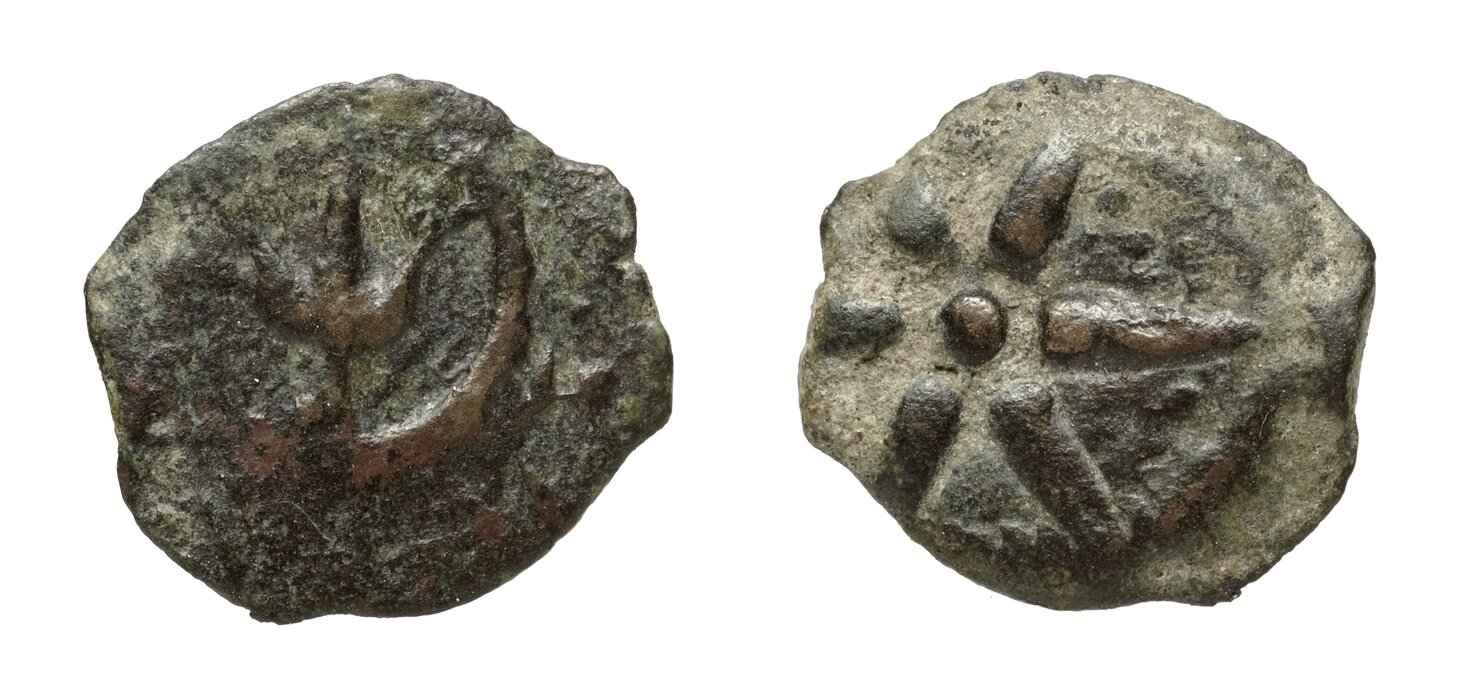
Bronze prutah of Alexander Jannaeus (103–76 BC): anchor obverse, eight-rayed star with paleo-Hebrew legend reverse — the small Hasmonean bronze the trade calls the widow's mite. The star is the feature to judge; on most surviving specimens it is worn nearly flat.
Bibliothèque nationale de France (Gallica), Public Domain, via Wikimedia Commons
The market for these runs through a quirk of the hoard supply. Until the late 1990s, large lots of uncleaned Jannaean small bronzes moved through the trade at very low cost — a hundred-coin lot for the price of one decent Roman denarius. Some of that bulk material still circulates, particularly through the larger Israeli dealers, but the supply has thinned. A clean, legible specimen today runs $40–150; sharp examples with full anchor and full star detail run $200–400; exceptional dies with both legends fully on flan can approach $1,000.
A particular note on what to look for. Most surviving Jannaean bronzes have the anchor crisp and the star or wheel reverse worn nearly flat — the obverse die was deeper and the reverse wore faster. A coin with a strong reverse is genuinely scarcer than the dealer pricing suggests. If you are buying one widow's mite to own one widow's mite, the question to ask is not "is the anchor sharp" but "is the star sharp."
2. The tribute penny — Caesar's image, traditional answer
"Render unto Caesar the things that are Caesar's, and unto God the things that are God's." The Synoptic Gospels carry the passage three times: Matthew 22:15–22, Mark 12:13–17, Luke 20:20–26. The setup is the same in all three. Pharisees and Herodians try to trap Jesus with a tax question. He asks for the coin used to pay the tax — a δηναριον, a denarius — and asks whose image and inscription it carries. The answer is Caesar's, and the trap collapses.
The collector question is: which denarius?
The traditional answer is the PONTIF MAXIM type of Tiberius, struck at Lugdunum (modern Lyon) across the bulk of his reign, AD 14–37. The obverse carries a laureate head of Tiberius facing right with the legend TI CAESAR DIVI AVG F AVGVSTVS. The reverse shows a draped female figure seated right on a throne, holding a long sceptre and a branch, with the legend PONTIF MAXIM — conventionally identified as Livia, Tiberius's mother, in the guise of Pax. The reference numbers run RIC I² 25–30 across throne-style variants; BMC Roman Empire Tiberius 34/48; RSC 16/16a; Sear RCV (5th ed.) 1763. The coin dealers most often catalogue as the tribute penny is RIC I² 30. The denarius itself, its long debasement, and its place in the wider Roman silver system are covered in the Roman denarius guide.
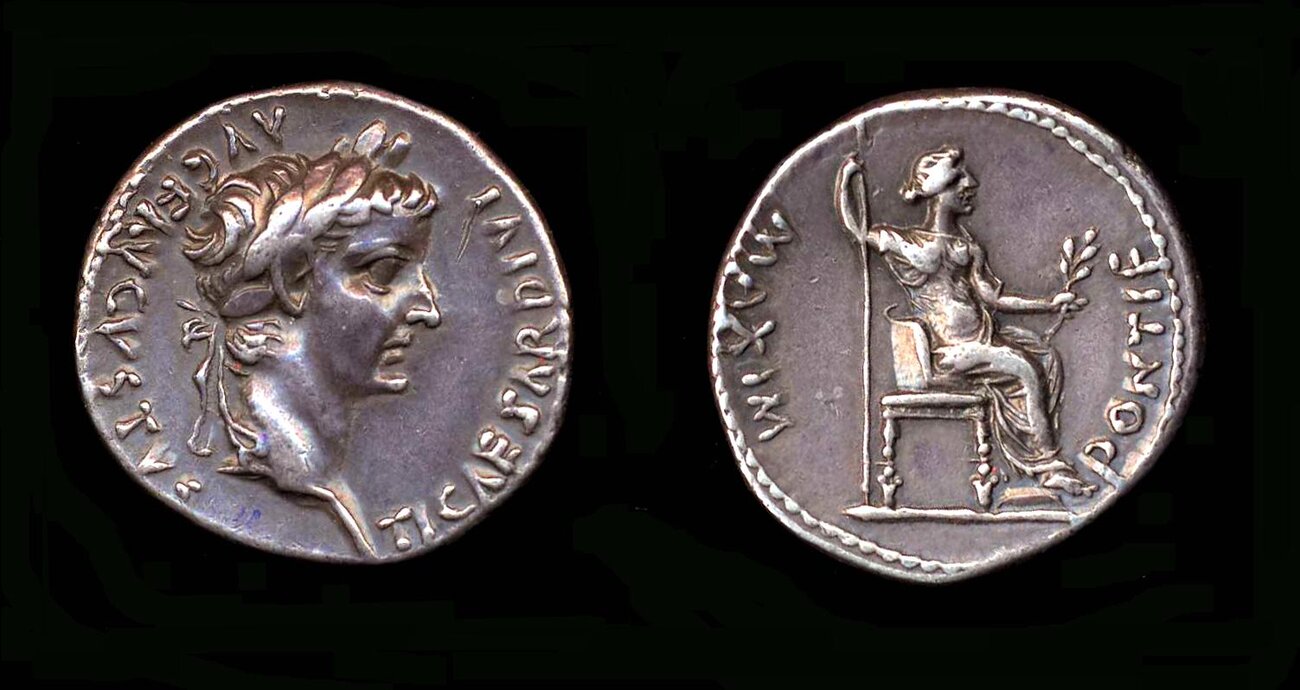
Silver denarius of Tiberius, Lugdunum, AD 14–37: laureate head with the legend TI CAESAR DIVI AVG F AVGVSTVS, and a seated female figure — read as Livia in the guise of Pax — holding sceptre and branch with the legend PONTIF MAXIM. This is the type dealers sell as the tribute penny (RIC I² 25–30).
Portable Antiquities Scheme, CC BY 2.0, via Wikimedia Commons
The identification rests on three threads. This is the dominant Tiberian denarius in circulation during the period of Christ's ministry — a coin a Roman tax collector in Judaea would plausibly hand over when asked. The prefect of Judaea under Tiberius was Pontius Pilate, and Roman denarii rather than provincial tetradrachms of Antioch were the standard for direct imperial tribute. And the portrait and legend match the Gospel's requirements: image of Caesar, inscription of Caesar.
It is not the only candidate. Some scholars argue for an Augustan denarius, on the grounds that the Augustan types stayed in circulation well into Tiberius's reign and the Gospel's "Caesar" is generic. A more substantial minority case favours a provincial tetradrachm of Antioch — the bulk of large-denomination silver in the eastern provinces, more numerous in the Levantine economy than Roman denarii, and arguably the more likely coin for an everyday tribute transaction in Galilee or Judaea. The objection is that the Greek text specifies δηναριον — a denarius, not a tetradrachm. Whether the writer used the term loosely or precisely is itself contested. For collecting purposes, the PONTIF MAXIM Tiberius is what dealers sell as the tribute penny, what auction houses catalogue under that name, and what carries the premium. Buy one and you are buying scholarly orthodoxy, not scholarly certainty.
Pricing. This is the coin whose market has moved most sharply over the last decade, driven by both biblical-collector demand and a general appreciation in mid-tier Julio-Claudian silver. F examples now run $250–500; VF $600–1,200; EF examples with sharp portraits start at $2,000 and routinely exceed $4,000 at major houses for premium dies. Watch the portrait — Tiberius's hair is the giveaway. Worn examples lose the laurel detail first, and a denarius with a flat hairline is worth half what a sharp one is. The type also comes in several portrait styles across the long run of issue: earlier portraits more idealised and Augustan, later ones flatter and harsher. Sharp early portraits are scarcer and command a premium, but most dealers sell the type without distinguishing. If you care, ask.
3. The Tyrian shekel — a pagan coin in a Jewish purse
The shekel of Tyre is the most demanding of the four. It is the most expensive in silver, it carries the most contested scholarship, and it is the only one whose connection to the biblical text is genuinely ambiguous in the original languages. It is also, by some margin, the most beautiful object in the group.
A Tyrian shekel is a tetradrachm in Greek terms — about 14g of silver, roughly 26 mm across, struck on the Phoenician weight standard at the autonomous mint of Tyre from 126/5 BC until the Roman destruction of the city's coinage privilege around AD 65/66. The obverse is a laureate head of Melqart — the Tyrian Heracles — facing right, with the characteristic lion's-skin knot at the throat. The reverse is an eagle standing left on a ship's prow, palm branch over its shoulder, with the club of Tyre and the regnal date in the fields, and a Greek legend reading ΤΥΡΟΥ ΙΕΡΑΣ ΚΑΙ ΑΣΥΛΟΥ — "of Tyre the holy and inviolable."
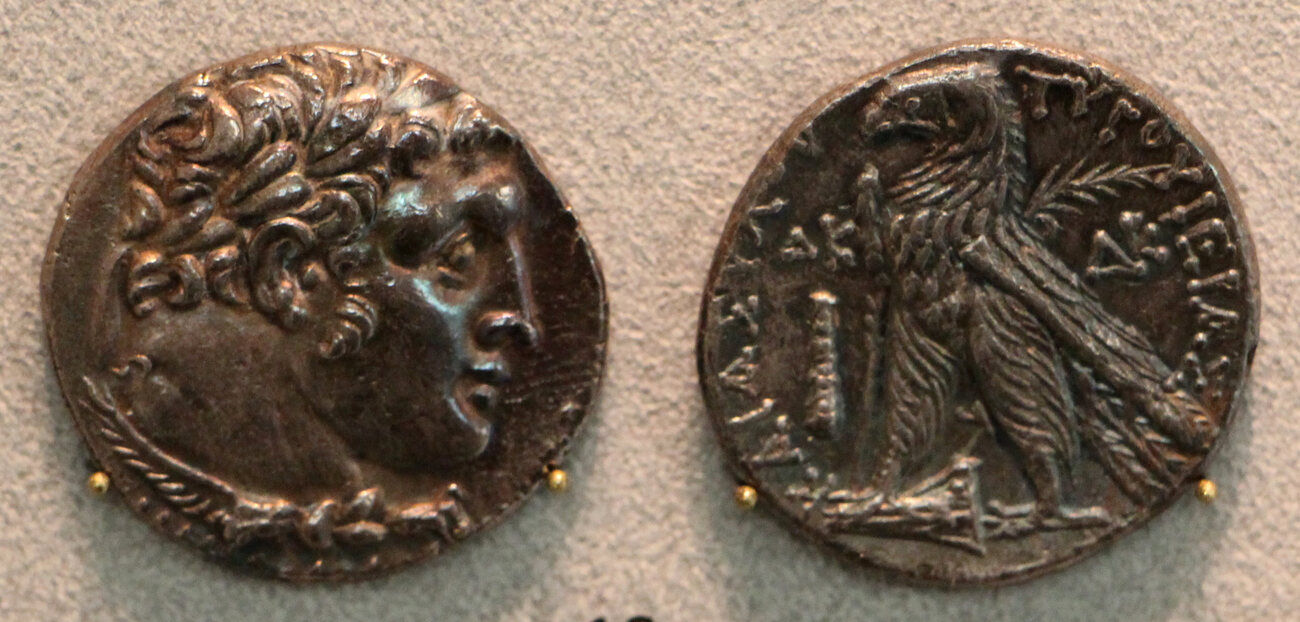
Silver shekel of Tyre (a tetradrachm in Greek terms, ~14 g): the laureate head of Melqart and an eagle standing on a ship's prow with a palm branch, the club of Tyre, and the legend ΤΥΡΟΥ ΙΕΡΑΣ ΚΑΙ ΑΣΥΛΟΥ — "of Tyre the holy and inviolable." The highest-purity silver in regular circulation in 1st-century Judaea.
Photo: Sailko, CC BY 3.0, via Wikimedia Commons
This is the coin the Mishnah (Bekhorot 8:7) treats as the holy-shekel standard — the Tyrian silver specified for major Temple-related payments, from the redemption of the firstborn to (by extension in Tractate Shekalim) the annual half-shekel Temple tax. The rabbinic ruling required that payment be made in Tyrian silver, not Roman denarii or Ptolemaic tetradrachms. The reasoning is not stated but is generally read as a purity argument: Tyrian shekels were struck to roughly 90–94% fine silver depending on period, among the highest-purity major silver coinage in the eastern Mediterranean. The Temple wanted bullion-grade silver. Tyre provided it. The visual paradox is obvious — the coin Jews were required to use for the holiest tax in their calendar carried a pagan god's portrait and a triumphal Phoenician eagle — and the rabbis appear to have accepted it without commentary. The silver mattered; the iconography did not.
The big scholarly question, and the one that matters most for what you are buying, concerns where the late shekels were struck. From the Augustan period onward the dies deteriorate, the engraving becomes harder and flatter, and the silver content, while still high, becomes more variable. Kadman in the early 1960s proposed that after about AD 18/19 the shekels were produced not at Tyre but at a workshop in Jerusalem, perhaps under Temple authority. Meshorer expanded the argument; Kanael and Kindler pushed back. The current position — as set out in Hendin's Guide to Biblical Coins and the catalogue essays accompanying the major hoard publications — is that the question remains genuinely open. Some die-linkage studies favour the Jerusalem hypothesis; others do not. A new specimen does not settle it.
For the collector, this changes how you read your coin. A sharp early shekel (year 1 = 126/5 BC up through about year 60, ~67/8 BC) is classic Tyrian autonomous coinage. A late shekel (year 90 onward, struck during the procuratorship of Pontius Pilate under Tiberius, through the destruction of the Temple) may be — depending on which scholar you believe — a coin struck inside Jerusalem itself, by the institution that received it.
This is also where the "thirty pieces of silver" association lives. Matthew 26:15 specifies the payment to Judas as "τριακοντα αργυρια" — thirty silver pieces. Mark's parallel (14:11) says only that the chief priests promised him "silver" (αργυριον), with no number. Matthew alone supplies the count, and the conventional identification of the silver with Tyrian shekels rests on economic geography: in Jerusalem in the early 30s AD, the highest-grade silver in regular circulation was the shekel of Tyre. Roman denarii were available but lighter and less pure; provincial tetradrachms of Antioch were debased. To pay a Temple official in silver, you used shekels. That identification is plausible. It is not provable. The coin is sold on the plausibility.
Pricing. Common late shekels in F move at $400–700. VF specimens with legible dates and clean Melqart portraits run $800–2,000. Sharp aEF/EF examples with full eagle detail and crisp legends start at $2,500 and can clear $5,000–8,000 at major houses (CNG, Roma, Leu) for early-period dies. Half-shekels are scarcer and priced by gram at a small premium. Watch for tooled examples — Tyrian silver tones to a distinctive dark cabinet patina, and any unnaturally bright surface should be questioned. Catalogue references to look for: Hendin's Guide to Biblical Coins (consult the current edition for the present number); BMC Phoenicia 235ff. (Hill, 1910, still the most detailed die-typology reference); RPC I for spot coverage of the post-Augustan period.
4. Judaea Capta — propaganda struck in bronze
The last of the four is the largest and least ambiguous coin in the canon. Judaea Capta is Roman triumphalism on a medallic scale, struck across several denominations in the years after the destruction of the Second Temple, and it is the only one of these four whose connection to the historical narrative is explicit on the metal itself. The background is the First Jewish–Roman War, AD 66–73: Vespasian was sent by Nero to suppress the revolt, then withdrew when proclaimed emperor in AD 69; his son Titus took Jerusalem in AD 70 and destroyed the Temple. The "Judaea captured" series begins in Rome in AD 71, the year of their joint triumph.
The iconography is consistent: a palm tree, the Roman emblem for Judaea, at the centre of the reverse, with a captive to one side — a bound male prisoner, or a seated mourning female personification of the province — and, on the larger types, the emperor or a Roman soldier to the other. The legend reads IVDAEA CAPTA on the major types. The headline piece is the bronze sestertius struck at Rome under Vespasian, one of the iconic objects of Roman numismatics, where a sharp example with original surfaces runs well into five figures; the Rome-mint IVDAEA denarii are the accessible entry point in real quantity, and the cruder provincial bronzes struck at Caesarea Maritima are the most underrated material in the series.
The full treatment — the history behind the type, the palm-and-captive iconography, the denominations from provincial bronze to gold aureus, and pricing by grade — lives on the dedicated Judaea Capta guide; the Vespasian guide carries the same series within his coinage rather than repeating it here. For the surviving types by RIC number see the NumisLens Vespasian catalog, and for the broader Flavian context the Flavian dynasty hub covers Vespasian, Titus, and Domitian together. The Year-1 silver shekel of the revolt itself — struck inside besieged Jerusalem and now the holder of a seven-figure auction record — is one of the entries in the most expensive ancient coins guide.
A coda — Bar Kokhba and the second silence
The four coins above all sit in or before AD 70. There is a fifth set worth knowing, though it does not always make the standard biblical-coin lists.
In AD 132, sixty-two years after Vespasian's troops levelled the Temple, a second Jewish revolt broke out under Simon bar Kosiba — remembered as Bar Kokhba, "son of the star." It lasted three years and ended in catastrophe. The emperor Hadrian's re-foundation of Jerusalem as the colony Aelia Capitolina — likely begun before the revolt as a provocation and completed after, on current readings of Cassius Dio 69.12 — closed the city to Jews entirely. The campaign also produced one of the most extraordinary numismatic acts in the ancient world: the Bar Kokhba coinage, struck in defiance as overstrikes on existing Roman silver and provincial bronze, with Temple-facade and palm-branch iconography and paleo-Hebrew legends declaring "Year One of the Redemption of Israel."
These coins are not biblical in any Gospel sense — they postdate the New Testament entirely. But they are the closing bracket of the world that produced the other four: the last time a Jewish authority struck silver in the land of Israel until the modern state began minting in 1948. Mildenberg's The Coinage of the Bar Kokhba War (1984) remains the standard reference; Hendin covers the surviving types. The market has appreciated sharply — silver tetradrachms (called sela by the rebels, who struck on the old Tyrian shekel standard) now run $3,000–8,000 in VF, with rarer Year 2 and Year 3 types reaching $10,000 and above; bronzes run $200–800. If you collect the four biblical coins, you will eventually want one. The Bar Kokhba sela is the answer the Judaea Capta sestertius does not contain.
What collecting biblical coins teaches you
There is no single right way to assemble a set. Some collectors aim for one specimen of each of the four classic types and stop there. Others go deep on a single sub-area — every variant of the Tyrian shekel, a complete Judaea Capta run across Rome and the provinces, every Jannaean small-bronze type. The category rewards both, because the material is genuinely various: pagan Phoenician silver, Hasmonean Hebrew bronzes, Roman imperial silver, Flavian bronze sestertii, and rebellion-overstrike silver all sitting in the same group.
What collecting these coins teaches, more than anything, is to read dealer descriptions carefully. The trade leans on association. A Tyrian shekel from year 91 is a Tyrian shekel from year 91, whether or not you call it "contemporary with Pontius Pilate"; a Jannaean prutah is the same prutah whether or not you label it "the widow's mite." The association is real history. The price premium attached to it is marketing. You can decide for yourself whether to pay it.
What you cannot fake, and what is worth paying for, is the object itself: a half-gram bronze prutah crude enough to fit on a fingertip; a Tiberian denarius small enough to disappear in a coin tray; a 14-gram disc of high-purity silver struck in Tyre by hand-cut dies; a sestertius the size of a US half-dollar with a mourning woman beneath a palm tree and one Latin word that explains the rest. These are real objects. Pre-modern human history is in them. The marketing is optional. The metal is not. If you want to start, start with the widow's mite — the price is forgiving, the history is unambiguous, and once you have one in hand the rest of the category will pull you forward whether you want it or not. When you have a coin in front of you and want help reading the portrait, the legend, or the type, the NumisLens identification tool is built for exactly that.
Frequently asked questions
What is the widow's mite?
The widow's mite is the small bronze coin from Mark 12:41–44 (with a parallel in Luke 21:1–4), where a poor widow gives two small coins — two lepta — to the Temple treasury. The coin the Gospel names is the lepton, the smallest denomination then in circulation in Judaea, equal to half a prutah. In the trade, "widow's mite" almost always means a small bronze of Alexander Jannaeus, the Hasmonean ruler of 103–76 BC, whose bronzes were struck in such quantity that they were still the dominant small change a century later. A clean, legible specimen runs about $40–150.
What is a Tyrian shekel, and why is it called the "thirty pieces of silver"?
A Tyrian shekel is a tetradrachm-weight silver coin (about 14 grams, roughly 90–94% fine depending on period) struck at Tyre from 126/5 BC until around AD 65/66, with the head of Melqart on the obverse and an eagle on a ship's prow on the reverse. Because it was among the highest-purity silver in circulation, rabbinic ruling required it for major Temple payments (Mishnah Bekhorot 8:7 and Tractate Shekalim). The link to the "thirty pieces of silver" paid to Judas (Matthew 26:15; Mark's parallel at 14:11 gives no number) rests on economic geography: in Jerusalem in the early 30s AD, the shekel was the obvious high-grade silver for a Temple-related payment. That identification is plausible, not provable.
What is the tribute penny?
The tribute penny is the coin from the "render unto Caesar" passage (Matthew 22:15–22; Mark 12:13–17; Luke 20:20–26). The traditional identification is the PONTIF MAXIM denarius of Tiberius, struck at Lugdunum (Lyon) across his reign, AD 14–37 — a laureate Tiberius on the obverse and a seated female figure, usually read as Livia in the guise of Pax, on the reverse (RIC I² 25–30, with RIC I² 30 the number dealers cite most). A minority of scholars argue instead for an Augustan denarius or an Antioch tetradrachm. Buying the Tiberius type means buying scholarly orthodoxy, not scholarly certainty. F examples run $250–500, VF $600–1,200.
What are the most collectible biblical coins?
Four coins make up the collector canon: the widow's mite (a Hasmonean bronze of Alexander Jannaeus, $40–150 clean), the tribute penny (a Tiberius denarius, $250–1,200 in collectable grades), the Tyrian shekel (high-purity Temple silver, $400–2,000), and the Judaea Capta series of Vespasian and Titus (bronzes and denarii commemorating the fall of Jerusalem, from a few hundred dollars for a worn provincial bronze into five figures for a sharp Rome-mint sestertius). Many collectors add a Bar Kokhba revolt coin as a fifth, even though it postdates the New Testament.
Are biblical coins a good investment, and is the "biblical" premium real?
The objects are real and the history is real; the premium attached to the religious association is marketing. A Jannaean prutah is the same coin whether or not it is labelled "the widow's mite," and a year-91 Tyrian shekel is the same coin whether or not the listing says "contemporary with Pontius Pilate." What you cannot fake — and what holds value — is the metal, the strike, and a documented provenance. Buy the coin, not the story. Pricing in this guide is set against recent CNG, Roma, and Leu results and is on the conservative side of the market.
References
- Hendin, David. Guide to Biblical Coins (consult the current edition for present catalogue numbers) — the standard collector reference for the whole series.
- Meshorer, Ya'akov. A Treasury of Jewish Coins from the Persian Period to Bar Kokhba (2001) — the Hasmonean and Herodian small-bronze typology.
- Hill, G. F. BMC Phoenicia (1910), 235ff. — the detailed die typology of the Tyrian shekel.
- Sutherland, C. H. V. RIC I² (1984) — the Tiberius PONTIF MAXIM types, 25–30.
- Carradice, I. and Buttrey, T. RIC II.1 (2007) — the Rome-mint Flavian Judaea Capta issues.
- Mildenberg, Leo. The Coinage of the Bar Kokhba War (1984) — the standard reference for the second revolt.
- Mishnah Bekhorot 8:7 and Tractate Shekalim — the rabbinic Temple-payment rulings.
- Greek New Testament: Matt. 22:15–22; Matt. 26:14–15; Mark 12:13–17; Mark 12:41–44; Mark 14:10–11; Luke 20:20–26; Luke 21:1–4.
- Cassius Dio 69.12 — the foundation context for Aelia Capitolina.